Introduction Topic : Kindergarten FL
__________________________________________________________________
Objectives for Students Completing Kindergarten
in the
Georgia Elementary School Foreign Languages Model
Program
These objectives make the following assumptions:
Note: Numbers in parentheses are references to the
Standards
for Foreign
Language Learning: Preparing for the 21st Century.
By the end of Kindergarten, students will be able to:
K.1 Listen to stories for enjoyment. (1.2, 4.2)
K.2 Begin to read linguistically and developmentally
appropriate materials. (1.2)
K.3 Begin to demonstrate an understanding of the written
language. (1.2, 3.2)
K.4 Give personal information based on templates or models
in the target language. (1.3)
K.5 Begin to demonstrate comprehension of some extended
oral discourse. (1.2)
K.6 Demonstrate an understanding of main elements of
a story or passage. (1.2, 1.3)
K.7 Use the target language for a variety of spoken activities.
(1.3)
K.8 Share information of their own choice with audiences
outside the classroom. (1.3, 4.1)
K.9 Begin to ask for information and make requests of
teachers and other language speakers. (1.1)
K.10 Provide information and respond to requests from
teachers and other language speakers. (1.1)
K.11 Begin to communicate orally using sentences. (1.1)
K.12 Follow complex oral instructions and give simple
commands. (1.1)
K.13 Demonstrate an understanding of a variety of speech
sources (teacher, peers, native speakers, other target language
speakers, tapes, CD-ROM's, and videos). (1.2, 5.2)
K.14 Identify examples or influences of the target language
and cultures in their own community. (4.1, 4.2)
K.15 Identify, compare and contrast diverse cultural
practices and products, including language, emphasizing similarities
as well as differences. (4.1, 4.2)
K.16 Begin to identify selected works of art, music and
literature of the target cultures. (3.1, 3.2)
K.17 Use culturally appropriate language and behavior
in both formal and informal target language situations (greeting,
leave-taking, eating customs, travel, school, etc.).
(1.1, 2.1)
K.18 Use the target language in appropriate content-related
areas including, but not limited to, mathematics,
social studies, science, literature and fine arts. (3.1)
K.19 Use a limited number of words and high frequency
utterances and phrases on a variety of familiar topics. (1.1, 1.3)
K.20 Participate actively in classroom experiences with
music, sports, games, songs, dance, or musical instruments from the target
cultures, and extend these
experiences into their personal lives. (2.1, 5.2)
K.21 Begin to use the target language to obtain information
to satisfy personal needs and interests. (5.2)
K.22 Use words and high frequency utterances to attempt
communication. (1.1, 1.3)
K.23 Draw from a basic vocabulary that permits exchanges
of a personal nature and on simple topics. (1.1, 1.3)
K.24 Demonstrate understanding of natural classroom speech
at a normal rate of speed, with nonverbal support. (1.1, 1.2)
Foreign Language Assessment Recommendations
Kindergarten
The following are only suggested assessment strategies.
Teachers are encouraged to develop additional strategies.
FL.K.1
Sequence pictures
TPR with pictures
FL.K.2
Sequence words
TPR with word labels
Match beginning letters to words
FL.K.3
Match words to pictures from stories.
FL.K.4
Answer questions posed by the teacher or other students
Complete sentences with personalized information,
Match expressions to statements of well-being.
FL.K.5
Respond to simple questions
TPR
Act out stories they have heard
Follow instructions and commands
Answer "either/or" questions
Sequence pictures to a verbal description
FL.K.6
Act out selected passages
Respond to questions
Predict what happens next
Create personalized versions of story or passage
FL.K.7
Chanting/Repeating
Songs
Various games
Guided conversations
Make requests in the target language
FL.K.8
Share songs, skits and other learned materials with family,
friends, other teachers, etc.
Respond to questions from others with information of
their own choice
FL.K.9
Ask for permission
Make requests
FL.K.10
Answer questions
Follow directions
TPR
FL.K.11
Whole sentence responses to questions
FL.K.12
TPR
Student led TPR
Student led "Simon Says"
Student pretends to be teacher
FL.K.13
Respond to questions
TPR
Retell stories
Follow directions
Act out stories
FL.K.14
Identify cognates
Identify typical foods that they have had
FL.K.15
Identify target culture holidays
Identify target culture foods
FL.K.16
Finger-paint an "impressionist flower"
Recognize songs from the target culture
FL.K.17
Students shake hands when greeting each other in the
target language
FL.K.18
TPR with floor maps
Solve math problems
Name animals, shapes, colors
Count
Simple descriptions of common objects
FL.K.19
Identify objects
Greet others
Ask for permission
Describe common objects or people
FL.K.20
Share songs, dances and other experiences with family
members, friends and other students
Participate in classroom dances
FL.K.21
Ask questions of others
Request permission
Express needs
Express feelings
FL.K.22
Participate in games
Ask for permission
Greet others
Make requests
FL.K.23
Respond to questions on a variety of topics (family,
pets, likes, dislikes, etc.)
Student choose activities for the class
FL.K.24
Follow commands
TPR
Respond to requests
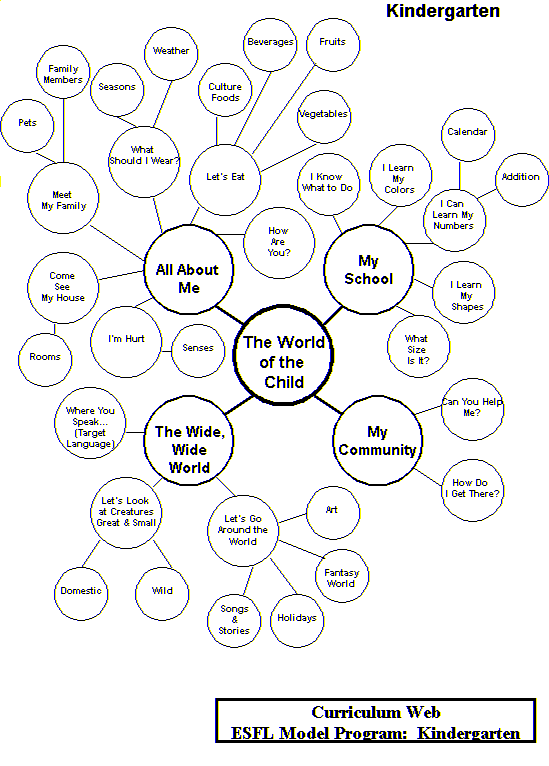
ALL ABOUT ME
KINDERGARTEN
LANGUAGE STRUCTURES USED BY STUDENTS
| I am _____ . (i.e. hungry, thirsty)
I have... I like/don't like... It is _____ . (weather) This/That is... |
yes/no
I/me my/mine you the/a/an |
PROGRESS INDICATORS
1. Students will appropriately use certain expressions
of emotion in context.
2. Students will answer selected questions related to
weather and seasons.
3. Students will recognize and identify a selected number
of household pets.
4. Students will produce basic information about selected
family members
5. Students will name and sort selected items of clothing
according to weather and seasonal changes.
6. Students will identify and name selected parts of
the body.
7. Students will recognize and respond to selected vocabulary
and information related to the five senses.
8. Students will recognize selected fruits, vegetables
beverages, and cultural foods.
9. Students will name and identify rooms of the house.
THEMATIC VOCABULARY USED IN TEACHING SECOND LANGUAGE
| EXPRESSIONS OF EMOTION
Productive Happy Sad Angry frightened tired so-so I am... |
Receptive
You are . . . Are you . . ? Is he . . ? Is she . . ? |
| WEATHER AND SEASONS
Productive It is sunny. It is windy. It is raining. It is cloudy. It is hot. It is cold. |
Receptive
How is the weather today? the seasons winter autumn spring summer It is snowing. |
| PETS
Productive Dog Cat Bird Rabbit Fish |
Receptive
Turtle Animal, pet Do you have a pet? It's name is . . . My . . . is the color . . . |
| FAMILY
Productive Mom Dad Sister Brother Baby Boy girl |
Receptive
Grandmother Grandfather Do you have a brother? Do you have a sister? What is you. . . 's name? How many. . . do you have? Family |
| CLOTHING
Productive shirt pants skirt dress shoes hose/socks/stockings hat |
Receptive
clothing scarf sweater coat boots long/short pants What are you wearing? |
| BODY PARTS
Productive head hands feet arms legs stomach mouth nose eyes ears hair |
Receptive
teeth shoulders knees back toes fingers elbow body face neck Touch your . . . What color is the . . .? Where is the . . .? What is . . .? My . . . is . . . |
| SENSES
Productive I hear. I touch. I smell. I see. I taste. |
Receptive
Touch. Look. Smell. Listen. Taste. |
| FOODS
Productive Apple Banana Orange Grapes Pineapple Pear Tomato Potato Lettuce Corn Carrot Milk Coffee Water Juice I am thirsty. I am hungry. I like. . . I don't like. . . |
Receptive
Fruits peach cherry grapefruit lemon vegetables onion cucumber peas Do you like . . .? Don't you like . . . |
| HOUSE
Productive House Living room Kitchen Bathroom bedroom |
Receptive
Where is the. . .? Dining room |
MY SCHOOL
KINDERGARTEN
LANGUAGE STRUCTURES USED BY STUDENTS
| I am________. (age)
I/You have... I like/don't like... This/That/It is... |
Yes/no
I/me You The/a/an |
PROGRESS INDICATORS
10. Students will respond to selected inquiries, questions
and courtesy expressions in proper context.
11. Students will use selected classroom expressions.
12. Students will respond to selected classroom management
commands.
13. Students will recognize and use selected vocabulary
for classroom objects.
14. Students will recognize and count the numbers 0 to
31.
15. Students will solve simple mathematical problems
dealing with addition using numbers 0-10.
16. Students will respond to selected questions related
to the calendar.
17. Students will identify and name selected colors.
18. Students will identify and name selected shapes.
19. Students will recognize and classify objects by size.
THEMATIC VOCABULARY USED IN TEACHING (ENGLISH)
| COURTESY EXPRESSION
Productive How are you? Fine, thank you. Thank you. Please. What is your name? My name Is... Where is. . .? Good morning. Hello. Goodbye. See you tomorrow. Mr. Mrs. Miss |
Receptive
You are welcome. Excuse me. Pardon me. Good afternoon. Good evening. See you later! |
| CLASSROOM EXPRESSIONS
Productive Yes No I like... I don't like... Good/Very good. Good job/Good work! English Spanish |
Receptive
What is...? Bathroom Don't worry. It's worry. It's all right. |
| CLASSROOM COMMANDS
Productive Sit down! Stand up Up Down Close... Open... |
Receptive
Raise your hands Come here Look at me Look toward the front Listen Close your mouths Do not talk now Let's begin Pay attention Wait Turn around Touch Look Jump Push Run Swim Fly Kick Bend over Stretch Shake Sleep/Wake up Put in/Take out |
| CLASSROOM OBJECTS
Productive Pencil Paper Crayon Glue scissors |
Receptive
Flag Book Chalkboard Chair Table |
| NUMBERS
Productive Zero One Two Three four five six seven eight nine ten eleven twelve thirteen fourteen fifteen sixteen seventeen eighteen nineteen twenty twenty-one,. . . thirty thirty-one,. . . Count. . . |
Receptive
Numbers 32-100 Number How many... |
| ADDITION
Productive 0-10 |
Receptive
Plus + Equals = |
| CALENDAR
Productive Calendar Birthday Monday Tuesday Wednesday Thursday Friday Saturday Sunday numbers 0-31 |
Receptive
What day is today? What day was yesterday? What day will tomorrow be? months of the year January February March April May June July August September October November December How old are you? |
| COLORS
Productive Red Blue Yellow Green Purple Brown Black White Orange |
Receptive
Pink Gray What color is this? colors |
| SHAPES
Productive Circle Square Rectangle Triangle |
Receptive
Which shape is this? Oval Figure/shape |
| SIZE
Productive Large Small Medium Long Short |
Receptive
Larger Smaller Longer Shorter Which is the...? Which size is the...? |
MY COMMUNITY
KINDERGARTEN
LANGUAGE STRUCTURES USED BY STUDENTS
| by/in/on (Transportation)
I have... This/That/It is... yes/no |
I/me
my/mine you the/a/an |
PROGRESS INDICATORS
20. Students will identify and name and respond to selected
vocabulary and information about community helpers.
21. Students will recognize and respond to information
about transportation.
THEMATIC VOCABULARY USED IN TEACHING (ENGLISH)
| COMMUNITY HELPERS
Productive police fireman doctor nurse teacher mailman dentist farmer |
Receptive
Who is...? |
| TRANSPORTATION
Productive Car Boat Plane Bus |
Receptive
Bicycle Truck Train Helicopter How do you get to school? I come by... |
WIDE, WIDE WORLD
KINDERGARTEN
LANGUAGE STRUCTURES USED BY STUDENTS
| I have...
I like/don't like... This/That/It is... Yes/no |
I/me
My/mine You The/a/an |
PROGRESS INDICATORS
22. Students will recognize and categorize a selected
number of zoo and farm animals.
23. Students will recognize and respond to questions
about where the target language is spoken and recognize the names of those
selected countries.
24. Students will observe selected works of art and recognize
them as creations from the target culture.
25. Students will listen to selected short narratives,
fairy and folk tales, traditional rhymes, and songs from the target culture.
26. Students will recognize selected cultural traditions
and holidays of America and the target countries.
27. Students will recognize and use basic vocabulary
related to selected holidays.
THEMATIC VOCABULARY USED IN TEACHING (ENGLISH)
| DOMESTIC ANIMALS
Productive Hen Cow Sheep Horse Pig |
Receptive
Turkey Rooster Chick Duck Farm |
| WILD ANIMALS
Productive Elephant Tiger Lion Bear Giraffe Zebra Monkey |
Receptive
Zoo Zoo animals Snake Crocodile Hippopotamus Chimpanzee Gorilla What is the name of the animal with...? Is the animal big or little? What sound does the animal make? |
COUNTRIES OF TARGET LANGUAGE
Selected Samples
WORKS OF ART
Selected samples
FAIRY AND FOLK TALES
Selected samples
SONGS
Selected samples
CULTURAL TRADITIONS
Selected samples
TARGET COUNTRY AND AMERICAN HOLIDAYS
Selected samples
HOLIDAY VOCABULARY
Selected samples