Introduction Topic : K-5 Foreign Language Introduction
Elementary School Foreign Languages Curriculum
Introduction
Students in Georgia will be participants in a competitive, interdependent world and will need to function competently in at least one language other than their native one. As the twenty-first century rapidly approaches, it is evident that Georgia students must become linguistically and culturally competent. Research has repeatedly indicated that students can and do acquire languages more quickly and easily if the language instruction begins as early as possible. In fact, recent brain research findings indicate that acquisition of language by very young children occurs much differently than previously thought. In short, the sooner we can begin language instruction, the better.
The Georgia Elementary School Foreign Languages Model Program, which began in 1992, advocates a long, articulated sequence of language instruction. As a demonstration of how successful an early start in second language instruction can be, the Georgia Department of Education implemented the ESFL Model Program in 1992 in Kindergarten in 24 schools from fifteen school districts. The curriculum used that first year was drafted by a group of foreign language teachers. At the end of the first year, that curriculum was fine-tuned to more accurately reflect what the teachers felt was realistic for that year. In each subsequent year since 1992, a new grade was added to the program and a new curriculum was drafted. Numerous revisions have occurred each year. In the summer of 1998, a committee revised the curriculum which now is a part of the Georgia Quality Core Curriculum. Additionally, a 6 - 8 Curriculum which follows the sequence of the K - 5 curriculum has been developed and is included in the Georgia Quality Core Curriculum. The Georgia Department of Education provides a Kindergarten through Twelfth Grade Curriculum in foreign languages for students who begin their foreign language study in Kindergarten Please refer to the Introduction to the 6 -8 Foreign Language Curriculum for a detailed explanation of the K - 12 sequence.
While the Georgia ESFL Model Program is funded in a limited number of sites, the curriculum has been developed for any sequential, daily language program. It is the hope of the Georgia Department of Education that the Model Program can serve as a model for replication across Georgia as well as across the United States and abroad. Its participating schools are always open for observation and its teachers and administrators are readily available for consultation. The Georgia Department of Education provides informational support to school systems who want to begin elementary foreign language programs and staff development activities for elementary foreign language teachers, those in the Model Program and others who wish to participate. During the past several years, it has provided a statewide elementary foreign language conference. Beginning in 1999, this conference will be held annually in conjunction with the Foreign Language Association of Georgia (FLAG) conference.
The Program advocates classroom language experiences which are hands-on, holistic, and meaningful. The teacher models language naturally and everyone, teachers and students, use the second language exclusively in the classroom (98-100% of the time). Students learn to use language for real communication. Teachers use a spiraled, recycled curriculum for repeated re-entry of vocabulary. As students progress, they also recognize the importance of correct, appropriate language usage.
Just as research has indicated the efficacy of early language learning, there are numerous reports that validate the positive impact of parental involvement in education. The Model Program strongly encourages parental involvement. Furthermore, FLES teachers should seek support from the school staff and entire community.
Using the Curriculum
The following pages present thematically based units which include objectives and progress indicators for Kindergarten through Third Grade. Fourth and Fifth Grades also feature thematically based units with objectives as well as suggested Scenarios. The regular elementary school curriculum was used as a resource to help design the Georgia Elementary School Foreign Languages Model Program curriculum. It reinforces the grade-level curriculum wherever possible. In order to view the thematic webs and the complete list of progress indicators and scenarios, it will be necessary to open the Appendix to the K - 5 Foreign Language Curriculum .
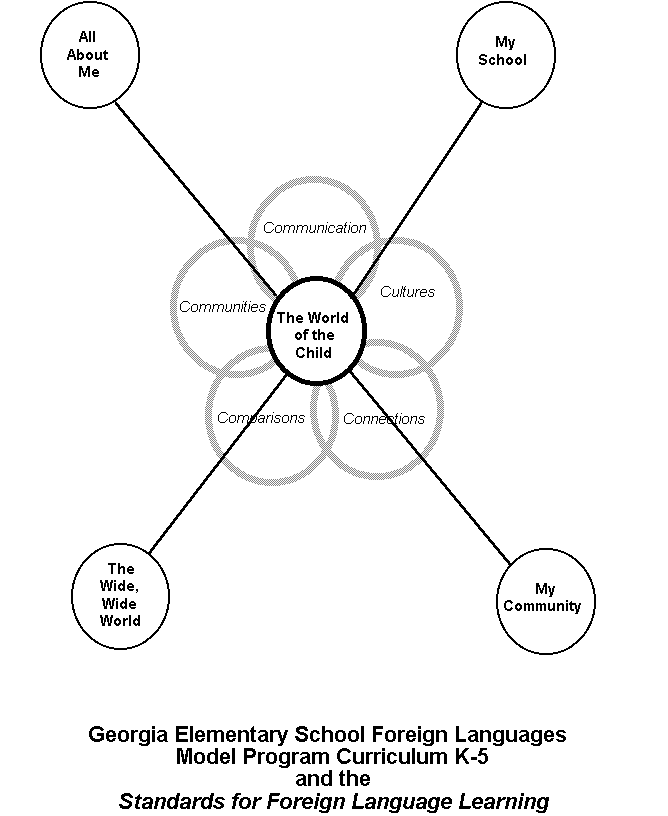
Foreign language instruction through thematic units complements the elementary curriculum. Grade level objectives are provided to show what the students should be able to do at the end of each year. Progress indicators are more specific, detailed and measurable explanations that define students' progress during the year. They are subdivided in grades K-3 into the four main themes of The World of the Child. They include: All About Me, My School, My Community, and The Wide Wide World. Also included are thematic vocabulary lists, including new and re-entry words as a teacher resource only. These lists are AT NO TIME to be taught or tested in isolation and are provided to help teachers determine what language students should be using. These thematic units also appear on the thematic webs for Grades 4 and 5. No vocabulary lists are included. Scenarios, which more closely ressemble Unit plans are included as suggested means of meeting the objectives.
This QCC document facilitates language learning that seamlessly integrates and emphasizes all four skills, listening, speaking, reading, and writing, while at the same time, incorporates the 5 C's: Communication, Culture, Connections, Comparisons, Communities of the Standards For Foreign Language Learning: Preparing for the 21st Century. It is important to emphasize that one format is used throughout Georgia's Quality Core Curriculum. The Elementary Foreign Language QCC contains the following information:
Subject: Elementary School Foreign Language
Grade: Grade level within elementary school
Strand: Grade level within elementary school
Topic: All topics and subtopics for each grade level
Concept: Language structures used by students
Content Standard: Statements that clearly define what students should know and be able to do
Assessment: Suggested methods to evaluate or measure student skills of each content standard
At a first glance, it appears that there is an extraordinary
amount of repetition in the foreign language document.
To simplify the use of this document, a large appendix
has been included. Teachers should feel free to print out
the grade levels they need. For each grade level, Kindergarten
through Third Grade, included are the following:
the Curriculum Thematic Web, the Objectives for Students
Completing Each Grade Level (correlated to the Standards), the Language
Structures and Progress Indicators and Vocabulary Lists (divided by Theme).
Grades Four and Five additionally contain various suggested Scenarios which
match the subthemes. The assessment recommendations should be considered
as suggestions of the types of activities that may be used to assess a
given content standard. It is not expected that classroom teachers should
be limited to these assessments. The numbers which follow each Content
Standard are the Standards For Foreign Language Learning: Preparing
for the 21st Century to which the entire K - 12 Foreign Language QCC
is correlated. These standards are also included at the end of this introduction.
Philosophy and Pedagogy
The Georgia Elementary School Foreign Languages Model Program advocates a language learning philosophy that includes many tenets. Below are those Statements of Understanding for elementary school foreign language instruction which also apply to middle school as well as high school foreign language teachers. These tenets are listed below.
Foreign language teachers should:
· Teach 98-100% of the time in the target language.
· Use the target language for classroom management as well as for instruction.
· Avoid using translation as a tool for clarifying meaning.
· Help learners to clarify meaning and express understanding without translation.
· Provide learners with a rich target language
environment that includes extended listening
opportunities such as narration, descriptions, and explanations.
· Provide learners with meaningful concrete experiences,
making extensive use of visuals,
props, realia, and hands-on activities.
· Present vocabulary in chunks and in context rather than as isolated words or lists.
· Plan and teach around a theme.
· Seek ways to include meaningful culture content in every lesson and every unit.
· Seek to integrate concepts from the general elementary
school curriculum in every lesson
and every unit.
· Use songs and rhymes to reinforce meaning and practice language.
· Choose authentic songs, games, stories, and rhymes
in preference to translations
whenever possible.
· Incorporate communicative use of reading and writing from early stages of instruction.
· Plan lessons to include a variety of activities,
student groupings, and types of
interaction that will appeal to differing learner interests
and learning styles.
· Provide opportunities for learners to express
personal meaning from the earliest stages
of the program.
· Encourage growing independence and independent
language use on the part of learners,
moving them toward increased expression of individual
ideas and opinions.
· Assess learner progress frequently and regularly using a variety of types of assessment.
· Use a variety of strategies to maintain frequent and regular contact with parents.
· Communicate regularly with classroom teachers
about student progress and program
goals and content.
· Work closely with other teachers in the program to plan curriculum and resolve issues.
· Seek frequent opportunities for professional and language development.
· Maintain open communication about the program
and student progress among teachers,
administrators, and the general public.
Student Success
The Georgia Elementary School Foreign Languages Model Program has had the opportunity to work with the Center for Applied Linguistics in Washington, D.C. in evaluating student proficiency in listening and speaking. Various assessments,including oral proficiency interviews with students, have been developed and performed. The results have been overwhelmingly positive. The Georgia Department of Education will continue to work with the Center in order to continue to track the success of these students.
Dr. Carol Saunders recently completed research which compares the Iowa Test of Basic Skills scores of third grade students who have participated in the Georgia Elementary School Foreign Languages Model Program since Kindergarten with similar third grade (non-foreign language) students. The findings have shown that the foreign language students scored higher in reading and significantly higher in mathematics than did the non-foreign language ones. When further research is completed, it will be published. It is anticipated that by fifth grade, the scores in reading and math will show even greater gains.
The Standards in Foreign Language Education
Several years ago a group of foreign language professional organizations, funded by the United States Department of Education and the National Endowment for the Humanities, developed a Standards for Foreign Language Learning:Preparing for the 21st Century. These standards establish a new context that defines the central role of foreign language in the learning career of every student. The approach to second language instruction in today's schools is designed to facilitate genuine interaction with others. As such, language and communication are at the heart of the human experience because one then knows how, when, and why to say what to whom.
Throughout the Elementary School Foreign Language QCC, each Content Standard has been correlated to the appropriate Foreign Language Standards. The Standards:
Below are listed the summaries for the Standards
for Foreign Language Learning: Preparing for the 21st Century.
Standards For Foreign Language Learning *
COMMUNICATION: Communicate in Languages Other Than
English
Standard 1.1: Students engage in conversation, provide
and obtain information, express feelings and emotions, and exchange opinions.
Standard 1.2: Students understand and interpret written
and spoken language on a variety of topics.
Standard 1.3: Students present information, concepts,
and ideas to an audience of listeners or readers on a variety of topics.
CULTURES: Gain Knowledge and Understanding of Other
Cultures
Standard 2.1: Students demonstrate an understanding of
the relationship between the practices and perspectives of the culture
studied.
Standard 2.1: Students demonstrate an understanding of
the relationship between the products and perspectives of the culture studied.
CONNECTIONS: Connect with Other Disciplines and Acquire
Information
Standard 3.1: Students reinforce and further their knowledge
of other disciplines through the foreign language.
Standard 3.2: Students acquire information and recognize
the distinctive viewpoints that are available only through the foreign
language and its cultures.
COMPARISONS: Develop Insight into the Nature of Language
and Culture
Standard 4.1: Students demonstrate understanding of the
nature of language through comparisons of the language studies and their
own.
Standard 4.2: Students demonstrate understanding of the
concept of culture through comparisons of the cultures studiedand their
own.
COMMUNITIES: Participate in Multilingual Communities
at Home and Around the World
Standard 5.1: Students use the language both within and
beyond the school setting. Standard 5.2: Students show evidence of becoming
life-long learners by using the language for personal enjoyment and enrichment.
* The National Standards in Foreign Language Education Project, 1996. Standards for Foreign Language Learning: Preparing for the 21st Century. Yonkers, NY: National Standards in Foreign Language Education Project. American Council on the Teaching of Foreign Languages.