|
|
|
The Portrait Of A Lady |
 |
|
Vivien Leigh & The Stage |
|
|
Reviews/Articles/Photos/Stories  
|
New
Plays (Plays and Player - UK - August, 1957)
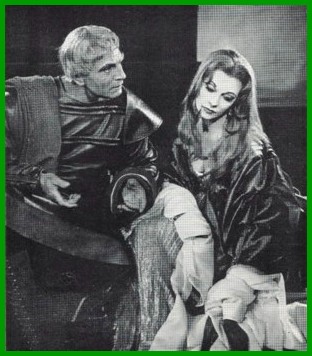
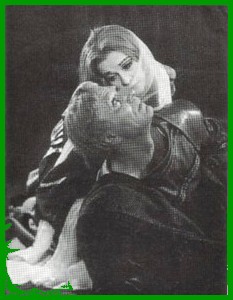
The Oliviers: Titus Andronicus and his daughter Lavinia Titus
Andronicus Some years ago, in pious - and indeed proper - preparation for a critique of the Brook-Stratford Measure for Measure, I was about to write in other, more ponderous columns, I borrowed a volume of Hazlitt's essays from the colleague who acted as a Second String to the wise and well-known critic of an august morning paper. Once again I have gone back to my Hazlitt. Titus Andronicus sent me in search of its faded claret covers. And what did I find? Why, that Hazlitt had gone straight to the "celebrated German critic" Schlegel and cravenly opted out of pronouncing on Titus for himself by announcing that, after a substancial quotation from The Master, he would add only "a few remarks of my own".
Vivien Leigh as Lavinia Schlegel, then, puts Titus within the authentic canon. But Hazlitt places it among the doubtful Shakespearean plays. I myself am far too busy canvassing my pet theory that it was William Shakespeare who wrote Bacon's Essays to give the matter more than passing thought. I would have said, however, that Shakespeare dropped in on the writing of his play Titus Andronicus long enough to pen those lines of deep tenderness with which Aaron the Moor greets his inky new-born son, whom the nurse has just described to him as "a joyless, dismal, black and sorrowful issue... as loathsome as a toad", with a cry of "Is black so base a hue? Sweet blowse you are a beauteous blossom, sure". I am delighted to record that Mr. Anthony Quayle brought tears to my eyes with the pride and tenderness he found in the words. We may, then, argue whether Shakespeare wrote the rest of Titus; but which of us will doubt that Peter Brook is a director of genius when he sets in motion a declamatory and spectacular play? It was not, perhaps, his fault that he was given too many chances too early in his career, so that by now his name has taken on an avancular aura. Never have I been to a Peter Brook production without wanting either to clap him on the back or to clout him round the ears, and what is this if not a response to excitement? In all that speaks to the eye and to the mind Mr. Brook does not fall short. It is all those moments when heart speaks to heart that Mr. Brook does not find our heart. I do not think he knows about the sweat in the palm of the hand, or the heaviness of resignation. Neither do I believe that he understands the ebb and flow of feeling between two people speaking quietly in room. But should this whirling master ever become interested in people as distinct from their predicaments (predicaments being the stuff that plot is made on) I do not know of another producer who would then be his peer. The Brook Titus has come home to London after travelling the world. We can take pride in this, our embassage. It is time - hight time - however, that Sir Laurence came out to us in another play like The Entertainer in a part that would inspire, stimulate, need and use him. His Titus, excusably perhaps, when one considers the troubles he's seen, is a tired old gentleman - a sort of work-a-day Lear with no Sunday in sight. Forward, please, Kit Fry. To say that Miss Leigh is at her most moving when her Lavinia cannot speak is only to remind the reader that she is, as it were, the Fonteyn of Drama, taking direction as a river takes rain and so absorbing it into her art that who is to know what she found in herself and what she has been lent. In a swift, resonant and amber-hued production she was most moving. There remains the admirable Audley in her articulate Tamora. Miss Taxine Audley's capable acting has cut through more waffle to shine in its own excellent if secondary right than any other artist on the stage today. As usual, then, she cut through the gertuffle. Caryl Brahms
|
2003 © Vivien Leigh & The Stage. |
-design by subtract- |