|
|
|
The Portrait Of A Lady |
 |
|
Vivien Leigh & The Stage |
|
|
Reviews/Articles/Photos/Stories  
|
Caesar
and Cleopatra
(Junior Film Annual 1946-47 - UK)
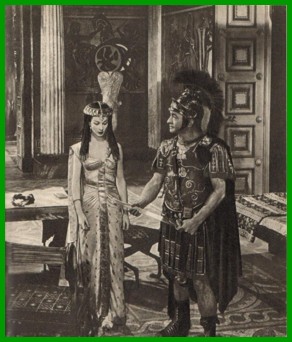
Cleopatra (Vivien Leigh) and Caesar (Claude Rains) It was the reign of the brother and sister, Ptolemy and Cleopatra, who were king and queen of Egypt. The whole country was in a state of terror at the coming of Julius Caesar, then a man of fifty-five, and his Roman army. The brother and sister had quarrelled. Ptolemy was ruling in Alexandria and, as most of the Egyptians had taken his part, Cleopatra had fled for a while into the desert. A rider came galloping across the sands at night bringing the news that Caesar's force was close at hand, and most of her attendants ran away and left her in the old palace in which she had taken refuge. Meantime Caesar left his camp to ponder alone over the many problems that were facing him. He was talking to himself as he walked across the sand in the moonlight. As he was passing a great statue of a Sphinx, he was very much surprised to hear the Sphinx answering him - or seeming to do so. In reality it was the young queen of Egypt - she was only sixteen - who had ran off her empty palace and was now hiding between the paws of the statue. She whispered to Caesar that there were Romans about, and invited to climb under the statue and share her hiding-place. This apealed very much to Caesar's sense of humour. He did as she suggested and asked her if she were afraid of the Romans. "Oh", she replied, "they would eat us if they caught us! Their chief is Julius Caesar. His father was a tiger and his mother a burning mountain; and his nose is like an elephant's trunk. They all have long noses, and ivory tusks, and little tails, and seven armas with a hundred arrows in each; and they live on human flesh". Little knowing who he was, she told him that he was a nice old gentleman. Caesar, who was a kindly person and had taken a liking to her, offered to help her if she would taken him back with her to the old palace. She did so, and there he made her dress in all her royal robes and sit on her throne to await the coming of the Roman soldiers. He promised she would rule in Alexandria if she face their entrance without showing fear.
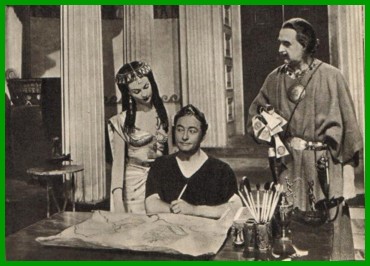
Cleopatra tells Caesar who is confering with his secretary Britannicus that he must not work - 'Kings don't have to work', she says When the soldiers marched in she was very frightened indeed, but the soldiers all saluted her kindly new friend and hailed him, "Caesar". Now she knew he was not such a demon as she had been taught to believe, and she said that she would trust him completely. Caesar marched with his small army to Alexandria and walked into the great palace where the boy-king Ptolemy - who was even younger than his sister - was finding life of sitting on the throne all day, making long speeches he didn't understand, a very dull one. Caesar was very sympathetic and tried to settle the royal troubles by making brother and sister sit on the throne side by side.
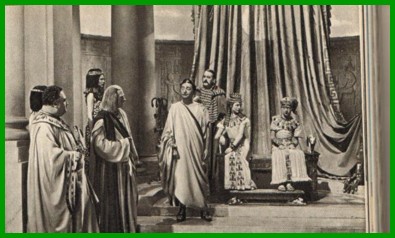
Caesar tells Cleopatra who doesn't like it at all, that she and her brother are to rule Egypt joinly As it was, he had serious troubles of his own. The Egyptians had a great army which was capable of defeating his tiny Roman force, and he knew that they were plotting to attack him. He moved across the harbour and occupied the Pharos Lighthouse which was the largest and strongest building in the port. It commanded the narrow channel leading to the open sea from where he was expecting another Roman army to sail in and relieve him. He hoped his reinforcements would arrived before the timid Egyptians plucked up courage to make their attack. But Cleopatra found out that the attack was going to take place immediately, and she realised that Caesar must be warned. The sentries had orders that she must not leave the palace, but she persuades Apollodorus, a young Sicilian, to smuggle her past the guard hidden in a carpet. He lowered his bundle with great care into a boat and rowed across the harbour to the Pharos. The boat was staved in on the rocks at the base of the lighthouse, but Apollodorus shouted up to Caesar that he had a valuable gift for him. Caesar's second in command, Rufio, a rough but faithful old soldier, warned his leader that the glib foreigner might mean some treachery, but Caesar gave orders for Apollodorus to be hauled up by crane along with his carpet. The carpet was unrolled, and Cleopatra popped out, delighted with her cleverness. The attack was already starting and there was no time to lose. They would have to swim back across the harbour if they were to save themselves. Caesar told Rufio to throw Cleopatra into the water after him, and dived in. The queen was heaved in like a sack of chaff and clung to his back as he struck out for the shore. They all got safely back to the Palace. Now they could do little but wait for the arrival of the relieving army. Meanwhile Pothinus, the young king's guardian, was worried by the way in which the young Cleopatra, under Caesar's guidance, was learning the way to govern. He realised that, if her education in the art of becoming a real queen went on as fast as this, his own influence at court would suffer. He tried his best to make trouble between the two, but Caesar was too clever for him and Cleopatra knew too well how much she owed to her Roman friend to listen to any scandal about him. At last the relieving army arrived. Caesar's work was done in Egypt and now he must sail back to Italy. Cleopatra was so unhappy at his going that she appeared on the way in mourning to see him off. Caesar's last act before embarking was to appoint the stout old soldier, Rufio, as Roman Governor in Egypt, and when the galleys took him away across the sea he was content in the knowledge that he had left Cleopatra no longer a frivolous young girl but a wise queen fit to rule her country.
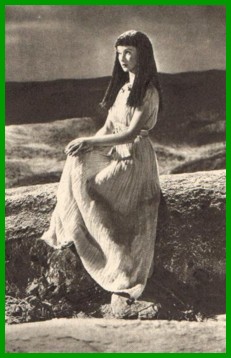
Cleopatra as Caesar found her when he first came to the Sphinx |
2003 � Vivien Leigh & The Stage. |
-design by subtract- |