|
|
|
The Portrait Of A Lady |
 |
|
Vivien Leigh & The Stage |
|
|
Reviews/Articles/Photos/Stories  
|
Cover Stories - (Plays and Players - UK - October, 1959)Mistress of comedy
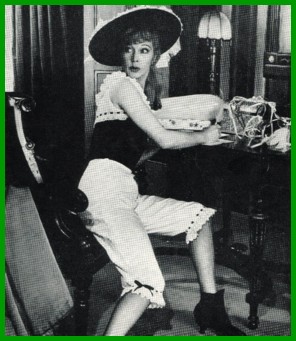
Vivien Leigh in Look After Lulu! at the New Theatre Vivien Leigh, now playing the title-role in Look After Lulu! at the New Theatre, has gone from success in the theatre since she played her first part at the Ambassador's 24 years ago. It is in comedy that she excels, and this Noel Coward adaptation of Feydeau's famous farce has given her an ideal role. It is strange that we should have waited so long to see Vivien Leigh in a Feydeau farce. With her delicate type of beauty, her aptitude for frothy comedy, her exquisitely controlled movement on the stage, and her sheer personal vivacity, she seems to have been born to play the alluring heroines of Feydeau. And did she not also study with Mlle. Antoine of the Com�die Fran�aise? Yet it is almost by chance that she is now playing in No�l Coward's adaptation of Occupe-toi d'Am�lie. Last year, travelling by train from London to Newcastle for the opening of Duel Of Angels, in which she starred with Claire Bloom, she happened to say to their producer, Jean-Louis Barrault, that she was looking for a light comedy to follow this more serious Giraudoux play. "Then why", he replied, "don't you persuade someone to translate Occupe-toi d'Am�lie for you. It should be ideal". Taking this advice, Vivien Leigh approached No�l Coward, who was immediately enthusiastic. He adapted the play, retaining all the situations of the original, but altering some of the dialogue to make it more suitable to the English stage. And so, in Look After Lulu! Vivien Leigh made her first appearance in farce. Asked how she enjoys playing in farce, her reply is forthright: "Actors don't really enjoy playing farce. It demands tremendous concentration, scarcely gives you time to breathe, and is utterly exhausting. But it is a wonderful exercise and excellent discipline". She found rehearsals a trial. "It is so depressing to rehearse a farce", she explains, "because the play soon becomes completely unfunny to the cast. You begin to think nobody else will ever find it funny either - until you play it to an audience. Then it suddenly comes to life again, and all the extravagant situations that have become stale to the actor become quite fresh once more". Whether or not she enjoys playing in farce, audiences are certainly enjoying Vivien Leigh's performance in Look After Lulu! which marks her twenty-fifth year on stage. It was in 1935, in The Mask Of Virtue at the Ambassador's Theatre, that she became an overnight success. She had, however, made her screen debut the previous year in a schoolgirl role.
Vivien Leigh She then made a name for herself in Shakespeare, appearing in the course of two years as the Queen in Richard II at Oxford, Anne Boleyn in Henry VIII at the Open Air Theatre, Regent's Park, and Ophelia at Kronborg Castle, Elsinore, with Olivier as Hamlet. She also played Titania in Tyrone Guthrie's notable production of A Midsummer Night's Dream for the Old Vic Company in 1937. For a time we lost her to America, where she made films in Hollywood and played Juliet on Broadway. Returning to the West End in 1942 she enjoyed a huge personal success as Mrs. Dubedat in Doctor's Dilemma. This was followed by one of her greatest triumphs, the part of Sabina in The Skin Of Our Teeth, first at the Phoenix Theatre until her illness closed the run, and later at the Piccadilly. Many of the highlights in her career are, of course, linked with that of Sir Laurence Olivier. At the New Theatre in 1949 they appeared together in The School For Scandal, Richard III and Antigone; at the St. James's, two years later, they starred together in the Cleopatra plays of Shakespeare and Shaw; while at Stratford they were seen in 1955 in Macbeth, Twelfth Night and Titus Andronicus. Vivien Leigh has enjoyed an unusually varied career. For many people she is thought of as a star of two of the most notable films ever made - Gone With The Wind and A Streetcar Named Desire. For theatregoers she is the beautiful and talented lady of our West End stage. And for those who feel that as a nation we are too little concerned over our theatrical tradition, she will always be remembered as the champion of the St. James's. A new side of Vivien Leigh's character emerged two years ago when it was announced that the St. James's Theatre was to be demolished to make room for a block of offices. Theatre lovers all over the country declared that such an action would be scandalous, but they felt nothing could be done. It was left to Vivien Leigh to show that something could be done. Summoning up a fighting spirit that none of us thought she possessed, she took part in a protest march down Fleet Street. Then, when this failed, she decided on more daring solo action. The sleepy atmosphere of the House of Lords was shattered by a firm, cool, determined voice from the public gallery - "My Lords, I wish to protest about the St. James's Theatre being demolished". With admirable dignity Vivien Leigh then allowed herself to be led out of the House. But she had made history. The campaign to save the St. James's failed, but had more of our leading players shown something of her courage and enterprise, this beautiful theatre, with the glorious memories, would almost certainly be standing today. And by her action, Vivien Leigh proved the sincerity and the depth of her regard both for her profession and for the ideals of the art she serves. She feels now that our theatre could be best served by repertory seasons such as she and Sir Laurence have run in the past. But these seasons are expensive to put on and difficult to arrange, in these days of high costs. She hopes, however, that it will be possible to present one again in the not-too-distant future. After Look After Lulu! she wants a change from light fare. She would like to play in Ibsen, which she has never done so far, or in Chekhov. And the mysterious allure of Cleopatra still draws her. But whatever she chooses to play, she will not fail to attract the huge public which thinks of her as mistress of comedy, spirited player of Shakespeare, or champion of the theatre whenever it is being threatened. F.G.B. |
2003 � Vivien Leigh & The Stage. |
-design by subtract- |