|
|
|
The Portrait Of A Lady |
 |
|
Vivien Leigh & The Stage |
|
|
Reviews/Articles/Photos/Stories  
|
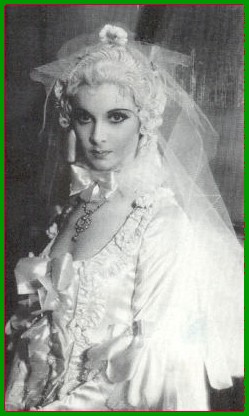
Vivien Leigh as Henriette Duquesnoy One day, Aubrey Blackburn, Associated Talking Pictures Studios's casting director, received a telephone call from a West End empresario, Sydney Carroll.
'I'm putting a play for Jeanne de Casalis... The Mask Of Virtue. I need a girl for the ing�nue role. Anyone you can send me? Doesn't have to act... must be pretty'.
The casting director said at once, 'Vivian Leigh'.
Gliddon, in due course, presented the opportunity of 'an important role' to his client.
The part was that of a young eighteen-century prostitute who is presented as a girl of unblemished reputation and rank in order to compromise a French aristocrat. The dramatist Ashley Dukes had adapted it from the German of Carl Sternheim, who in turn had lifted it from a conte by Diderot.
Thought the girl's was not the leading role, it was one that would grip the audience and to say that the actress 'didn't have to act' was a considerable misstatement. She had to suggest how her real love for the victim of the cruel joke chastened and reedemed her.
Carroll's producer on The Mask Of Virtue was Maxwell Wray, a former dialogue director for Korda - in those days, London theatre and cinema was a very small world. He was a pliable man, which is how Carroll liked things; but the latter was surprised when Wray, who had strolled out to inspect Gliddon's candidate, returned and said, 'If Vivian Leigh's the girl at the end, then as far as I'm concerned the part's cast'.
Gliddon saw Carroll's face show surprise at being preempted. Hastily he said, 'You met her yourself, at The Green Sash. You gave her your card. You must remember what Charles Morgan said about her'. Carroll, mollified by the feeling that he had already passed a good opinion on Vivian, said, 'Bring her in'.
'I remember him sitting back in his office chair, just looking at this beautiful girl', Gliddon said. 'He was smitten - and Vivian knew it. She did her usual spell-binding act and in what seemed an amazingly short time Sydney Carroll had hired her at � 10 a week, subject to a satisfactory audition. She got more than the job - she got Sydney Carroll round her little finger'.
Carroll made only one immediate demand on her, a small one, but it signified the proprietorial interest he was already taking on her. He didn't like her first name. '"Vivian" - it's neither one thing nor the other. It'll confuse people. They won't know if you're a man or a woman. Will you agree to spelling it "Vivien"?'
Vivien looked so young and inexperienced at the audition that even Sydney Carroll began to doubt whether this virtual child understood that the part she was to play, in the euphemism then employed, 'a woman of easy virtue'. Not wishing to embarrass her, he prevailed on the actress Liliian Braithwaite, fortuitously encountered at lunch, to plumb the extent of Vivien's knowledge of life. 'Sydney', said his emissary, after a discreet t�te-�-t�te on the Ambassador's empty stage, 'put your mind at rest. Miss Leigh is married and already has a child".
As Vivien read for Sydney Carroll and Maxwell Wray, their anxiety shifted from moral to technical grounds. Her voice was clear and crisp enough, but small in volume and thin in tone. When she raised it, she tended to go shrill. But there was a month's rehearsal - time to work on her voice. And with the right lighting and positioning, she was certain to look dazzling: her movements, her grace, the period costumes and her youth ensured that Sydney Carroll knew the extra sensation that the 'discovery' of a virtually unknown actress would impart to his production.
It was a small cast: Lady Tree, Jeanne de Casalis and Frank Cellier (as the Marquis) were all accomplished players. Vivien was a tremulous beginner. They took pity on her. The play's construction as a chamber drama fostered a working intimacy between them all. They generously guided Vivien through the passages where her inexperience was shown up painfully. For two-thirds of the way, her role was relatively straightforward, personifying the putative chastity and purity that are used as bait for the nobleman; but the last third, when her duplicity is exposed, was much more taxing. Prostrating herself before the angry man, who is threatening to shoot her, she has both to beg forgiveness and declare that her love for him is genuine.
The intelligence with which she read her lines might well have seen her through, but the muted appeal of her naturally small voice caused the audience to come to her, to lean towards her, so to speak, so as not to miss a word. Almost without trying, she invited them into her confidence, thus concentrating their attention, while those virginal looks which had perturbed the play's producers excited their sympathy.
In later years, however, Vivien was the first to admit that she had been very lucky in the direction she received from Maxwell Wray and her fellow players.
'Every day during the three-week rehearsal they nearly fired me because I was awful. I remember someone saying at the Ivy restaurant: "She'll have to go - she is terrible". I was lucky enough to wear a lovely pink dress, a lovely black dress and a wonderful nightdress... but I didn't know what to do...'
Those who knew Vivien best have given accounts which suggest that her part in the play was a triumph of personality over performance - allied to the expectancy that Sydney Carroll had created over the preceding weeks. John Gliddon was present. 'The play itself wasn't of much interest. But Vivien charmed everyone. The second act curtain went up and there she sat as the prostitute charming the old man. She charmed the whole audience. You could feel her charm come over the footlights'.
By the end of the evening, the promise that Sydney Carroll had hyped, to use a modern idiom, had been converted into what Harold Conway, the Daily Mail's theatre critic, called the next morning, 'one of the biggest personal ovations a newcomer has had on the London stage for quite a long time'. (Daily Mail, May 16th 1935)
The following forty-eight hours gave shape to Vivien's fortunes and ambitions for years to come. Her parents and her husband had been in the first-night audience on May 15th 1935, and all of them, accompanied by friends, made up a table at the Florida, a fashionable night-club, until the first editions came off the Fleet Street presses. Vivien didn't need to strain her eyes in the dim lights of the night-club in order to discern her triumph - it was writ in headlines. The critics praised her without exception and the reporters succeeded in extracting a news angle from her 'discovery', so that it ran both in the review columns and on the news pages. A very powerful combination.
Sources: |
2003 � Vivien Leigh & The Stage. |
-design by subtract- |