|
|
|
The Portrait Of A Lady |
 |
|
Vivien Leigh & The Stage |
|
|
Reviews/Articles/Photos/Stories  
|
Two Queens - One Actress (Theatre World - UK - No. 318 - July 1951)
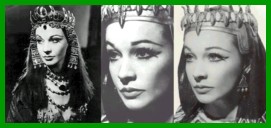
Eric Johns discusses Vivien Leigh's great performances at the St. James's Vivien Leigh is enjoying the unique experience of appearing on successive nights as two different Cleopatras during the current season at the St. James's, where she is playing the girl queen in Shaw's Caesar and Cleopatra, as well as the twenty years older Serpent of Old Nile in Shakespeare's Antony and Cleopatra. These two queens of Egypt, though the same woman, present a vivid contrast in character. Shaw's kittenish Cleopatra, only a mere 16, has reached the age at which she troubles men. Of Shakespeare's enchanting heroine, Enobarbus says: Age
cannot wither her, nor custom stale To effect a convincing transformations from the girl to the self-assured woman, Miss Leigh adopts a deeper and richer voice. The eyes and mouth are given a different shape, tough the colouring of the face is the same. Caesar's Cleopatra is a somewhat unkempt girl, but the sophistication of the older woman is reflected in subtle touches of makeup, such as a thinning of the eyebrows. During her study of the play Miss Leigh read Plutarch, Emil Ludwig and other authorities in her search for details concerning the appearance of this fascinating immortal. Shaw suggests that her hair was black and wavy, but on the evidence of the historians Miss Leigh prefers to think she was a redhead. As she was a Macedonian Greek there is no reason to assume that she had black hair. It is also recorded that being short of stature she wore the highest possible heels. She was obviously temperamental, showing no sign of nobility in her nature until after the death of Antony when she felt ...there
is nothing left remarkable Shakespeare seemed to understand the "infinite variety" of Egypt's Queen far better than Shaw, who starts out to draw her as a funny English school-girl, but appears to lose interest in the character before the end of the play, when she deteriorates into a mere mouthpiece, offering rather poor material to the actress. Although 300 years elapsed between the writing of the two plays, Shaw's work makes a surprisingly effective prelude to Shakespeare's. Miss Leigh is stimulated by playing the two parts in succession. She finds it less exhausting than repeating the same part night after night. At the St. James's she enjoys playing the Shaw because of the tragedy that is about to follow on the morrow. Miss Leigh confesses a preference for Shakespeare's heroine because the role challenges every actress to pursue what would seem to be an unattainable ideal. She learns something more about Shakespeare's Cleopatra at each successive performance and derives greater artistic satisfaction from trying to bring her to life. That alarming mechanical contraption known as a revolving stage added to Miss Leigh's terrors on the opening night and she still has a secret fear that it might break down or get out of control and swing her out of sight, instead of bringing her to a stand-still in full view of the audience for one of her big scenes. Yet never had Antony and Cleopatra been so effectively produced until Michael Benthall mounted it on the revolve at the St. James's, where Roger Furse so ingeniously suggests either Rome or Egypt with ellegant pillars which tell the audience at a glance whether they are on the banks of the Tiber or the Nile. With breathless speed the play swings across the Mediterranean from one country to the other. By magnificently mastering the two Cleopatras Miss Leigh has scaled a lofty peak in histrionic achievement, with Laurence Olivier as her Caesar and her Antony. The St. James's is one of the few West End theatres at present displaying House Full boards every night with unfailing regularity. The Oliviers deserve such a reward for their imaginative presentation of an ancient and a modern classic in nightly succession, showing how a young girl, discovered asleep in the shadow of the Sphinx, became one of the most magnetic queens in history. Eric Johns |
2003 � Vivien Leigh & The Stage. |
-design by subtract- |