Here's looking at you, Kid

What a kidder!
Kid Eternity: Billy Batson’s Cousin?

By John Haines

    As everyone knows, DC put the “Big Red Cheese”--Captain Marvel--out of commission for being too close of a copy of their cash cow Superman. At it's height, Fawcett’s Captain Marvel actually outsold the Man of Steel. Not to be outdone, Quality decided on a little homage of their own, only this time the original being copied wasn’t Superman, it was a copy of the carbon, Captain Marvel. I’m surprised that Fawcett didn’t file against Quality when they got an eyeful of Kid Eternity and his pal Mr. Keeper.

    There are more than just a few similarities between the first Kid Eternity story and the original Captain Marvel all of which are overshadowed by the huge “coincidence” of the Kid and Billy Batson both being able to change into powerful characters simply by shooting off their mouths. It’s pretty common knowledge that Billy Batson’s magic word transforms him into Captain Marvel who is imbued with the wisdom of Solomon, the strength of Hercules, the stamina of Atlas the power of Zeus, the courage of Achilles, and the speed of Mercury. And most golden age aficionados also know that when Kid Eternity shouts his magic word, Eternity, he is “able to call on any person in mythology or history”. But unless they have read the first exploit of Kid Eternity as presented in Hit Comics #25, they probably don’t realize that originally, he actually traded places with those heroes, just like Billy and the Cheese. Since our erstwhile editor always needs me to fill up space, first let’s do a little background on the title that eventually gave birth to Kid Eternity. [Ed.: It's all the news that's print to fit.]

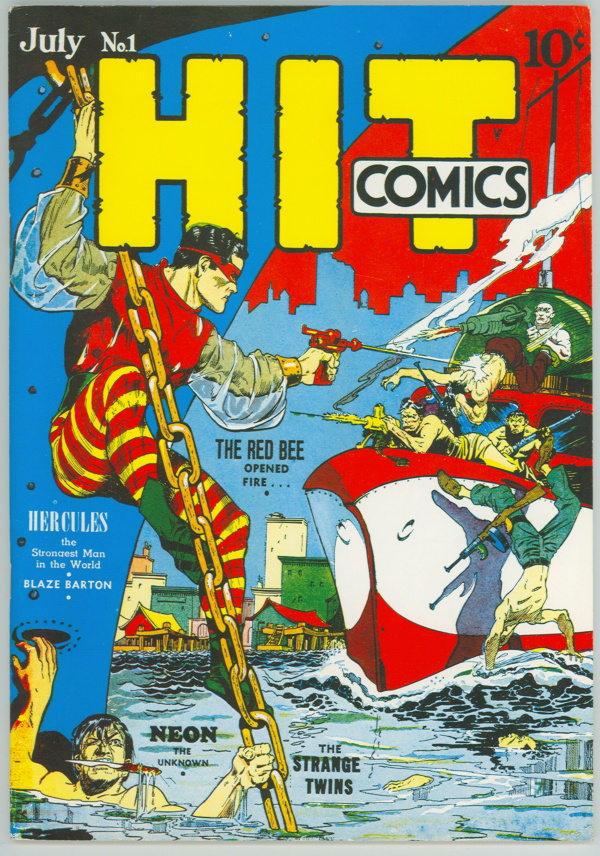
    E.M. “Busy” Arnold brought Hit Comics #1 into the world as an anthology title through his publishing line Comic Magazines, Inc. cover dated July 1940. Arnold’s line became known as Quality Comics at least in part because his stable of artists was headed by Will Eisner and included the likes of Reed Crandall, Alex Kotsky, Paul Gustavson, Al Bryant, and best of all, Lou Fine. And it was the great Mr. Fine who was enlisted for the cover of the first issue of Hit Comics, turning in a very Eisnerish rendition of the ridiculous Red Bee fighting a gang of waterfront pirates. Despite Lou getting things off to a great start, the contents of the interior of Hit #1 contained mostly disappointments.

Stop hitting me!     The first issue led off with Hercules, brought to us by "Dan Enloz" a pseudonym if I ever saw one. (In fact, as you will see, most of the early Quality artists signed cutesy and punny names to their work.) What’s the story behind Herc? Well, he sure wasn’t the same mythical Hercules that contributed all that strength to Captain Marvel. According to ol’ Enloz, “comic magazine fans have for some time now been following the adventures of various ‘strong men’…true they are indeed all-powerful, amazing and unusual. But there still remains one great, powerful man of might, whose outstanding adventures are yet to be told…He didn’t come from another planet…he wasn’t made by a mad scientist or by some other fantastic manner…he’s a real American youth, born in the north woods and imbued with the greatest strength mortal man ever possessed…Our story opens at the state fair of a mid-western city. Great crowds gather at one booth to marvel at the great strength of Joe Hercules, which is earning him a tidy sum.” Joe Hercules. How original. How about a cross-over? Like G.I. Joe Hercules?
    In an unremarkable first story, Hercules brings the con men that caused his mother’s death to justice. Hercules ran around righting wrongs while dressed in blue shorts and boots, a red cape, with a bare chest and legs. He may have had super strength but he struggled to reach issue #21 when he was finally retired. Hercules.jpg

    Although the Hit #1 opened up with your basic superhero story, several non-superhero features also debuted in the first issue of Hit. “X-5 Secret Agent” by Cary Weyt (carry weight, get it?) was a pretty pedestrian spy faire and only lasted four issues. Nobody cared since Eisner’s “Black X” over in Smash Comics was far more entertaining anyway. “Jack and Jill Super Sleuths” was clearly a thinly-veiled "Thin Man" rip-off, brought to us by Lowell Riggs featuring some pretty sketchy and primitive artwork. It did a little better than X-5, lasting until issue #7 before being banished to that great murder mystery dinner theatre in the sky.

    Worse yet was Casey Jones by Pad Docke (paddock; witty no?) [Ed.: Uh, no.] The less said about this railroad engineer story the better, although he did make it to issue #3. At the bottom of the barrel we find “Tommy Twinkle and Mary Lou in Twinkle Town” inflicted upon us by Pauline Comanor (commoner?) in execrable fashion. This is not to be confused with the entertaining "Twinkle Twins" from Green Hornet Comics.

    It’s an acknowledged fact that early 40’s comics sold like mad to servicemen during the war, so most anthology titles featured at least one military-oriented strip. Hit’s contribution was “Bob and Swab” by Klaus Nordling. These guys were your basic navy cut-ups. The early Nordling art is pretty sketchy, as he hadn’t fully codified his style yet, but you can see where it was going. Here we have a light-hearted naval humor strip aimed right at military sales. Bob and Swab went the distance appearing through issue #61.

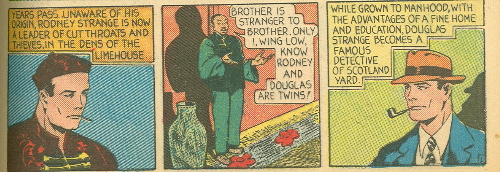
    Of the non-superhero features in Hit, “The Strange Twins” by S.M. Regi, probably a Jerry Iger anagram, is the real deal and is definitely a step up overall. Finally we get a great story, the best in the issue. It shows its influences coming from the pulps and movie serials. “One brother pays for the other’s crime. From the black heart of London’s Limehouse, reaches the hand of fate, to cross the life of Douglas Strange with that of his brother Rodney, denizen of the underworld.” The art is pretty good too, it’s unsigned but is probably by Alex Blum. The odyssey of the Strange Twins twists its way through issue #24. It’s very literate and really entertaining reading--recommended by yours truly.

 People are strange

    Back in the land of the super-powered, cover feature “Red Bee” by B. H. Apiary (it's a pun--"apis" is Latin for "bee") at first looked like he had promise in Lou Fine’s cover, but ultimately he was a pretty lame character. “Smashing a powerful political machine that had held the city in its corrupt grasp through years of criminal rule, the Red Bee, mysterious fighter for the common good, begins his startling one man fight on crime.” The Bee is really Raleigh an assistant DA who slips into a sissy red outfit with a black domino mask complete with weird gossamer arms. He and keeps a bee [!] hidden in his belt that flies out and stings the bad guys. [Ed.: The fact that bees die after stinging leads me to believe it's really a wasp with a secret identity!]

    The Bee featured mediocre art and the trained bee is pure bush-league. This character was so goofy that it’s hard to tell why he was chosen to be the cover feature. Someone at Quality must have believed in him since he made it all the way to issue #24.

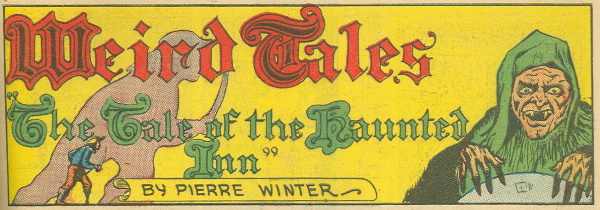
    Providing the scary stuff quotient was “Weird Tales” by Pierre Winter. True to its name, ghosts haunt the old Murdered Sailor’s Inn. “Hidden deep in the hear of the forest, sheltered by watchful old trees, whispered to by the night winds, stands the old crone’s house…A gaunt black cat is the only sentinel at the creaking oaken door…The door opens and the ancient witch invites us in. 'Come in out of the night,' she says, 'and I will tell you tales to freeze the marrow in your bones.' [Ed.: My boots are leather, not marrow. Must be a sea thing.] Overstreet lists the Old Witch as starting in #2 but here she is one issue early called the "Old Crone." This features a moody intro but degenerates into a mundane story of spectral retribution on a murderer’s heir and is clearly based on Nathaniel Hawthorn’s "House of the Seven Gables." The witch tried her hand at scaring readers for 13 more issues before packing it in. Man, those witches with their number 13!

 Better witch than bi....

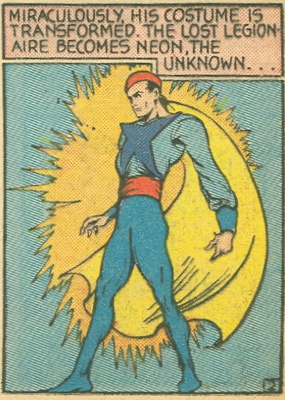
    Another super-powered misfit, Neon the Unknown by Jagor Maroy also began in Hit #1. Neon sported a generic blue costume with a red headpiece and had a very odd origin sequence, one that rates right up there with Timely’s character the Whizzer for all-time most implausibility. “Out of the mysterious unknown comes a strange, but powerful, figure, Neon, possessed with great neonic [!] powers, to save the world from destruction by individuals hungry for power and glory…” Our story has French Legionnaires perishing in the desert. “Only one man remains, Tom Corbet (not the Space Cadet), drags himself over the burning sands. At last, a shining pool of clear water glistens in a green oasis beckoning hopefully to the dying man. Parched with thirst, weak from the intense heat, Tom Corbet crawls forward in agony. Phosphorescent vapors rise from the water as Tom drinks. Amazingly refreshed, Tom rises; a strange luminous glow surrounds him. Miraculously, his costume is transformed. The last legionnaire becomes Neon the unknown…” Really, that what it said! Neon could fly, had strength, and could emit rays from his hands and the vapors from the pool had even given him a dandy new costume. His exact powers were unclear, whatever neonic means, that’s what he had. This story is so bizarre that it’s actually fun to read. Neon made it 17 issues before he ran out of vapor.
 
I got the vapors!     Closing out the debut issue was “Blaze Barton and the World of the Future” nominally by Roy Taylor, but clearly the work of ubiquitous H.C. Kiefer. Blaze appeared in a tightly told tale wherein mankind goes underground when global warming destroys the upper world [Ed.: once more, reality imitates comics]. Blaze soldiered on through issue 13 before things finally got a little too hot.
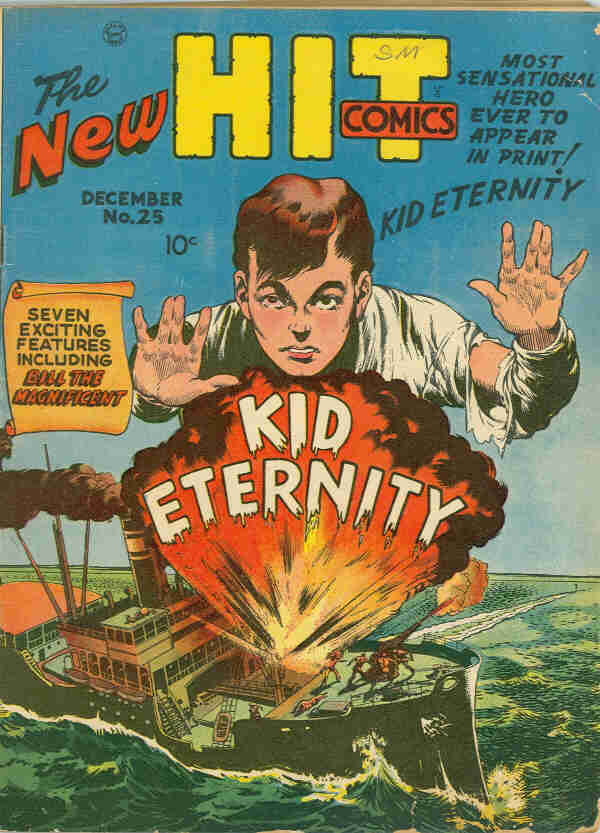
    Given the poor quality of the characters and the stories in Hit it’s a wonder that it survived long enough for a strong feature to appear. If not for the cover art and the appeal of Bob and Swab to enlisted men, I doubt that the title would have continued at all. Betty Bates came on board in issue #4 and was somewhat of an improvement. Prizefighter Don Glory also gave everything he had starting in issue #9, but when issue #25 appeared in December 1942, the new lead Kid Eternity was head and shoulders above any of the previous features. At last, an origin sequence that made some sense, willingly suspending disbelief, of course. Up until now, it seemed as if the Quality editorial staff believed that the costume and powers were all that mattered when it came to selling copies.

    Just like a mall needs a good anchor store, every anthology title needs a lead feature with superior quality captivating enough to interest diverse readers. Kid Eternity fit the bill. The writing is first-rate and the power to changes places with heroes from history and mythology, along with the ability to fly and turn invisible if needed, were different enough to make him stand out on the crowded magazine stands of the day.

Look at me! I'm dead!

    The cover leads into the issue with a dramatic scene of Kid Eternity trapped on an exploding boat, and things just take right off from there. The initial story is uncredited but is generally attributed to Shelly Moldoff. It looks to me like several artists worked on it, the splash looks like Rayboy inks, and the last two pages are a lot better rendered than the body of the story. Moldoff, if it was Moldoff, designed a tasteful costume of purple slacks, white turtleneck, red waist sash, and red cap for the Kid. The red cap didn’t really work, and was eventually dropped as the Kid got a little older.

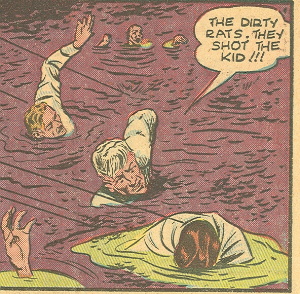
    The story itself has become comic book legend by now: we meet our hero on a merchant vessel cruising the Atlantic with a cargo of rubber and crude oil. No alter ego is ever given; everyone just calls him Kid. TheycallmeKid.jpg. A Nazi sub torpedoes the ship, killing the captain who is Kid’s grandfather and then delivers the coup de grace with machine-gun volleys at the survivors in the water killing Kid along with everyone else who had managed to survive the torpedo strike. Kid dies, kiddies

    Cut to the scene of a line of people moving toward a heavenly gate in the clouds where an old man is checking names against a list. To the sentinel’s amazement, the kid is not on the list. Turns out that Mr. Keeper, who maintains the list, has finally made a mistake after 2,000,000 years [Ed: Of course, modern man is only 100,000 years old. Did Austalopithicus go to heaven?]. Kid was not due for another 75 years. Mr. Keeper restores the kid’s body but at this point he is neither dead nor alive.

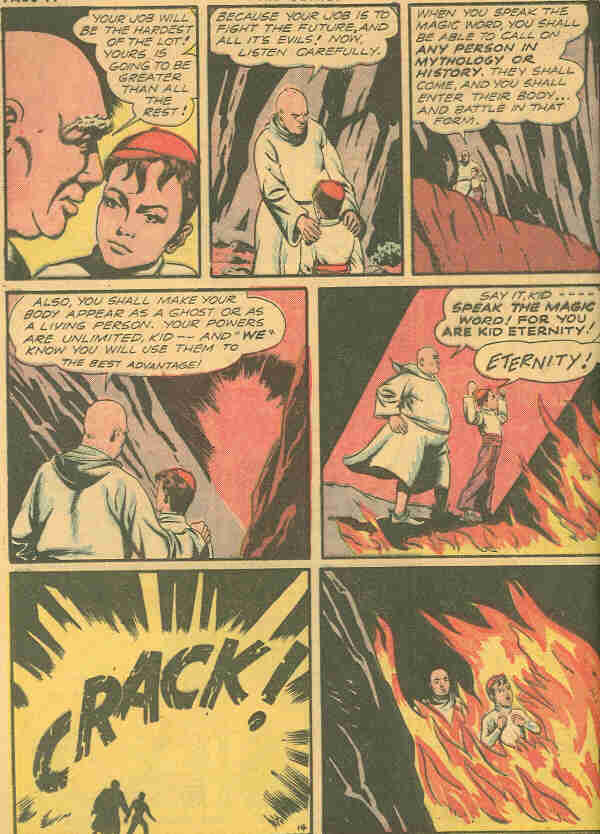
    The boy gains his miraculous powers after reciting his particular version of the standard good-guy oath: “Justice shall never perish from the realm of the living. It shall exist throughout eternity.” WRAM.jpg. According to Keep, “When you speak the magic word, you shall be able to call on any person in mythology or history. They shall come and you shall enter their body and battle in that form.”

I'm dead, but I'm not really dead, dead

    When I first read this story many years back, I was struck by the fact that Kid Eternity actually changed places with the characters he summoned just like Billy Batson and Captain Marvel. After the first issue, though the concept was altered slightly so that the characters were summoned separately from Kid Eternity and he fought side by side with them. After that point he diverged from Captain Marvel. Did Fawcett complain? Who knows. But such an abrupt change suggests he did (like after MLJ complained about Captain America, the shield was changed to round).

    Kid Eternity proved to be just what Hit needed. He headlined every issue until Hit’s format changed in issue #61 and ran in 18 issues of his own title. There were other parallels between Captain Marvel’s origin story and Kid Eternity’s to be sure. Here’s a few of them:
Magic Bus
You're homeless cause you wanna be!     


     º
Coincidence #1 - Both Billy and the Kid are orphans. Billy lives on the streets selling papers while the kid is raised by his “grandpa” aboard ship.

     º Coincidence #2 - Someone has to die before any powers are bestowed. Shazam dies to pass powers on to Captain Marvel while the Kid actually perishes in order to gain his powers. Ghostly figures mentor both of our protagonists. Shazam instructs as a ghost as does the Keeper. In fact, the Kid can actually assume a ghostly aspect himself.

    º Coincidence #3 - Have to do some travelin’ to get there. The Kid has to go down the corridor of time to stand before the Rock of Eternity while Billy had to journey down the abandoned subway tunnel to get to old Shazam’s throne.

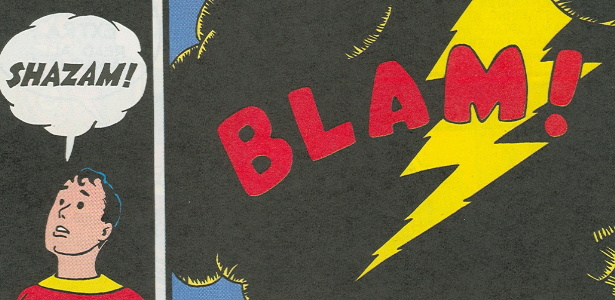
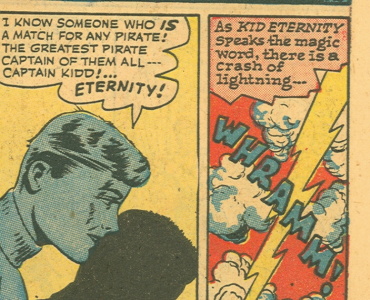
    º Coincidence #4 - All you need is the right magic word. Billy shouts: Shazam! while the Kid yells Eternity! Both transform in a flash of lightning.
Wham, blam, thanks Shazam!
      Whraam, bam. not Shazam!  

  º Coincidence #5 - Where does it all come from? Capt. Marvel gets power from heroes who make up his name while Kid Eternity uses heroes from all of history and mythology.

    Like I said, Kid was a lot like Captain Marvel in issue #25, then by #26 the character evolved and Kid summoned his heroic figures rather than changing places with them. Of course, this concept is similar to Maj. Victory from Timely's USA Comics. Kid was a great character. If you haven’t had the pleasure of reading one of his stories yet, do yourself a favor and try one.

Shazbot, I mean Shazam!     The rest of Hit #25 wasn’t too shabby either. Betty Bates Lady at Law turns in an atmospheric ghost story entitled “The Death-House Blues” wherein the criminal Redfern is undone by the ghost of Slugs Moran whom Redfern had let take the rap for him. Betty was usually credited to Stanley Charlot who was most likely really Al Bryant. Betty had real staying power, starting back in issue #4 and lasting through the end of the run.
    George Brenner of “The Clock” fame turned in a wacky story about his character the Ghost of Flanders. “Young Bill Jones needed a lesson in patriotism and the Ghost of Flanders, who is the Unknown Soldier of the First World War, made sure he got it.” The Ghost started in issue #19 and Brenner consistently turned in very clean but static art, a lot like what Fred Guardeneer was doing at the same time.

    Adding to the general improvement in quality in the title is Stormy Foster the Great Defender. This issue’s story “Men With Two Faces” is uncredited but clearly is the work of Rudy Palais. Stormy has been working as a soda jerk at Dr. Vaughn’s drugstore starting in issue #18. Stormy gains great strength and stamina through special vitamin capsules a la the Hourman. Stormy defended his last with issue #34.

    Bob and Swab were still appearing, still by Nordling, and looking much better at this point. Nordling had really come into his own.

    As mentioned earlier, prizefighter Don Glory first appeared in issue #9 but was nearing the end of the line by #25. Here we have a rather goofy story where Don is shanghaied to Japan by his Chinese laundry men and ends up bringing back an American spy traitor. The story is uncredited but is most likely by Rubimor.

    Closing out the issue was Bill the Magnificent. The story is uncredited but I see Jack Cole’s handiwork loud and clear: good art and classic comedic elements. In this surreal episode we learn that when Bill Hanson, copy boy at the local newspaper office, says “Jeepers Creepers” he gets super strength and incredible speed, which is ALSO like Capt. Marvel and Kid Eternity. Bill has no costume and just runs around in his street clothes. When he changes back he doesn’t remember his powers or what he had done. No explanation is given; in fact the back-story is a newsreel editor assigned to follow Bill around to see where Bill’s powers come from. Strangely, all of the local townsfolk are aware of Bill’s abilities even if Bill is not. They speak to the audience in humorous asides - a clear Cole trademark of ever there was one.

Grab cloud, dude!

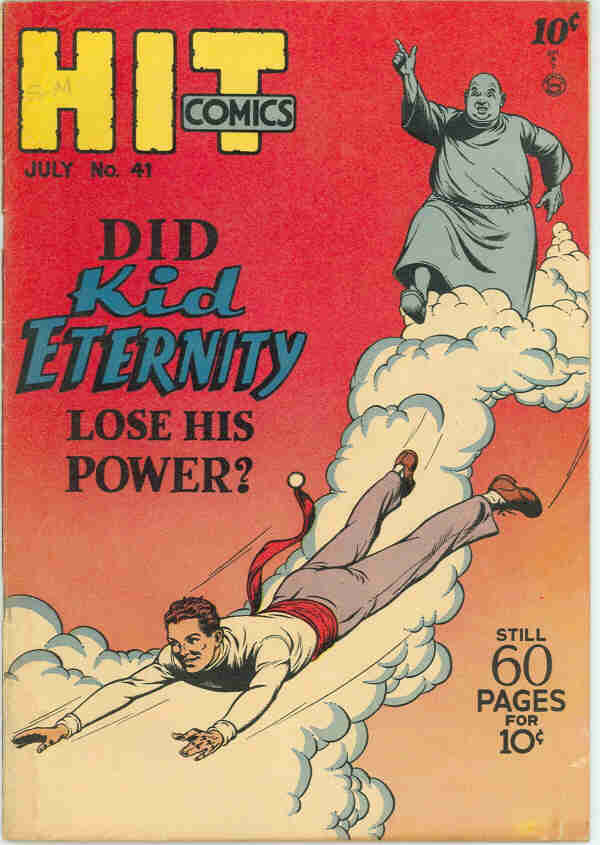
    By the time that Hit #41 rolled around in July 1946 the contents had stabilized. The cover is by Al Bryant, featuring Kid Eternity and Mr. Keeper flying along on their way to an adventure. As always, Kid Eternity leads off the issue with a story about the first time that his power had failed. When the Kid tries to summon Captain Kidd the captain fails to appear! The magic word wasn’t working because Capt. Kidd had escaped from eternity and so couldn’t be summoned. The Kid and Keeper return Captain Kidd and his crew to Eternity and all is well by the tale’s end.

    Toward the end of the 1940’s, almost all anthology titles featured at least one anthropomorphic funny-animal feature. Hit had two: Marmaduke Mouse and Charlie Horse.  Marmaduke Mouse, by Ed Hart, is a great example of a Quality funny animal feature. Marmaduke was so popular that he ended up with his own title which had a great run of 65 issues - the same number of issues as Hit itself! The premise is pretty simple: Marmaduke mouse pulls pranks on Louie the lion in a formula that worked for Marmaduke as well as it worked for Tom and Jerry or Bugs Bunny. Marmaduke.jpg. While the Marmaduke character really worked another feature, the Charlie Horse strip, really stunk. We should just hold our noses and move on.

    Good girl features had also proved to be popular and Quality wasn’t going to be left out. Starting in issue #28 we’d been treated to stories of the little old lady con artist “Her Highness” and her sexy partner Silk. The stories are uncredited but could be by Gustavson. Her Highness is a prime example of the type of the good girl package Quality put in all of their anthology titles. Silk.jpg. Her Highness may have been the title character but I imagine that the provocative Silk was the real draw. The other good girl feature in Hit, Betty Bates is still on board, still unsigned, and still probably drawn by Al Bryant. In issue #41 Betty wraps up a phony fortuneteller scam.

    Bob and Swab are still going strong but are no longer being produced by Nordling who dropped out somewhere around issue #33 and is now being produced by someone named Ginger.

    Closing out the issue is a fascinating feature “Big Brother” with no artists credited. This feature is most interesting in light of the original comparisons between Kid Eternity and captain Marvel in Hit #25 four years earlier. There are CC Beck swipes all over the place. Big Brother is based on Li’l Abner, another super strong hick trying to make good. The real shocker is that he’s a dead ringer for Billy Batson. In fact he could easily pass as Billy’s older brother. Check it out! Bigbrother.jpg. Who’d ‘a thought that we’d find another Captain Marvel tie-in 16 issues after the intro of Kid Eternity. Decades later yet another Captain Marvel/Kid Eternity parallel popped up. DC had acquired the rights to Captain Marvel and began publishing new Captain Marvel stories with Shazam #1 in February of 1973. Of interest is issue #27, November 1976 where Captain Marvel actually teamed up with Kid Eternity for the first time. Seems like these two were destined to meet.

Mumy gets mad!

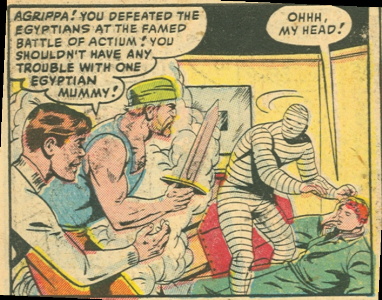
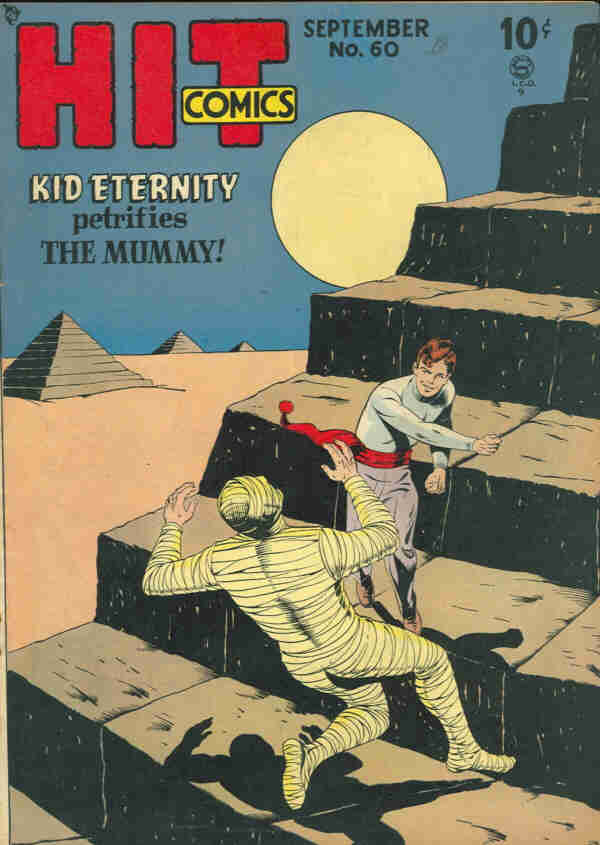
    Kid Eternity’s Golden Age swan song was Hit #60 September 1949, once again featuring a cover attributed to Al Bryant. By this time, only a few features were left. Hit had slimmed down to the silver age size of 32 pages from the old golden age size of 64 pages. The kid goes out in style facing a murderous mummy. “From ancient Egypt arises a menace unlike any that Kid Eternity and Mr. Keeper have ever faced! Who is the strange creature whom his terrified victims know only as the Mummy? What is the strange secret that has brought him across the gulf of three thousand years to strike and kill again?” Nice summary: “Taken from this world before his time, Kid Eternity, by way of celestial recompense, was given the power to return to earth and, under the guardianship of Mr. Keeper, to reassume visible form! This the Kid accomplishes by uttering the magic word Eternity… a summons which can also bring to his aid heroes of the historic past!” As members of an archaeology team die off one-by-one after opening the cursed tomb of Ra-Kut, Kid E gets involved. Billy--stop hitting me!

    The rest of the gang was now down to:
Sir Roger - an inane, unsigned, humor strip revolving around a hobo.
Betty Bates - nice art, no longer Bryant and actually kinda looks like Rubin Moreira who was working over at DC at this time.
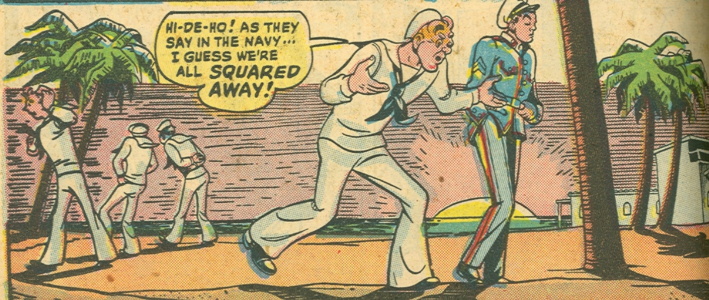
Bob and Swab - Still up to their old tricks. The final panel of the final issue featuring the Kid is quite fitting - a nice aloha.
Swab has left the building

    In issue #61, the Kid was nowhere to be seen, replaced by Jeb Rivers, Riverboat Pilot. Hit struggled on 4 more issues giving up the ghost, so to speak, with issue #65. The Kid’s own title had already ended after 18 issues changing to Buccaneers with #19. Bye Kid, no doubt the readers missed you.

    None of the Quality comics featuring Kid Eternity are really rare, although Hit #25 and #26 are challenging to locate. Two classics are Hit #26 featuring a neat Blackhawk crossover in Kid Eternity, and Kid Eternity #3 with it’s fine Mac Raboy art. Qualities in general are among the most affordable major gold age publishers and you can pick up some examples for under $30 if you look carefully. For those on a tighter budget a few reprints are available:

Hit #1 was reproduced as part of the Flashback Reprint series during the early 1970’s published by Ken Pierce. This series featured color cardboard covers and black and white interiors.
Kid Eternity’s origin from Hit #25 was reprinted in DC’s Secret Origins #4 in 1973.
Misc. Kid Eternity stories have also been reprinted in Superman #245 1972 (DC 100 Pg. Spectacular #7), and Superboy #185 1972 (DC 100 Pg. Spectacular #12).

Hope you like ‘em - JohnTremble, puny human! I am Kirby!

Hit Comics Features:

Neon The Unknown #1 through #17
Hercules #1 through #21
Red Bee #1 through #24
Bob and Swab #1 through at least #61, maybe through #65
Blaze Barton #1 through #13
Strange Twins #1 through #24
X-5 Secret Agent #1 through #4
Casey Jones #1 through #3
Jack and Jill #1 through #7
Old Crone #1 through #14 (Called Old Witch beginning #2)
Betty Bates #4 through #65
Don Glory #9 through at least #25
Lion Boy #11 through maybe #21
Hell Divers #15 through unknown (Not in #25)
Stormy Foster the Great Defender #18 through #34
The Ghost of Flanders #18 through at least #25
Captain Flagg #22 through unknown (Not in #25)
Kid Eternity (and Mr. Keeper) #25 through #60 - origin by Moldoff
Bill the Magnificent #25 through at least #31 (Not in #41)
Blackhawk X-over #26
Her Highness (and Silk) #28 through at least #41
Plastic Man X-over #32
Jeb Rivers #61 through #65 (River boat pilot, Crandall covers, Good Girl covers 3 out of 5)


Hosted by www.Geocities.ws

1