Personal Information
School Information
Reference Materials
Information for Students
Problem of the Week
Chaparral & New Mexico
Math Tutorial
Marvelous Math Links
Odds & Ends
Games and Gadgets
Fraction Calculator
Weekly Skills Quiz
Famous Matematicians
Student of the Month
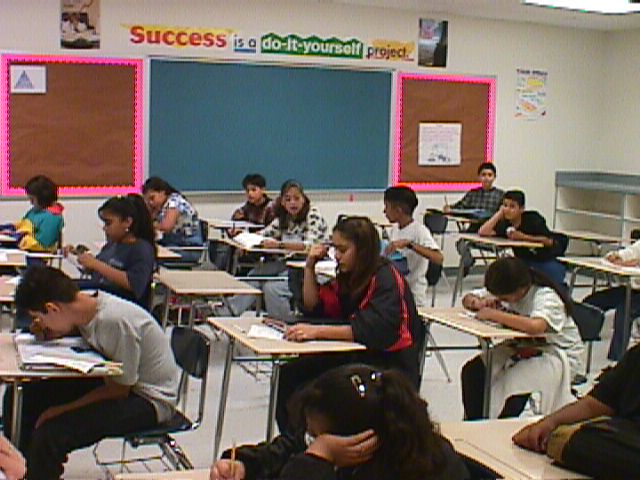 Welcome to Mr. Miller's 7th
grade math class. You are entering
upon a journey that will prepare you
for success in both high school and life.
It is not always an easy journey but there
is nothing you will face this year that
you are not able to do. It will take a lot
of work from you and myself to reach a
successful end. I believe every student can
succeed if they try. This class is difficult
at times, but in the past it has been the
highest scoring 7th grade math class in the
Gadsden School District.
Welcome to Mr. Miller's 7th
grade math class. You are entering
upon a journey that will prepare you
for success in both high school and life.
It is not always an easy journey but there
is nothing you will face this year that
you are not able to do. It will take a lot
of work from you and myself to reach a
successful end. I believe every student can
succeed if they try. This class is difficult
at times, but in the past it has been the
highest scoring 7th grade math class in the
Gadsden School District.
These rules are important for each and every student in order to provide you with the best possible opportunity to learn. We all make choices every day. I sincerely hope you will make good choices this year.
      1. Respect ALL others and their property at
	     all times.

      2. YOU are responsible for your own actions.
	     No one else can do it for you and no one
		 else wants the job.

      3. Come to class properly prepared each day.

      4. Use your time in class wisely and properly.

      5. Follow all school rules as outlined in the
	     student handbook.
At times you will be asked to write at least one page (250 words) on what you did, and learned recently. In addition this paper should explain something of what it meant to you and how it relates to real life situations and probably include sample problems of the important things you learned. This paper is an important part of your portfolio and your grade. You should do the very best you can on it!
Be prepared to learn math, which is not the same as arithmetic. During your years in school so far you have learned a lot of arithmetic, now it is time to go beyond that.
You will have ample opportunity to practice arithmetic, but it will be done in a math setting. Unfortunately this means you will be required to think.
There will be a lot of puzzles this year that require logical thinking and/or new ways of looking at math. For example, if a clock takes 2 seconds for a clock to strike 2 o'clock how long will it take to strike 3 o'clock? (Be careful, this is not as easy as it looks!)
    Terminology     The meaning of math words will be
	                discussed in all areas

    Properties of
    Numbers         primes & composites, factoring,
	                figurate numbers, series & sequences,
					Pascal's triangle, etc.

    Whole numbers   expanded notation, order of operations,
	                arithmetic

    Decimals        expanded notation, arithmetic, converting
	                to a fraction

    Fractions       LCM, LCD, reducing, comparing, arithmetic,
	                converting to a decimal

    Percent         changing to decimals and fractions,
	                arithmetic

    Area            area of various geometric figures,
	                square, rectangle, circle, triangle, etc.

    Volume          volume of various geometric figures,
	                rectangular solids, pyramids, prisms,
					cylinders, spheres, etc.

    Probability     calculation of odds of something happening.

    Ratio and
    Proportion      changing sizes or measures for recipes,
	                maps, etc.

    Percent         part of a whole, taxes, sales and
	                discounts, interest

    Angles          measuring, using to solve triangles and
	                other figures

    Geometric
    figures         properties of points, lines, squares,
	                rectangles, circles,
                    triangles, Pythagorean theorem, etc.

    Measurement     English & Metric measure, conversion
	                between systems, adding and subtracting
					measures,

    Statistics
    and Graphing    range, median and mode, average, ordered
	                pairs, line, circle, and bar graphs.
    1.  You have a right to expect your teacher to do
	    everything possible to insure you both learn
		and pass.

    2.  You have a right to expect your teacher to treat
	    you with respect.

    3.  You have a right to expect work that is on a proper
	    level for you.

    4.  You have a right to expect a proper learning
	    environment.

    5.  You have a right to expect an appropriate amount
	    of work without excessive homework.

    6.  You have a right to fair treatment and grading
	    standards.

    7.  You have a right to have your questions and
	    concerns answered.

    8.  You have a right to end this year knowing what
	    you need to know to succeed in future years.
The single most important thing expected of you in this room is to respect all other people and their belongings.
Your teacher wants you to succeed by learning the math you will need for the future. For you to do this there are several things you will need to do.
    1.  You must come to class every day properly
	    prepared and ready to learn. Bring your book,
		paper and pencil, and any other items that
		will be needed that day. Missing a day could
		put you behind and cause later problems,
		particularly if you miss something that is used
		later.

    2.  You will need to complete each assignment. If
	    you are absent it is your responsibility to get
		your makeup work and complete it within the
		required time. Attendance is very important and
		when you are absent you could miss something
		important you will need later!

    3.  In general, late work will not be accepted -
	    turn in work when it is due!

    4.  Your teacher wants you, and your classmates,
	    to have the proper setting for learning. You
		will need to follow all school rules and in
		particular the classroom rules for Mr.
		Miller's room.

    5.  If you show these five characteristics you
	    will do fine this year. They are respect,
		caring, citizenship, fairness, trustworthiness,
        and responsibility.
   5.  Your paper demonstrates exceptional work and
       learning beyond what is expected.

   4.  Your paper is complete. There may be a few minor
       errors but your work indicates you fully
	   understand the math in the assignment.

   3.  Your paper indicates that you mostly understand
       the work although this might be unclear to me in
	   places. There will be at least one error
	   indicating a lack of understanding.

   2.  Your paper indicates an adequate understanding of
       the work involved but should be better.

   1.  Your paper indicates a minimal understanding of
       the work involved. There are many errors some of
	   which are serious.

   0.  Your paper indicates a total lack of understanding
       or a paper was not turned in.
Because of the different types of errors that might be
made it is possible for two people to miss the same number
of problems and yet get different grades. Remember your
work is judged primarily on your understanding of the
material.
Daily Grades:
    You should expect an assignment every day. They
	will be checked for completeness and a grade for
	these will be recorded each week. This will count
	as approximately one-fourth of your total grade.

Quizzes:
    You should expect to be given quizzes on a regular
	basis . Quizzes will count about one-fourth of your
	grade. Normally, you will be told ahead of time to
	allow time to prepare. On occasion you will NOT be
	told ahead of time so be ready at all times.

Assessment Tasks:
    You will be given tasks to complete on a regular
	basis. These will count about one-fourth of your
	total grade. You will usually be given time to
	complete these outside of class although some
	will be done in class.

Portfolio:
    You will be required to keep a portfolio. It should
	include samples of your work, including the
	assignment tasks described above. You may select
	samples of your best work to include and the teacher
	will require some items be included.

Group Work:
    You will receive both a group grade and an
	individual grade for group work done in this
	class. Your individual grade will depend on you
    contribution to the group as determined by the
	teacher and also your fellow group members. This
	will be part of your daily grade.
   1.  Notebook paper and pencils.

   2.  Ruler that measures both inches and centimeters

   3.  Graph paper (quarter inch square paper is best.)

   4.  Calculator - preferably one that will do square
       roots.

   5.  Protractor (for measuring angles) and a compass
       (for drawing circles)

   6.  Colored pencils

   7.  Scissors (a small plastic pair will work fine)

   8.  Folder or notebook for portfolio. May be
       a cheap 20 cent paper folder.

   9.  A flexible yardstick such as the type
		used in sewing.

   10. The teacher provides tissue but it would be
       appreciated if each student would bring a box
	   to be stored and given out to students as needed.