 |
|---|
 |
 |
 |
 |
 |
 |
 |
 |
Culture
The culture of New York City in centuries of immigration, the city's size and variety, and its position as the cultural capital of the United States. Many major American cultural movements originated in the city. The Harlem Renaissance established the African-American literary canon in the United States. The city was the epicenter of jazz in the 1940s, abstract expressionism in the 1950s, and the birthplace of hip hop in the 1970s.
Wealthy industrialists in the 19th century built a network of major cultural institutions, such as Carnegie Hall and the Metropolitan Museum of Art , that became internationally established. Artists have been drawn to the city by opportunity, as well; the city government funds the arts with a larger annual budget than the National Endowment for the Art.
 |
 |
|---|
Daily life
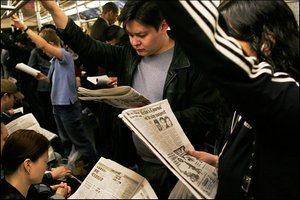
New York's use of mass transit gives the city a large newspaper readership base. The everyday lifestyle of New Yorkers differs substantially from that of other Americans, and has in some ways been compared to that of urban Western Europeans. Despite the best efforts of Robert Moses, residents are less attuned than other Americans to the 'car culture' that dominates most of the country. The well-designed New York City Subway and the threat of congestion keep six in ten residents, including many middle class professionals, out of cars and off of the highways. Even the city's billionaire mayor is known to take the train to City Hall each morning. This pattern is strongest for Manhattanites, who live in an area with better subway service and worse traffic, but more moderated for residents of the outer boroughs, especially in more peripheral areas, though many here too commute by train to Manhattan. Also in Manhattan, between subway stops and destinations, is built up the "walking city", a real pedestrian culture unrivaled in the U.S.Unlike most Americans, although less atypically for city dwellers, the great majority of New Yorkers rent their housing in what is usually seen as a very overpriced and difficult market at all ends. In this crowded city space is a precious commodity and self-storage is a strong local industry. Again, the pattern is strongest in Manhattan and moderated but still present in the outer boroughs, which do have a number of suburban-style homes. Growing up in an ultra-cosmopolitan city like New York can sometimes foster an impressive cultural awareness.
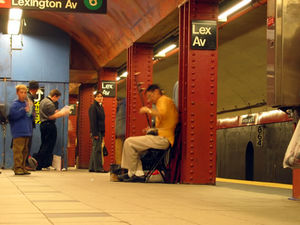
One outcome of the city's extensive mass transit use is a robust local newspaper industry. The readership of many New York dailies is comprised in large part by transit riders who read during their commutes. The three-day transit strike in December 2005 briefly depressed circulation figures, underscoring the relationship between the city's commuting culture and newspaper readership.With nearly 8 million people riding the transit network each day, the system is also a major venue for commerce, entertainment and political activism. Campaigning at subway stations is a staple of New York elections akin to candidate appearances at small town diners during presidential campaigns in the rest of the country. Each week, more than 100 musicians and ensembles - ranging in genre from classical to Cajun, bluegrass, African, South America and jazz - give over 150 performances sanctioned by New York City Transit at 25 locations throughout the subway system.
The subways of New York have been venues for beauty pageants and guerrilla theater. The MTA's annual Miss Subways contest ran from 1941 to 1976 and again in 2004 (under the revised name "Ms Subways"). Past Ms Subways winners include Eleanor Nash, an FBI clerk described by her poster that hung in subway cars in 1960 as "young, beautiful and expert with a rifle." The 2004 Ms Subways winner, Caroline Sanchez-Bernat, was an actress who played a role in Sunday Brunch 4. The 35-minute piece of performance art was a full enactment of a Sunday brunch — including crisp white tablecloth, spinach salad appetizer and attentive waiter in black tuxedo — performed aboard a southbound A train in 2000. With subway riders looking on, the actors chatted amiably about Christmas, exchanged gifts and signed for a package delivered by a UPS man who entered the scene at the West 34th Street stop.
 |
 |
|---|
Cultural diversity
| Select Holidays Officially Observed in New York City | ||
| Holiday | Culture | Month (2006) |
| Eid al-Adha | Muslim | January |
| Asian Lunar New Year | East Asia | January |
| Ash Wednesday | Christian | March |
| Purim | Jewish | March |
| Passover | Jewish | April |
| Good Friday | Christian | April |
| Shavuot | Jewish | June |
| Feast of Assumption | Catholic | August |
| Rosh Hashanah | Jewish | September |
| Yom Kippur | Jewish | October |
| Succoth | Jewish | October |
| Diwali | Hindu | October |
| Eid al-Fitr | Muslim | October |
| All Saints Day | Catholic | November |
| Eid al-Adha | Muslim | December |
To some observers, New York, with its large immagrant population, seems more of an international city than something specifically "American". But to others, the city's very openness to newcomers makes it the archetype of a "nation of immigrants". Among large American cities only Los Angeles receives more immigrants, but immigration to New York is considerably more diverse. It is not without reason that the city government maintains translators in 180 languages. Residents are accustomed to thinking of everyone in the city as a member of a minority in some sense, but they also have a shared identity as New Yorkers. The term "melting pot" derives from the play The Melting Pot, by Israel Zangwill, who adapted Shakespeare's Romeo and Juliet to a setting in the Lower East Side. The phrase referred to the densely populated neighborhoods of lower Manhattan, where droves of immigrants from diverse European nations in the early 1900s learned to live together in tenements and row houses for the first time.
The cultural diversity of New York can be seen in the range of official city holidays. With the growth of New York's South Asian community, Diwali, the Hindu Festival of Lights, was recently added to the calendar.
As in many major cities, immigrants to New York often congregate in ethnic enclaves where they can talk and shop and work with people from their country of origin. This phenomenon is more pronounced in New York than in other U.S. cities, and the five boroughs are home to many distinct communities of Iriah, Italians, Chinese, Koreans, Dominicans, Puerto Ricans, Caribbeans, Hasidie Jews, Latin Americans, Russians and many others, though there are also more multi-ethnic or cosmopolitan neighborhoods where people of different backgrounds can coexist in ease or in tension.
Many of the largest city-wide annual events are parades celebrating the heritage of New York's ethnic communities. Attendance at the biggest ones by city and state politicians is politically obligatory. These include the St Patrick's Day Parade, probably the top Irish heritage parade in the Americas, the Puerto Rican Day Parade, which often draws up to 3 million spectators, the West Indian Labor Day Parade, among the largest parades in North America and the largest event in New York City, and the Chinese New Year Parade. New Yorkers of all stripes gather together for these spectacles. Other significant parades include the Gay Pride Parade, Greenwich Village Halloween Parade and the Coney Island Mermaid Parade, all icons in the city's counter-culture pantheon.
New York City has a larger Jewish population than any other city in the world, larger so than even Jerusalem. Approximately one million New Yorkers, or about 13 percent, are Jewish. Percentage-wise, this is second largest percentage in the United States after Miami, Florida. As a result, New York City culture has borrowed certain elements of Jewish culture, such as bagels. New York City is also home to the Jewish Theological Seminary , the headquarters of Orthodox Jewish movements, one of three US campuses of Hebrew Union College of Reform Judiasm, and the home of the Anti-Defamation League. In addition to the many religious institutions, there are also museums such as the Jewish Museum (New York) and the Museum of Jewish Heritage. As a result of the history of Jewish immigration to New York, it is often thought to be the home of Secular Jewish Culture in the US. Ahraham D. Beame was New York City's first Jewish mayor, and the current mayor,Michael Bloomberg , is also Jewish.
