 Rome and her origins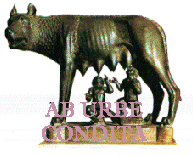
The story of country-men and thieves that before imposed their own control on the neighbours, and after gave themselves noble origins, the origins of the Gods indeed. But it's also the story of strong and holy grace men, of chiefs that believed in in Rome over all, that gave legitimation to the city's duty to lead the world under the Pax Romana.
From the Hellenic legends to the Romans.
Rome and her originsThe name of Rome seems to be originated from Rumon, etrurian denomination of the river Tiber, although the legend, like everybody knows, brings back to his founder Romolus. He settled on the Palatine hill where he dug the furrow of the square city, and killed the brother Remus who was the first to violate the rule that nobody had to cross that limit with warlike purposes; talking about the name of the river Tiber, there are traces of the origin of his denomination in the Aeneid of Virgil where he attested that it derived from the Thybris name, an ancient giant king lived in the Latium, and that his name in origin wasAlbula .
Rome was founded, according to the legend, on April 21th 753 b.C by Romolus, at the same time son of the God Mars and of the vestal Rea Silvia, a direct descendant of Ascanius, first king of Alba Longa and son of Enea (who had founded the city of Lavinio on his arrival in the Latium) and therefore, according to the epic of Omerus and Virgil, child of the goddess Venus and of the troian prince Anchise.
Rome and the legends of
fateAccording to an ancient legend when the equestrian statue of the Marc Aurelius, whose copy is situated in the center of square of the Capitol, it will return to be resplendent of gold, the "owl", ( the lock of the mane of the horse) will sing announcing the universal judgment. That of Marc Aurelius is the only horseman statue survived from the antiquity just because it was believed representing Costantine, the emperor that proclaimed the Christianity official religion of the Empire.
Rome and popular storiesDuring a procession proclamed by Pope Gregorius in 590 to beg God pardon for the epidemic that struck Rome in those years, when it was on the bridge of St.Angel's Castle, the archangel Gabriel was seen on the monument (just where nowdays the statue of bronze is set) while he sheathed his sword in sign of clemency with the citizen.
In the garden of Vittorio Emanuele' square there is the so-called "magic door" that it is affected with strange signs that seems correspond to a magic recipe for the manufacturinf of gold; the door was the one of the villa of the marquis of Palombara and it was there until 1680 when it came dispossessed to build the plaza.
On August 352 the pope Liberius dreamed the Lady that told him to found a church in her own honor where he had found the snow falling; the day after on top of Esquiline hill it snowed and the Pontiff decided to build the stately basilica of Santa Maria Maggiore. To commemorate that event once a year a function is celebrated and it is repeated the snowfall making a white flowers fall from the ceiling of the church.
The church of Quo Vadis was built on the point where Jesus' ghost and Peter met while he ran away from Rome to escape from the persecutions that Nero had ordered against the Christians. Christ appeared him and addressed telling "Quo Vadis?" (Where are you going ?). The imprints Christ left on the place is believed to be the ones in the near church of St. Sebastian, but in the church of Quo Vadis there's a copy.
 Questa pagina in italiano�
 Get your own Free Home Page
