 Rome and
its world supremacies
Rome and
its world supremacies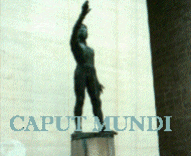
Once upon a time when horsemen ran on the roads of Europe, Asia and Africa to deliver messages and commands from Rome to the Empire's corners. But before losing this role, Rome took another one: be the center of Christianity; and today Pope's message reach the same old corners of the Earth. And often we can live here world events fitted for the ancient capital of the world, the CAPUT MUNDI.
We leave now for a journey to places where you can touch the universality of this city.
Rome and
its world supremaciesSt. Peter's basilica is the biggest Catholic church in the world; it measures 186 x 137 meters and has a height of 132 meters at the cross on the dome ( 42 meters of diameter for a height of 136.5 meters); it stretches on a surface of 25,616 squared meters. In the central aisle of the basilica there is a headstone on the floor remembering the length of the church of Saint Paul in London, which comes second in length after the Roman building.
The obelisk, that you can see everywhere in the big plazas of Rome, is an architectural element of beauty, and also it contains another function: pope Sisto V, in the XIV century, studied a road system that allowed the pilgrims to go from a church to one of the other six scheduled to visit to have the indulgence, following long rectilinear streets. Besides Sisto V set the obelisks in the squares to have a point of reference in the march. We could remember that in Rome there is the greatest concentration of obelisks in the world, included Egypt! The last obelisk arrived at Rome it was the one of Axum, proned by Mussolini from Ethiopia to set in front of the former Office for Italian Africa.
It’s commonly known that the State of the City of Vatican is the smallest in the world measuring only 44 hectares of surface; the number of residents is 402 inhabitants while the accredited ambassadors at the Holy Site are 120. Besides the composed nucleus of the citadel, it’s considered property of the Vatican State other buildings such as the Laterano palace, the one of the Chancellery, of the Dataria, of Propaganda Fides, of the Sant’Uffizio, of the Convertendi, of the Vicariato, little palace of Cybo, the four patriarchal basilicas of Rome, Villas Glori and Barberini and the summer residence of Castel Gandolfo.
The Capitolini’s museums are the most ancient public harvest of work of art in the world; it was founded in 1471 by Sisto IV that gave them to the Rome Municipality. Rome has also the world supremacy of the greatest number of museums with 85, 3942 archaeological goods and 300 churches of monumental and historical value.
Rome, center of the ChristianityIn the building of the Santa Sanctorum, close to St.John in Laterano, rises the Scala Santa, in other words the stairway of the palace of Ponzio Pilato in Jerusalem, where Jesus was carried to his presence. A writing warns that there is not a holiest place in the world. The Scala Santa is stepped by knees from the believers.
The first door from left of the St. Peter's basilica, is the famous holy door that is always closed but for the duration of the jubilee years. Those ordinary happens every 25 years and the first had proclaimed in 1300. Last one in 2000, with the door closed on 6th January 2001.
Together St. Peter’s square and the Basilica, have a precise meaning: the dome, that overhangs the plaza, is the papal hat, symbol of the Church, that embraces, with the colonnade, the immense courtyard, the humanity. To realise how enormous is the construction you think that the letters that compose the writing "TU ES PETRUS" (You are Peter) on the façade of the basilica, are tall two meters and half.
In Saint Paul outside the walls’s basilica there are represented the complete sequence of the popes from Peter to John Paul II, on medallions of about two meters of diameter, in the transect of the central aisle and in those of the sides. It started St. Leone Magno in 498 with frescos after replaced with mosaics. In the course of the millennia popes were 264 of whom 81 saints and 7 blessed. The longest pontificate was the one of Pious IX (32 years), the shortest of Stephen II lasted one very day in 752. The eldest chosen pontiff was Adrian (80) while the youngest was chosen at 12 in the 1032 (Benedict the Ninth). In the classification of the first names or varied ones that popes are chosen (beginning since 533 with John II), John wins with 23 times; second comes from Gregory (16) and Benedict (15).
Rome, the capital city of ItalyWith the construction of the Altare della Patria, built to commemorate 50 years since the birth of the nation, they wanted to symbolize the characters of the new country with its elements: the equestrian statue of Vittorio Emanuele II, with the rapresentations of the cities that contributed to the unification, on his plinth; we have then, at the peak of the stairway, the statue of Rome and to its left the allegory of the "triumphant love for ours own country" and to its right the "triumph of the work"; the fountains to the sides of the stairway represent the Adriatic Sea and the Tirrenian Sea, while above these there are the statues of Law, of Sacrifice, of Harmony and of Strength; there are twenty statues to symbolize the italian regions while the two chariots on the top of the building are Freedom and Unity.
When on the little bell cellar of the Quirinale palace, built in 1723 by the pope Innocenzo XIII when the palace was the pontifical center, the Italian tricolor flag waves in the air, it means that the president of the Republic is presently in Italy, while his presence in the palace is signalled by the blue flag.
In the center of Rome there are almost all the palaces of the government and of international institutions. Particularly via Nazionale and via XX Settembre gathers many of these centers of the power: the embassy of United Kingdom, the Department of the Treasury, the one of the Defense and of the Internal, the palace of Quirinale home of the President of Republic, the palace of Consulta and the Bank of Italy.
Rome,curiosities
known around the worldThe capital term finds his origins from the name of Capitol (in Latin Capitolinum), the sacred hill to the ancient Romans. It had two tops: the Arx and the Capitolium in narrow sense; between the two reliefs there was a saddle Asylum call and that it had leveled with the varied constructions, last of which the square of Michelangelo.
The most famous tradition of Rome and maybe known in all the world, is the one about tossing a little coin with your shoulders backward the fountain of Trevi so that one can propitiate the return in future in the eternal city.
 Questa pagina in italiano
 Get your own Free Home Page
