I
did a large amount of research for
swapping in a V-8, spending months reading over piles of catalogs, old
magazines, and CJ manuals. I carefully studied everything because I had
a super low budget, and I couldn't afford to make any mistakes. I ended
up relying primarily on two sources, Advance
Adapters,
and Novak
Adapters. Advance
Adapters has extremely helpful catalogs, although some of the details
are really buried in there. Of course, the catalogs were from 1991,
(when I did this swap), maybe the catalogs are better now. Novaks
catalog was a bit more sparse, but still helpful. The old Mr
Novak was very helpful in answering my questions then too. I
think he passed away recently, but the company lives on.
Ultimately, I decided to go with a Ford 302. This seemed the best low buck approach for these reasons:
The first job was to find a motor. To swap a small block ford into a CJ, you need to use an oil pan/oil pickup from an early bronco. Any SB Ford will do, but you still need to get the proper oil pan combo. I was extremely lucky to find a 1970 Bronco 302, complete from the carb to the flywheel for 200 bucks!!. I picked up the engine in the Scrambler, and it wasn't too happy carting around the engine for a week while I tried to find a cherry picker to get it off. I finally got one to borrow, and started by pulling the 258. (I ended up keeping the 258 on a dolly for 7 years, it ended up in my current CJ-7) My hands were dirty finally! After countless trips to many boneyards, I found a bellhousing, Duraspark II distributor (to upgrade from the existing points on the Ford), clutch linkage parts, and lots of doo dads.
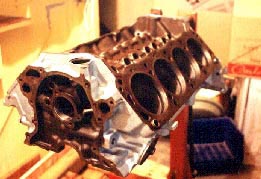
I decided to re-ring the motor with a kit from Summit Racing. This would get me all new bearings and rings, plus re-seal the whole thing. Since I was super low budget, the only thing I bought was the re-ring kit, and a hot-tank job at a motor shop. The cylinder walls were quite tapered at TDC. Even so, all I could afford to do was ridge ream it and hone the bores (myself). I did take great care with the rebuild, and even managed to port the heads a bit, but that is a nasty job, so all I really did was grind off the EGR bumps inside the exhaust ports. They were cast in there even though they weren't used on the 1970 engine.
First of all, to bolt the T-176 Jeep trans to the Ford, you must trim the tranny input shaft by about 3/8ths of an inch. Otherwise, the tranny input shaft will bottom out inside the ford crank. I trimmed the shaft with a 4 inch angle grinder. There is plenty of tip length to do this. Chamfer the tip so it'll slip in nicely to the pilot bearing. Now, you need a custom bushing in order to use a stock jeep pilot bearing in the Ford crank. I bought one from Novak, but the darn thing was loose in the ford crank. So, I had the original ford pilot bearing bored out to accept the smaller jeep bearing. The new composite bearing was tapped into place, and it worked fine.
The tricky thing about a jeep trans to a Ford engine is that the Jeep trans input shaft requires a General Motors spline size clutch disc. A Ford clutch disc won't work. So, I bought an 11 inch GM disc, and tried to see if it would fit between the Ford pressure plate and flywheel. It fit okay on the pressure plate side, but not on the flywheel side. (I used the original stock pressure plate that came with the Ford engine, the 3 finger style) The hub of the GM disc interfered with the inside lip of the flywheel surface. It would need machining to remove a very small amount of material to provide clearance. I was very lucky that my brother worked at a foundry, so he was able to have a machinist mount the flywheel in a huge lathe and perform the mod in a few minutes. I imagine this wouldn't be too expensive if you had pay someone though, would it? So the rest was easy, the throwout bearing is the same for jeep and ford, I used the Ford throwout arm, and it all bolted up fine.
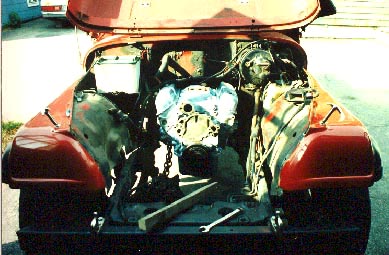
I was lucky enough to have access to a small machine shop at work to fabricate power steering pump brackets, alternator brackets, and clutch linkage brackets. I tried to find a SB Ford waterpump which exited on the same side as the 258, but never found one. So, since I was nearly out of money, I made a funky hose/tube combo which brought the radiator outlet over to the passenger side to the water pump. Even though it lasted for a year, I was always afraid of it blowing out, so I eventually purchased a "GM" engine conversion radiator from MEPCO. This has the lower outlet on the passenger side.
All the catalogs said I would HAVE to get custom headers, but I found that a stock passenger side exhaust manifold from an early 70's Ford van worked awesome. Lots of different stock styles work on the driver side. I regret not getting dual exhaust, but money was ever tight. Over the course of 5 weeks, I performed the swap. How good it felt to fire up the engine for the first time with no exhaust! I did get a custom exhaust made at a Meineke Muffler shop. The truck burned some oil for a couple of weeks, but then the rings seated, and the truck ran exceptionally. Power was vastly improved, although it still wasn't entirely zippy with those 2.73 axle gears.
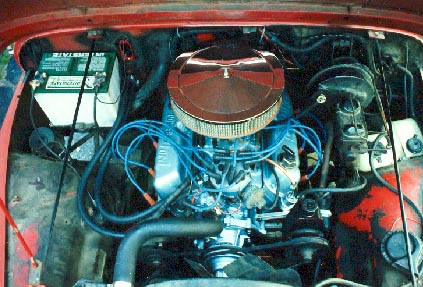
Pic of engine. It's painted with Pontiac metallic blue! I happened to have some cans left over from my Goat! By the way, it passed smog with flying colors with only a catalyst.
A hybrid motor swap is not for the faint of heart. I did the job in a tiny garage I rented for 25 bucks a month. But, I did EVERYTHING myself with just the bare minimum of basic tools. I only needed to farm out two jobs: One being the exhaust system, and the other the flywheel machining. I ended up very close to the 1000 dollars, amazing when I think about it. No way it could be done for that money now.