Festivals of Nepal
Tihar
The
festival of lights, the veneration of Lakshmi, Goddess of wealth, a
festival in homage to certain animals. In addition to all this, the
Newar community celebrates the beginning of their own New Year ! (No
wonder that Tihar has a series of other names such as Diwali, Lakshmi
Puja, Yama Panchak etc..). This festival extends for five consecutive
days.
There
are too many legends connected with Goddess Lakshmi, with the God of
the realm of the dead, Yama, with the various animals that are going
to be honored, lastly with the lights dominating everything. It is
impossible to mention them all. Here, three of the most popular ones:
1) It
is a legend linked with Lakshmi: Every night, during Tihar, she is
supposed to circle around the earth riding her mount, an owl (it sees
in darkness!) to make certain that every human being at least in Nepal
has cleaned his house and lighted wicks or lamps in streets and on
doorsteps, for she is very fond of lights. Those who took this at
heart may count on Lakshmi's favours and protection, their prosperity
is granted for the whole year.
2) Once
upon a time, there was a wealthy and powerful king. His daughter
always insisted that she was, indeed, a "princess who had
everything she desired" and that this was her proper destiny and
not because of her father's fortune or merits. This
"bragging" made the king, her father, very angry. Then and
there, he decided to marry her to one of the poorest hermit he knew,
one who had retired in a miserable hovel hidden in a dense forest.
On a
certain morning, before performing his daily ablutions, the king put
on the ground his diamond-studded necklace. A hawk spotted the
glittering jewel, plunged, took the necklace in its beak, and flew
off. While cruising over the forest, the hawk saw a dead snake lying
near a hut. The bird dropped the necklace and picked up the snake
which appealed more to the bird's appetite. Of course, that small hut
belonged to the hermit and his wife, the princess who recognized at
once her father's necklace.
Days
passed. Meantime, the king had promised an important reward to anyone
who would bring back the string of diamonds. Hearing this, the
princess asked her husband to return the necklace to her father,
refuse any reward but ask for the following "very modest
favor": the king should order that not a single light should burn
not even twinkle inside or outside the Palace, and the village too
should remain in complete darkness during the next five days (which
was to be Tihar). The hermit-husband went and complied. The king
granted the request without thinking any further. On Tihar's first
night, Lakshmi flew over the whole area and surprised, angry even,
that not a single light was glittering in her honor. Only a tiny glow
flickered through the trees somewhere in a forest. There she landed,
spotted a shack decorated by well-kept flower beds. She entered the
hut and found the princess asleep, surrounded by many shimmering oil
lamps. She also found a plate containing many sweet offerings
obviously prepared for her, Lakshmi.
The
goddess, moved by the princess' devotion promised herself that she
would not forget. And as years passed, the hermit became wealthier
while the king first lost his fortune and, later, his throne.
3) The
third legend links Lakshmi with Yama, the king of the realm of the
deceased.
Again,
there is a king in the center of the story: Astrologers predicted him
that, on a given though undetermined night, a snake would kill him.
The only way to escape, they added, was to place as many lights as
possible between the palace's entrance-door and his bedroom to entice
Lakshmi to enter and protect him. The king followed their advice. On
Tihar night, the snake sneaked into the building. The Queen wished it
welcome and gave it food and drink. Of course, this snake was no-one
else but Lakshmi herself. She agreed to intercede with Yama on the
King's behalf and plead for a longer life for him. Yama consulted his
"big ledger" found the King's name accompanied, in the last
column, by the figure "O" which meant that the King was to
die that very day. Lakshmi succeeded in distracting Yama's attention
for a second, which made it possible for her to quickly add a
"7" in front of the "O". She even managed to
persuade Yama that he had been mistaken when he had first looked at
the inscription. Thus, the good King gained 70 more years of life. In
homage to this event, so the legend says, it was this sovereign who
ordered everybody to put as many lights as possible everywhere during
the whole time of the ''Lakshmi Puja" - Tihar festival.
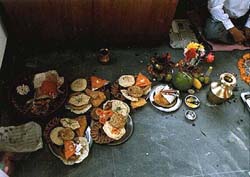
1st
day: This day is called "Kag Tihar" and is dedicated to the
crows. Rice grains are spread in the streets for them. Crows are
believed to be Yama's (the god of the dead) messengers. Therefore,
they must be honored and appeased.
2nd day
This day is called "Kukur Tihar", dedicated to the dogs.
Whether a watchdog or a pet, all dogs will be garlanded on this day by
their master or servants. Naturally, the dog's dinner has to be a very
special one with meat and bones. One of the reasons for honoring the
dogs is because it is considered as the most faithful companion of men
and the most trustworthy guardian of the house.
The
third day is dedicated to Lakshmi, Goddess of wealth. Businessmen,
merchants and shopkeepers open new account-books, clean and decorate
with flowers and garlands images of Lakshmi placed on their safes,
cash-boxes and counters.
In
order to invite the Goddess to pay a "profitable visit" to
each house, lights are placed at the doorsteps of each building, and
they lead to the "puja-room" the house sanctuary where all
private offerings and "pujas" are performed. In the evening,
the whole city is brightly decorated with thousands of lights.
Since
Lakshmi is supposed to dispense wealth to all, the evening of this
third day will be spent gambling. The whole night through groups of
players throw cowrie shells on the gambling rug, betting on which side
how many will fall. This popular game has very complex rules.
4th
day: Now it is the turn for the cows to be honored and decorated with
garlands. Their horns are painted, sometimes one in silver, the other
in gold. This homage is paid to them in the early hours of the morning
and, of course, it emphasizes the sacred character of this most
precious animal.
There
are many explanations for this essentially Hindu concept of the cow's
sacredness. Certain scholars date it back to over 2000 years BC when
the Aryans from Afghanistan and Persia migrated towards India and
therefore had to cross the arid desert of the northern part of the
Indian sub-continent. During the migration, so it is said, it was
imperative that cows should not be slaughtered since the babies
depended almost entirely on their milk for survival: Thus, the priests
"deified" the cows in order to save the newly born from
starvation.
Such a
procedure which consists in integrating into religious precepts a
simple necessity of either hygienic, economical or social nature has
often used by more than one religious leader.
The
same scholars add, as an additional "proof", the fact that
buffaloes (which, after all, are close relatives to cows) are not
"sacred" for the pragmatic reason that buffalo milk is not
easily digested by young babies. Very convincing, as long as they omit
to say that buffaloes are living in tropical and humid climates and
therefore were completely unknown to the wandering Aryans whose land
is mostly arid and barren. However, the explanation may anyhow hold
water ...
5th
day: Oxen and bullocks are honored. Although not regarded as sacred,
these animals are nevertheless invaluable helpers to all farmers,
whether they pull the plough - if the terraces are wide enough ! - or
drag along carts and carriages.
To the
Newar community, the fourth day marks the beginning of their New Year.
In Newari, this day is called "mha puja" which, literally
means "the day of self-worshipping" based on the belief that
every living being is of a divine nature and thanks must be given to
the God of Death for allowing life to exist ! Another connotation is
that "mha puja" brings about self-realization in the heart
of the devotee.
A more
materialistic feature is that Newar businessmen and merchants
"close" their accounts and open new ledgers.
6th
day: The last day of Tihar is "Bhai Tihar", the
"brother-sister-day" Every man's duty is to call on his
sister and adopted one if needed. Vice-versa, sisters pay homage to
their brothers, garlanding them, scattering petals on their head and,
above all, putting an especially prepared "tika" on their
forehead, one that spreads from the brows to the hairline. At the same
time, she will bind the luck-bringing yellow cotton thread around the
brother's left wrist.
Later,
she will serve sweets, walnuts, fruits and savory dishes.
The
legend that gave birth to this brother-sister rite is told in many
different ways. The basic elements of the story are the following:
"Yama, the God of Death, was impatiently waiting to take away the
soul of a young man seriously ill. The boy's sister begged Yama to
wait until she would have finished her "puja". This meant
for Yama to wait until the cut flowers the sister had presented her
brother would bear fruit or, according to another version, until a
walnut got saturated with water or even until a drop of oil would
evaporate etc... Whatever the condition was, it never materialized of
course and the boy was saved from an early death.
Whatever
in the Tihar festival is linked with Death or Yama is based on the
belief that every year, during these five days, Yama takes a rest in
his sister, Yamuna's house. Hence the name "Yama Panchak" (Yama's
five days) which is popularly given to Tihar.
<<
Back to main page