About Nepal
Brief Information About
Nepal
Nepal
is small land-locked country of high Himalayan mountains, artistic
monuments, exotic wildlife and with different cultures and languages.
Nepal is situated between between China in North and India in South. It
is a birth place of Lord Buddha (more than 2500 years ago). Here lies
eight of ten highest mountains in world.
Area:
It occupies 145,391 square kilometer (i.e. 56,139 square mile). It
stretches 885 kilometers (i.e. 553 miles) from east to west and averages
160 kilometers (i.e. 100 miles) from north to south. Nepal is mountainous
country. 14% of the land is cultivated, 13% is pasture, 32 % is forested
rest are all mountains.
Climate:
Even being a small country of the world it has variety of climatic
conditions ranging from tropical heat of the Terai plain to the freezing
cold of the high mountains. Temperature of Terai plain ranges between 8 degree
Celsius to 37 degree Celsius, Kathmandu Valley ranges between 2 degree Celsius
to 28 degree Celsius and in the Mountainous region it ranges between -6
degree Celsius to 16 degree Celsius.
Population:
Population of Nepal is about 20 million growing at the rate of 2.7%
annually. 50% of total population are under age of 21.
Capital:
Capital of Nepal is Kathmandu. Here resides the palace of His Majesty
King in Narayahiti. Population of Kathmandu Valley (that includes three
districts namely Kathmandu, Lalitpur and Bhaktapur) is about one
million.
Peoples:
There are many groups of people leaving in Nepal. They have their own
sociey, culture and language. The group includes Gurung, Limbu, Magar,
Newar, Rai, Sherpa, Tamang, Tharu. Major castes groups are the Brahmans
and Chhetris. There are also some Indians and Tibetans over here.
Languages:
Common language spoken in Nepal is Nepali. It is also considered as
national language and used in Government offices with Devanagari script.
This is a language spoken by different groups of people for
communicating each other. 58% of total population speaks Nepali, 3%
speaks Newari, 19% Tibetan mainly in hilly region. 20% speaks Indian
mainly in Terai region. Nepal has over 30 languages. English and Hindi
are widely understood in the urban centers and areas.
Religion:
Main religion are Hinduism and Buddhism. There are few Islamic and Christians.
Hinduism and Buddhism are somewhat overlap.
Highest
Point: The highest point of Nepal is highest point of the world. Mt.
Everest also known as Sagarmatha and Chomolangmu the highest point is
8848 meters (i.e. 29,028 feet).
Currency:
The Currency of Nepal is Rupees at this time it is nearly equivalent to
1/68th part of US Dollar.
Kathmandu
City
Some
sight-seeing places in Valley
Kathmandu is capital of Nepal. The name of Kathmandu is derived from
Kasthmandap, an imposing Pagoda near Durbar Square. This city was built
by king Gunakama Dev in 723 A.D. Kathmandu abounds in large places,
beautiful and delicately produced temples, lofty Buddhist pagoda as well
as museums and other lot of beautiful places. Some of them are
Durbar
Square: This is
the historic places of the ancient kings of Nepal. A complex of many
temples and monuments, built between the 12th-18th centuries. An
intriguing piece here is the 17th century stone inscription set into the
wall of the palace with writings in 15 languages. Other interesting
things to see are: statue of the Monkey God Hanuman, Basantpur Durbar,
Statue of King Pratap Malla, The Big Bell, Kal Bhairav, Sweta Bhairav,
Taleju Temple, etc. There are also two museums inside the palace
building.
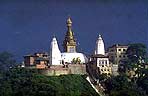 Swayambhu
Nath Stupa: This
is said to be 2000 years old and is one of the world's oldest Buddhist
chaityas, The stupa which is forms the main structure is composed of a
solid hemisphere of brick and earth supporting a cornice of copper and
gilt. Painted on the four sided base of the spire are the all seeing
eyes of lord Buddha. It is two miles west of Kathmandu city situated on
a hillock it is about 250 feet high above the level of the valley.
Swayambhu
Nath Stupa: This
is said to be 2000 years old and is one of the world's oldest Buddhist
chaityas, The stupa which is forms the main structure is composed of a
solid hemisphere of brick and earth supporting a cornice of copper and
gilt. Painted on the four sided base of the spire are the all seeing
eyes of lord Buddha. It is two miles west of Kathmandu city situated on
a hillock it is about 250 feet high above the level of the valley.
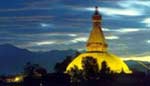 Bauddha
Nath Stupa: This
is one of the largest stupas in the world. Four pairs of eyes of Buddha
in four cardinal directions, are keeping and internal watch over the
people and their doings.
Bauddha
Nath Stupa: This
is one of the largest stupas in the world. Four pairs of eyes of Buddha
in four cardinal directions, are keeping and internal watch over the
people and their doings.
Budhanilkantha:
Is situated below Shivapuri hill at the northern end of the Kathmandu
Valley. The hub of the temple complex is a pond in which lies a great
stone figure of the Hindu God Vishnu. This is the stone image of
sleeping Vishnu on a bed of snakes. This is an excellent and stately
example of the art of stone sculpture of Nepal.
Pashupatinath
Temple: One of
the most sacred Hindu shrines in the world, Pashupatinath lies five Km.
east of the city. The temple of Pashupatinath with two-tier golden roof
and silver doors is famous all over the world for its superb
architecture. Entrance into the temple precincts is restricted to Hindus
only.
Kasthamandap:
The wooden, temple known as Kasthamandap was built in the beginning of
the 17th century. It is made of the timber sawed off a single tree.
Residence
of the living Goddess:
Near the Durbar Square is the residence of Kumari, The Living Goddess it
was built in 1760. Its wooden balconies and windows are profusely
carved.
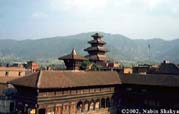 Bhaktapur
City
Bhaktapur
City
Bhaktapur, literally the "City of Devotees", is renowned for
its elegant art, fabulous culture and the typical Newar lifestyle. The
ancient city, Bhaktapur, spreading over an area of 6.88 square
kilometers and situated at 14 Km. east of Kathmandu, was founded in the
12th century by King Anand Dev Malla.
Durbar
Square: The main square of the city contains innumerable temples and
other architectural showpieces like: the Lion Gate, a Statue of King
Bhupatindra Malla, a Picture Gallery, the Golden Gate, the palace of 55
Windows, the Batsala Temple, the Bell of barking Dogs, etc.
Nyatapola
Temple: This five storied pagoda was built in 1702 A.D. by King
Bhupatindra Malla. It stands on a five story terraced platform. On each
of the terraces there is squat pairs of figures; two famous wrestlers,
two elephants, two lions, two griffins, and Baghini and Singhini, the
tiger and the lion goddesses. Each pair of figures is considered ten
times stronger than the ones immediately below, while the lowest pair,
the two strong men, Jaya Malla and Fatteh Malla, were reputedly ten
times stronger than any other men. This is one of the tallest pagodas
and is famous for its massive structure and subtle workmanship. The
temple was built for Goddess Laxmi.
Bhairavnath
Temple: This temple was first built as a one-story pagoda during the
reign of King Jagat Jyoti Malla, and later changed into a three storied
temple in 1718 A.D. by King Bhupatindra Malla. The temple is noted for
its artistic grandeur, It is dedicated to Lord Bhairav, the god of
Terror.
Dattatreya
Temple: This temple is said to have been built from the trunk of a
single tree. It was built in 1427 A.D. during the reign of King Yakchhya
Malla and was repaired in 1458 A.D. by King Bishwa Malla.
Surya
Binayak: This is a shrine of Ganesh, the elephant-headed God, situated
in the beautiful surroundings of Bhadgaon, placed in a sylvan setting to
catch the first rays of the rising sun. The view of the city of
Bhaktapur is seen from here with snow-capped peaks in the background.
Nestled in a thick forest, it is a good picnic spot flanked by many
attractive landscapes.
Changu
Narayan: Located at the end of a long ridge, which runs well into the
Valley, this temple is said to have been build in 323 A.D. by King Hari
Dutta Verma. The temple is richly decorated with sculptures and
carvings. It is said to be the oldest temple in the Valley. Situated
about 153 meters above the level of Kathmandu Valley, it affords a
beautiful view of the surrounding countryside.
Nagarkot:
Nagarkot is a popular tourist resort. It is located 32 kilometers east
of Kathmandu at an altitude of 2175 meters above sea-level. A panorama
of the major peaks of the eastern Nepal Himalayas, including Mt.
Everest, can be seen from here. Himalayan peaks like Manaslu(8463),
Ganesh Himal (7111), Gaurishanker (7134) etc. are also clearly seen from
Nagarkot. A motorable road links Nagarkot with Bhaktapur.
Patan
City: The
ancient city of Patan is situated on the southern bank of the river
Bagmati and is about five kilometers southeast of Kathmandu. The city is
full of Hindu temples and Buddhist monuments with bronze gateways,
guardian deities and wonderful carvings. Noted for its craftsmen and
metal workers, it is known as the city of artists. The major visitor
attractions of Patan are described below.
Durbar
Square: Patan Durbar Square, situated in the heart of the city, is the
main tourist attraction. The square is full of ancient palaces, temples,
and shrines noted for their exquisite carvings. One can rummage for
treasures and souvenirs in the various shops around the square. The main
attraction of Patan Durbar Square is the ancient Royal Palace itself. It
consists of three main chowks, or courtyards; the central Mul Chowk,
Sudari Chowk and Main Keshab Narayan Chowk. In the northeastern corner
of the courtyard is a triple- roofed octagonal tower, Taleju Bhawani
Temple, built by King Shree Niwas Malla in 1667.
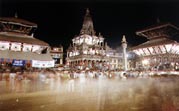 Krishna
Mandir: Built in the seventeenth century by King Siddhi Narsingh Malla,
the temple of Lord Krishna holds a commanding position in the palace
complex of Patan. It is the only temple in Nepal to have 21 shrines and
is completely made of stone. Most of the important scenes from the
ancient Hindu epics the Ramayana and the Mahabharata, have been engraved
on its friezes.
Krishna
Mandir: Built in the seventeenth century by King Siddhi Narsingh Malla,
the temple of Lord Krishna holds a commanding position in the palace
complex of Patan. It is the only temple in Nepal to have 21 shrines and
is completely made of stone. Most of the important scenes from the
ancient Hindu epics the Ramayana and the Mahabharata, have been engraved
on its friezes.
Mahabouddha:
A little further from Patan Durbar Square lies this Buddhist temple made
of clay bricks in which thousands of images of the Lord Buddha and
engraved. The Terracotta structure is a fourteenth-century Nepalese
architectural masterpiece. It was constructed by an architect named Avay
Raj.
Hirnya
Varna Mahavihar: This three-story golden pagoda of Lokeshwor (Lord
Buddha) was built in the twelfth century by King Bhaskar Verma. It is
located in the courtyard of Kwabahal. Inside the upper story of the
pagoda, placed on a pedestal, are golden images of Lord Buddha and a
large prayer wheel. There are a wealth of gem-like carvings on its walls
and a complete life history of Buddha in gold relief.
Kumbeshor:
Kumbeshwor temple in Patan and Nyatapol temple in Bhaktapur are the only
five- storied temples in the Valley, with the exception of the round
five-tiered Pancha Mukhi Hanuman of Kathmandu's Hanuman Dhoka Palace.
This temple of Lord Shiva was expanded during the reign of King
Jayasthiti Malla but originally constructed in 1392. A fair is held here
on the Janai Purnima day in August.
The
Ashokan Stupas: There are four ancient stupas, popularly believed to
have been built in 250 B.C. by Emperor Ashoka, at the four corners of
Patan. The four stupas are located in Pulchowk, Lagankhel, Ebahi (way to
Shankhamul), and in Teat (way to sano Gaon) respectively. These stupas
give evidence to the city's ancient religious importance.
Accheshwor
Mahavihar: This temple was established towards the beginning of the
seventeenth century by Accheshwor who built a temple to house and idol
of Lord Buddha. The Mahavihar has recently been reconstructed. It has 30
rooms including a monastery, "Dhyankuti" research are,
training areas, library, review rooms, and guest rooms. Situated behind
the Ashokan Stupa at Pulchowk, the Mahavihar commands a beautiful view
of the Kathmandu Valley.
Temples
of Machhendra nath and Min nath: The pagoda of Red Machchendra Nath,
also known as Avalokiteshwor and Adinath Lokeshwor, is housed here for
six months each year. For the remaining six months, the idol is taken to
its shrine in Bungmati. The temple of Min Nath is situated in Tentgal,
on the way to Tabahal. The temple of Min Nath is thought to be older
that the temple of Red Machchendra Nath.