Festivals of Nepal
Teej- The
festival of women honoring their husbands.
1.
Although he knew of his daughter's love for Lord Shiva, Parvati's
father had taken the decision
to give her in marriage to Vishnu !
On the
eve of the wedding ceremony, Parvati implored her friends and her maid
servants to help her escaping from her father's palace. They succeeded
and took her away to a deep forest where she hoped to meet her beloved
Shiva.
 From
his abode on Mount Meru (also called Kailash), Shiva had watched her
adventure and knew of her motivation. Now he saw her praying to him
and imposing many penances. Shiva's heart was sincerely moved but
still, he wanted to submit her to a final "test": he took
the shape and appearance of Vishnu. Then, approaching Parvati still
hiding in the forest, flattered her with compliments while, at the
same time, vilifying Shiva ! In spite of all the bad things she heard
about her beloved, Parvati reaffirmed again and again her
determination to marry Shiva and no one else. Shiva then abandoned his
disguise and agreed to marry Parvati, having now obtained her father's
consent.
From
his abode on Mount Meru (also called Kailash), Shiva had watched her
adventure and knew of her motivation. Now he saw her praying to him
and imposing many penances. Shiva's heart was sincerely moved but
still, he wanted to submit her to a final "test": he took
the shape and appearance of Vishnu. Then, approaching Parvati still
hiding in the forest, flattered her with compliments while, at the
same time, vilifying Shiva ! In spite of all the bad things she heard
about her beloved, Parvati reaffirmed again and again her
determination to marry Shiva and no one else. Shiva then abandoned his
disguise and agreed to marry Parvati, having now obtained her father's
consent.
Thus, TEEJ commemorates the love of women for their husbands as well
as it celebrates solidarity among women.
 2.
Shiva had lost his first wife (whose name is not mentioned anywhere !)
His sadness made him neglect his duties, one of which was to ensure
that Good always prevails over Evil. For a very long time, he spent
days and nights in complete prostration praying and meditating. The
gods, touched by so much devotion, decided to give "new
life" to his wife. thus, beautiful Parvati was born. But Shiva
hardly threw a glance towards her and remained unmoved whereas Parvati
fell more and more in love with Shiva. As a last resort, she decided
to fast until death would come.
2.
Shiva had lost his first wife (whose name is not mentioned anywhere !)
His sadness made him neglect his duties, one of which was to ensure
that Good always prevails over Evil. For a very long time, he spent
days and nights in complete prostration praying and meditating. The
gods, touched by so much devotion, decided to give "new
life" to his wife. thus, beautiful Parvati was born. But Shiva
hardly threw a glance towards her and remained unmoved whereas Parvati
fell more and more in love with Shiva. As a last resort, she decided
to fast until death would come.
Then only, Shiva took pity on her and proposed marriage !
What
happens: The festivities start with an especially elaborate, fine and
convivial meal, (usually a rich mutton and chicken curry.) It is meant
to enable the women to endure more easily the ensuing compulsory 24
hours' fasting. On this occasion, the husband has no right to grumble
against his wife's expenses related to this repast.
In the
afternoon, a lively exchange of visits takes place.
From then on, women stay together, chatting and feasting until
midnight, the hour when the TEEJ fast is deemed to start. Not the
tiniest crumb of food nor the smallest drop of drink should be
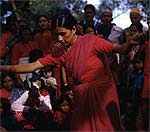
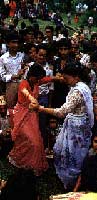
absorbed. Custom rules that women have to proceed towards
Pashupatinath, dressed in their red and golden saris (usually the ones
they wore on their wedding-day). Walking arms in arms or holding
hands, singing and dancing, they cover any distance in order to reach,
before sunrise, the sacred bathing place along the banks of the
Bagmati. Should some of the women have to stay inside their house,
they would also abstain from any menial domestic work.
Once at
Pashupatinath, they change saris and take one or several baths.
However it is "taboo" for them to touch the Shiva lingams
displayed around the famous temple and on the surrounding hills. They
must be satisfied by throwing flower petals or rice grains on Shiva's
masculine symbol.
After
having taken their ritual dips, many women will visit one after the
other the 108 chaityas (108 is a very sacred number both for Hindus
and Buddhists !) erected in the Pashupatinath area. This
circumambulation is said to ensure good health and long life to
husbands.
One
more procession has to be performed on Teej: at Teku, the confluence
point of Bagmati and Vishnumati, where ablutions have also to be made
before proceeding onto the other bank of the stream, climbing up the
steep hillock to pay homage to Goddess Bijeswari, at the temple
dedicated to this goddess and which is exclusively reserved to women
worship.
<<
Back to main page