Festivals of Nepal
Indra
Jatra
Homage
to Indra, the "King of the abode of the Gods" Dedication
to Bhairav , the terrifying representation of Shiva and protector of
Kathmandu. Homage
to the deceased and to Dagini, Indra's mother. Consecration
of the Royal Kumari for another year. Commemoration of Kathmandu's
conquest by Prithvi Narayan the Great in 1768 A very complex festival
indeed !
Once
upon a time, Dagini, Indra's mother was unable to pick a certain white
flower called "Parijat" she needed to perform a given puja.
So she requested her son to fetch some on earth, below, where there
were plenty. Indra disguised himself as an ordinary farmer, wrapped
himself in a cloud and landed on Earth. He found the flowers but he
was caught "red-handed" by the owner of the meadow. He was
put in fetters and kept as a prisoner in a certain house in Kathmandu.
Dagini, anxious not to see her son return to heaven, went down herself
to Earth and made herself known to the people she met. Now that it
became dear that Indra was their prisoner, he was immediately
released. And as a token of gratitude, Dagini promised to spread
enough dew over the Valley during the winter-months to ensure a rich
crop. The other promise she made was to take to heaven all those who
had passed away that same year.
The
legend explains, at least in part, the various stages of the festival:
exuberant rejoicing for having succeeded in capturing nonless than the
"King of the Gods", homage paid to Dagini and the deceased.
 Referring
to the Living Goddess, "Kumari".
Referring
to the Living Goddess, "Kumari".
Jaya Prakash Malla, the last King of Kathmandu (1736-1768) loved to
play dice with Goddess Taleju. One day, fascinated by the Goddess'
beauty, the King was about to forget she was not an ordinary human
being. Taleju immediately rushed away from him, swearing that she
would never take again a human shape when and where the king could see
her. But during the same night, she appeared to the King in a dream,
warned him that his dynasty was nearing its end, adding that she would
forget his insult and avert the threat to his throne if he would find
a Newari girl in whom she, Taleju, would incarnate herself.
Furthermore, she made the King promise to build a splendid Palace
where this girl - herself in fact - would henceforth live. Finally,
once a year, the King should personally pay homage to her. Jaya
Prakash Malla agreed on all points. Nevertheless, Taleju's prediction
proved true since it was precisely during the very festival of Indra
Jatra, on Sept. 25th, 1786 that Prithvi Narayan Shah conquered
Kathmandu and compelled Jaya Prakash to abandon his throne, thus
putting an end to the Malla dynasty that had reigned over the Valley
for more than five centuries.
What
happens: On the eighth day of the clear fortnight of Bhadra, a huge
tree is carried from Tundikhel, Kathmandu's parade-ground, to Hanuman
Dhoka square, close to the old Royal Palace.
This
tree has not been selected at random: One year before the beginning of
the festival, it stood in a specific forest, miles away. A sacred goat
was let loose there and the on lookers watched against which tree this
goat would rub its flank. Thus, the tree was identified felled and
carried away. The goat was sacrificed at once as an offering to Indra.
Once the tree reached Hanuman Dhoka, another goat, sometimes a
rooster, would be sacrificed and the blood poured in the hole prepared
to receive the thick end of the post.
Now,
while it is still lying on the pavement, devotees prostrate themselves
and touch the wood with their forehead. This
marks the beginning of the festival. Images of Indra, carved in wood,
copper or brass, even crudely painted on paper, are displayed
everywhere. He is always represented with threads and strings - symbol
of being a prisoner. At the foot of the pole, a priest places a box
containing a small gold statue of an elephant, Indra's mount.
At the
precise moment determined by astrologers, men start hoisting the pole
- which in essence, symbolizes too a Shiva's lingam.
Once
the post is set up, roosters and goats are sacrificed, while the crowd
shouts "Indra with us", a petition for a prosperous year.
Simultaneously,
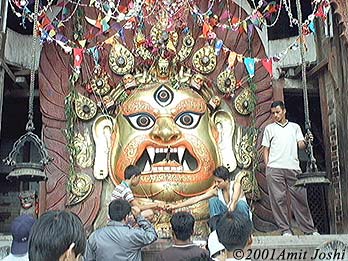
Bhairav, one of the Valley's patron-deity comes to sight. The wooden
lattice screen that concealed his huge mask during the whole year, is
suddenly thrown open Urchins climb up to his golden face while men and
women throw rice-grains and flower-petals 7'' at him. A wooden duct
sticks out of its half-open mouth and held by its protruding fangs.
On the
eve of the festival, three golden chariots stand ready along the
northern side of Basantpur Square, close to the Living Goddess' house.
On
Indra's first day, at around 11 am, women and children start taking
place - assaulting would be the better word - on the steps of all
surrounding temples. The sight of this extraordinary colorful
gathering that makes the temples look as if draped in bright red, t.
golden and blue skirts is really unforgettable.
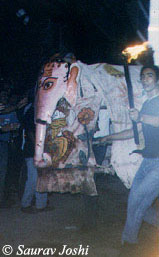
Teams
of especially designated men and boys are busy giving the chariot's
decorations ^ their finishing touch. The larger chariot will carry the
Living Goddess, the smaller ones, Bhairav and Ganesh.
 Around
1 PM. the whole area on and around Hanuman Dhoka will be crammed with
people. Policemen prevent onlookers from proceeding further and, in
particular, approaching too closely the Royal Palace's neo-Greek
facade called Gaddhi Baithak. But foreign visitors especially if in
groups and carrying cameras, will be allowed to reach certain spots
which are - in theory - reserved for them, facing the balcony.
Around
1 PM. the whole area on and around Hanuman Dhoka will be crammed with
people. Policemen prevent onlookers from proceeding further and, in
particular, approaching too closely the Royal Palace's neo-Greek
facade called Gaddhi Baithak. But foreign visitors especially if in
groups and carrying cameras, will be allowed to reach certain spots
which are - in theory - reserved for them, facing the balcony.
At the
"auspicious" moment ascertained by astrologers (usually
between 2 and 4 p.m.); the first act takes place: two men will be seen
coming out of the Kumari's house. They help two boys - dressed in
girl's clothes, their faces covered with make-up - to hoist themselves
onto their respective chariots. For they act as Bhairav and Ganesh,
the Kumari's "attendants".
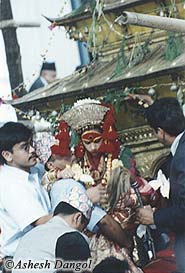
A few
moments later, the Royal Kumari herself appears through the same
narrow door next to her Palace. If a servant spreads in front of her a
long piece of immaculate white cotton serving as a carpet leading to
her chariot, the Kumari may walk this short distance; if not, she will
be carried, for under no circumstance should she get
"soiled" by touching with her feet the dirt of the street !
She wears a red velvet blouse, a very elaborate hair-do [ and a golden
crown on top. Impossible to describe all her necklaces, ornaments,
bracelets and other jewelry. Her forehead is almost entirely covered
by a thick layer of red "sindur" paste and a black "tika"
encircled in blue, marks her "third eye". Her face is
absolutely without expression and throughout the ceremony she remains
impassive, looking straight ahead.
Meantime,
foreign diplomats and Nepalese dignitaries have taken place on the
balcony. His Majesty the King accompanied by Her Majesty the Queen and
their children also step | down to the loggia's railing, cheered by
the crowd.
The
procession starts. The chariots move around Gaddi Baithak and stops in
front of the balcony. His Majesty the King greets the Kumari and
throws coins among the gathering onlookers. And so do the dignitaries
too.
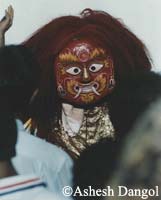
While
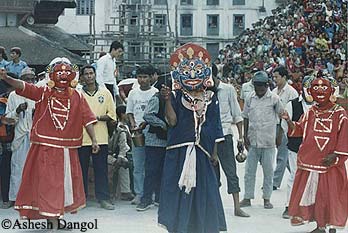
this is going on, a dancer wearing a fierce-looking mask,
gesticulates, jumps around as if possessed. He is a "Lakhe",
i.e. a demon who is said to perform the dance in order to avoid severe
punishment for his bad behavior while he was still an ordinary man !.
Later, "Lakhe" will join other masked dancers called "Bhaku",
who, before 1940, specialized in a kind of bull-fight each night of
Indra Jatra in the narrow lanes of old Kathmandu, chasing and slashing
an inebriated black buffalo ! But although this revolting game has
been prohibited since, the "Bhaku" are still playing their
part of Indra Jatra.
Now the
chariot has moved on and reaches Hanuman Dhoka where it stops in front
of the grim face of the golden Bhairav.
As
mentioned before, his face is now in full view and, as soon as the
Kumari arrives and pays homage to the image, the yearly
"miracle" happens: a stream of "beer" spurts
suddenly out of the masks mouth ! The crowd's amazement is excited by
the thundering noise of the cymbals, drums and curved large horns, a
Newari instrument not often seen in Kathmandu. The miracle is loudly
cheered and everyone indulges in hazardous acrobatics in order to
catch a sip of beer for himself.
 As the
chariots proceed along the "diagonal street" and reaches
Indra Chowk, the Kumari again pays homage to another image of Bhairav,
called the "blue Bhairav", although its face is entirely
covered with red sindur-paste. This statue is erected in front of the
temple decorated with the European-style tiles.
As the
chariots proceed along the "diagonal street" and reaches
Indra Chowk, the Kumari again pays homage to another image of Bhairav,
called the "blue Bhairav", although its face is entirely
covered with red sindur-paste. This statue is erected in front of the
temple decorated with the European-style tiles.
Late
afternoon start the various ceremonies dedicated to those who passed
away in the course of the year. Several processions take place almost
simultaneously.
One
starts from the Bhimsen Tower (the "minaret"). Close
relatives of a deceased person gather here, each participant carrying
a small oil-lamp containing a burning wick which he puts on the
ground. As the procession builds up, a long luminous serpentine
spreads itself out all along the route.
Once
darkness has fallen over the city, two spectacular episodes deserve to
be mentioned : a procession of Newari women holding each other by the
red hem of their black saris, proceeds towards "Indra's
lake" in order to prevent the souls of the deceased to throw
themselves in its waters, following an ancient tradition. The
participants in this procession appeal to Indra's mother Dagini who
had promised to take all souls directly to "heaven".
Another
cortege builds up near Kasthamandap (the "temple-made-of-the
wood-of-one-tree) This procession is exclusively composed of young
men. They carry a "snake" made of four bamboo poles bed
together to give it the shape of a flexible plank on which are placed
many small oil lamps with burning wicks.
On
Indra Jatra's last day, the chariot returns to its shelter next to the
Kumari's Palace. On that occasion, it was customary that His Majesty
the King would call on the Kumari in her own house and receive the
"tika" mark from her hands. But this is no longer a
compulsory rite.
The
festival ends with the lowering of the, pole set up in front of Kalo
Bhairav's image on Hanuman Dhoka Square. Once on the ground, it is
dragged down to the Bagmati and left there to float away or to be saw
into pieces and used as firewood.
<<
Back to main page