Festivals of Nepal
Dashain
 The
most important of all festivals. Celebrated all over Nepal. In some
ways it may be compared with Christmas, but, of course, its background
is completely different. Like many Nepalese festivals, Dashain has
many facets:
The
most important of all festivals. Celebrated all over Nepal. In some
ways it may be compared with Christmas, but, of course, its background
is completely different. Like many Nepalese festivals, Dashain has
many facets:
Dashain
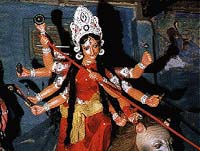
is dedicated to Goddess Durga (therefore it is also called "Durga
Puja"). It commemorates Durga's victory over the demon-buffalo
Mahisasur, which led to its more extensive significance as the
"festival celebrating the victory of Good over Evil"!
Dashain
also commemorates the victory of the Hindu hero Rama over the evil
demon-king Ravan who, as described in the epic called "Ramayan",
kidnapped Ram's wife Sita and kept her imprisoned for many years in
his island of Ceylon.
In the
eyes of the farmers, Dashain means the promise of a prosperous crop
for it coincides with the time when barley has to be sown.
Above
all and for all Nepalis, Dashain, somehow like Christmas, is the
occasion for exchange of visits and presents.
The
word "Dashain" means "Ten days" ("das"
in Nepali = "ten") Indeed, the most important day of this
long-drawn festival coincides with the "tenth" day after the
new moon (called "aunsi") of the month of "Ashwin"
But "Dashain" begins on the first day of the clear fortnight
of that month.
In
every house, village, and town of the country. Dashain is one of the
few festivals that is celebrated throughout the country.
Before
Dashain starts, a general cleaning takes place in each house. Floors
are thoroughly washed with water and cow-dung, walls are white-washed
or painted in ochre and, since every family wishes to have Durga
visiting their home, a "path" of red or yellow powder is
spread from the doorstep to the "puja-room" ( or the "puja-corner"
if, like in modest houses, there is no special room ) where all daily
rites are performed.
 At
the entrance of each village (sometimes also on its main square) a
curious scaffolding is erected. It consists of four huge bamboo poles,
strongly tied together two by two on top, their "legs"
widely spread out and solidly fixed in the ground. a horizontal bar
links the four poles and a swing made of twisted and intertwined
bamboo and other fibbers are attached to this bar with thick ropes.
At
the entrance of each village (sometimes also on its main square) a
curious scaffolding is erected. It consists of four huge bamboo poles,
strongly tied together two by two on top, their "legs"
widely spread out and solidly fixed in the ground. a horizontal bar
links the four poles and a swing made of twisted and intertwined
bamboo and other fibbers are attached to this bar with thick ropes.
Young
and old enjoy using these swings during the whole Dashain period and
immediately when it is over, they are dismantled. In some villages,
the swing is replaced (or added to) a system of rotating wheel to
which four primitive seats are attached.
On the
banks of each river: devotees perform their ritual ablutions and offer
fruits and flowers to Durga.
The
various stages of the festival:
The
first day :this day is called Ghatasthapana and is an official
holiday. The word means: "preparing the sacred jar". In
fact, on that day nothing spectacular happens in the open. But in each
house, the holy water-vessel called "Kalash", often embossed
with Durga's image, is taken out of its recess and filled with
consecrated water and, on the outside, a few seeds of barley are
planted with great care in a mixture of cow-dung and fine sand
collected from the banks of the sacred river Bagmati. This vessel is
kept in a dark room and the seeds and forthcoming sprouts are watered
every day. No women is supposed to enter this room for ten days. But
special rites must be observed and wealthy families hire the services
of a Brahmin for this purpose. On the last day of Dashain, it is
important that these sprouts should have grown to about four inches .
a good omen for the coming harvest. Then, men and women cut the
sprouts and fix them, shaped like a small yellow-green bouquet in
their hair above the left ear, a pretty as well as a luck-bringing
ornament.
The
following four days, again nothing is to be seen in the streets. On
what is traditionally called "the seventh day", but which
does not necessarily coincide with it, the first important ceremony is
"Fulpati" which means: the day of the flowers.
In the
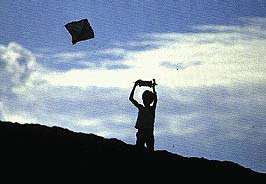
early morning hours, boys prepare their kites by rubbing the strings
with a mixture of glue and glass-powder. Kite-flying, throughout all
Dashain, becomes a real sport. Its objective consists in
"cutting" the opponent's string if his own has a sharper
glass-coating. (In fact, simple kite-flying starts earlier than
Dashain for it is connected with the approach of the monsoon and
originally, the kites were regarded as a kind of
"prayer-letter" sent to the abode of the gods to beg for
beneficial rain at the right time.)
The
main ceremony of the "seventh day" is the solemn arrival of
the "Royal Kalash" to Kathmandu. This is a jar made of
red-brown clay containing various kinds of flowers, long-stemmed
banana-leaves, sugarcane stalks etc. , a whole bouquet neatly tied
together with a red (Nepal's national and most "auspicious"
color) silk or cotton ribbon.
This
jar is carried by a group of Brahmins. All the way from Gurkha, some
45m. west (72 km. ) of Kathmandu. Having reached the capital, their
first stop is the Royal parade-ground called Tundikhel where His
Majesty is in the process of reviewing the troops and receiving "Dasain
wishes" from Nepalese and foreign dignitaries. Officials who do
not attend the military parade gather nearby, all of them wearing the
formal Nepalese dress, the black coat and the immaculate white
jodhpur, the head covered by the black "topi" cap.
Why has
this jar to be brought all the way from Gorkha ?
Firstly,
because Gorkha is the cradle of the present reigning dynasty and the
princedom from which Prithvi Narayan Shah the Great started his
unification campaign. Secondly, because the "Fulpati"
bouquet symbolizes Taleju, the Royal family's tutelary goddess whose
most sacred image is enshrined in the ancient Gorkha Palace.
The
second stage of the Fulpati procession is Hanuman Dhoka. Along this
route, the jar is carried on a richly decorated palanquin, protected
by a hand-painted umbrella and preceded by a unit of soldiers wearing
the black uniform dating back to Prithvi Narayan's time (end or the
18th century).
Later,
the Fulpati is carried inside the old Royal Palace and deposited in
one of the courtyards reserved for the members of the Royal Family.
The Sovereign and his entourage preceded by a detachment of
red-uniformed horse-guards arrive at this place to "make
certain" that the Kalash and the Fulpati have reached now their
final destination.
The
following day, i.e. the "Great Eighth day" ("Maha
Astami") and, even more so, the night after, called "Kala
Ratri" (= the Black night), are mainly dedicated to massive
sacrifices of various animals as offerings to Durga and her
blood-thirsty 'alter ego', Kali.
On this
occasion, it is a matter of several hundreds of he-goats imported
mostly from Tibet over the dreaded Nangpa - La (18,945 f. = 5776 m.)
in the Khumbu which are doomed, after having been granted a last
couple of days "rest" on Tundikhel's grazing ground, where
they are fed, weighed and sold. In addition, several hundreds of
buffaloes are also offered to Durga, in commemoration of her victory
over Mahisasur.
The
sacrifices take place near one of the many temples on Hanuman Dhoka,
specifically in one of the courtyards. At midnight, 8 buffaloes and
108 (a very auspicious, even sacred number), goats will be beheaded,
the first ones with a large sword called "khora", the second
with the ordinary "khukri". Both executions have to be
carried out with one stroke only. Woe to the executioner who would
have to resort to a second ! During the rest of the night, festive
suppers are served in many Nepalese houses. Meat (collected after the
sacrifices) is distributed profusely: Dashain is one of the few
occasions in many families when meat is consumed !
On the
ninth day, called "Navami" the series of sacrifices continue
from dawn onwards, this time in the historical "Kot
courtyard" close to the Police Head-Quarters building on Hanuman
Dhoka. Foreigners may attend this ceremony if they get up early and
then only if there is still space to accommodate them on the special
balcony reserved for them.
Here,
the blood of the sacrificed animals helps to protect the regimental
flags presented at the Kot and, in town, the bonnet and wheels of all
vehicles, At the airport, it is the nose of each plane which will be
sprinkled with goat's blood. The stains must remain for a whole week,
otherwise, the protection would not be effective against any mishap.
Similarly, tools, instruments etc. are being given the same treatment.
 The
tenth day marks the end but also the apex of the whole festival:
thousands of good-wish cards are exchanged and mailed among relatives
and friends.
The
tenth day marks the end but also the apex of the whole festival:
thousands of good-wish cards are exchanged and mailed among relatives
and friends.
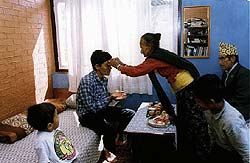
In the
course of the morning it is imperative that each Nepali calls on his
elder relatives, to begin with his parents and grand-parents.
Officials have to call on their superiors with the purpose of
receiving from them the "tika" i.e. the red dot - a mixture
of sindur powder rice-grains and curd, placed on the forehead. The
"tika" ceremony also takes place inside the Royal Palace,
where His Majesty himself receives it from the High-priest attached to
the Palace. In turn, His Majesty puts the red dot on forehead of the
dignitaries, officials etc... who come to present the Sovereign their
good wishes, loyalty and respect.
In the
afternoon, in all three cities of the Valley, masked dances and
processions mark the end of Dashain. Several of these dancers carry
wooden swords, also a symbol of a Durga and a reminder of her prowess.
Dashain
ends on the day of the full moon (Kartik Purnima) a day on which Hindu
women go fasting and proceed on a pilgrimage to Pashupatinath.
To be
noted: Buddhists also take part in the Dashain festival although it
is, of course, primarily, a Hindu celebration. But in Patan and
Bhadgaon, where there is a large Buddhist population, many processions
may be watched, visiting one shrine, sanctuary or temple after the
other, offering rice-grains, coins etc... to Buddha or Bodhisttava
statues.
Dashain
is over and the Nepalis who have observed all the rites face the
coming twelve months with full confidence.
<<
Back to main page