All
"stupas" and "gompas" (monasteries) are repainted
and richly decorated. The splendid golden spires of Bodnath and
Swayambhu are adorned with thousands of burning lights. Throughout the
night, pilgrims from all parts of the country gather at these two
sanctuaries - most of them at Swayambhu - to circumambulate the base,
recite mantras, turn prayer - wheels and make offering.
Some
devotees go around the monument by successive caterpillar-like
prostration. In the early hours of the morning, the courtyard, houses
and of course, the stupa itself, are decorated with flags, colored
pieces of material, prayer banners and flower garlands. A rare
collection of Thang-kas (painted scrolls) representing Buddha or other
holy men as well as complex "Mandalas" are displayed along
the southern wall of Swayambhu's courtyard. This is the only day of
the year when these are exhibited.
A
little later, a religious ceremony is performed at which everyone -
whether Buddhist or not - is warmly welcome. The lamas of Swayambhu's
"nyingma-pa" (non-reformed) lamaist school, dressed in their
gorgeous Chinese-made silk brocade robes perform ritual dances around
the stupa, accompanied by musicians. Their hands move in what may also
be termed as "dances" ("mudras") while holding the
"dorje" (or "vajra" = thunderbolt) in their right
and the "Drill-bu" (or "ghanta" = bell) in their
left hand.
Similar
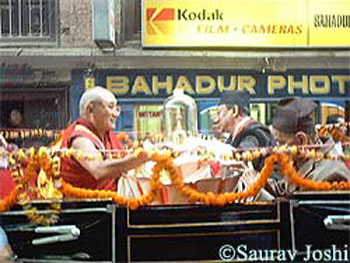
ceremonies, maybe less colorful ones, take place at Bodnath. There, in
the morning, a procession leads monks and nuns, devotees, pilgrims and
onlookers from the old Chabahil stupa to Bodnath.
Another
procession takes place in Patan, where a Buddha statue is carried from
temple to temple, also accompanied by musicians.
<<
Back to main page