He
forced himself to keep awake. Towards midnight, he noticed two
thin threads moving out of the princess's nostrils. These two
"threads" swelled rapidly and became dangerous snakes. With
one stroke of his sword, the valiant prince killed them both. The
following morning, the princess' servants were very surprised to find
both the girl and the young man in eager conversation and apparently
satisfied with their respective achievements.
Of
course, the story ends by their being married. To commemorate this
"happy end", the King ordered the construction of a
beautiful chariot topped by a huge pole. At the highest tip of this
mast, two long pieces of cloth had to be attached: they were to
symbolize the remains of the two slain snakes. On New Year's day, the
chariot is drawn through the streets of the city, carrying also the
image of goddess Bhadra Kali, the spouse of Kala Bhairav, the tutelary
patron
of
Kathmandu Valley.
The
various stages of this festival were fixed by Jagat Jyoti Malla, King
of Bhadgaon (1613- 1637)
Four
days before the New Year, Day, the image of Goddess Bhadra Kali a tiny
brass statuette, hardly ten inches tall - is ceremoniously carried
from its own sanctuary to the Akash Bhairav temple which stands at
right angles with the five-tiered Nyatapola on Bhadgaon's square.
Bhadra Kali is venerated as Bhairav's consort, Bhairav being Shiva's
"representation" in its aspect of god of destruction.
In
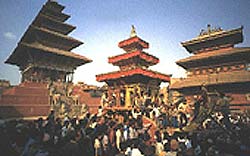
front of this temple, two chariots wait for their passengers. Bisket's
festivities start when Bhadra Kali has taken place on the smallest and
Bhairav on the largest of the two. The latter has the shape of a three
- tiered pagoda. The end-piece of the carriage's pole is slightly
lifted, as to give it the profile of a snake's head.
Now the
crowd grasps the thick ropes and drags the chariots in opposite
directions. To move them, it is sometimes necessary that several men
clutch at the wheels themselves, pushing them with all their strength.
The
team that succeeds in moving "its" chariot first is the
winner who, therefore, will place the whole coming year under the
protection of "his" god.
Similar
competitions take place during the two following nights and days.
Sometimes, they turn into such a tumult that one of the chariots may
tip over, a very inauspicious sign for the concerned team and the
prestige of its deity !
But,
normally, the two chariots are dragged through the town, and devotees
may offer their "pujas" on their passage.
Two
days before New Year, each family makes the sacrifice of one animal,
usually a he-goat, either in a symbolic or in a real way. While the
blood is offered to the god or goddess, the families rejoice in
festive meals and curries, abundantly accompanied by much "chang"
-drinking. The curries are traditionally served in those large plates
made of "sal" -tree leaves stitched together.
On
New-Year's Eve, the chariots are brought back to their resting and
waiting place, on a square in Bhadgaon's lower quarters.
In the
first hours of New Year's day, a huge pole (about 60 f. = 19m long)
lies on the ground, its thick end resting in a hole walled with
concrete and stones. People will have to erect this pole by pulling
two or more thick ropes - made of creeper fibers - tied to it.
Sometimes a rope breaks and the pole comes down with a crash, killing
or injuring onlookers, a bad omen for the coming year. But, most of
the time, after much pulling and shouting, the pole finally stands
upright and hundreds of spectators rejoice, sprinkle blood on the
wooden mast and decorate it with flowers, garlands and leaves.
Now,
young men climb on the top to tear off some of the twigs or ribbons
that are attached up there. They will keep these trophies throughout
the year as luck-bringing tokens.
In the
afternoon, a new demonstration of skill is to take place: the pole has
to be pulled down again. Two teams tear, tug and tow from opposite
sides. Again there may be some injuries if anything goes wrong but,
ultimately one team will win. The moment the pole crashes on the
ground is regarded as the real beginning of the New Year !
During
the four following days, the chariots are dragged back towards Taumadi
near the Akash Bhairav temple where their different parts will be kept
until the next year starts.
<<
Back to main page