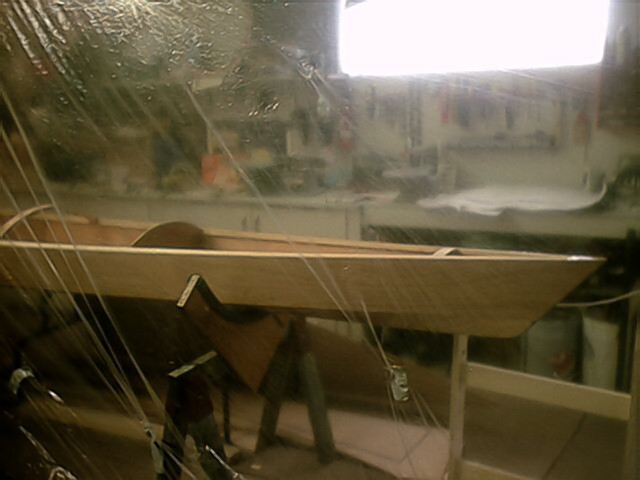
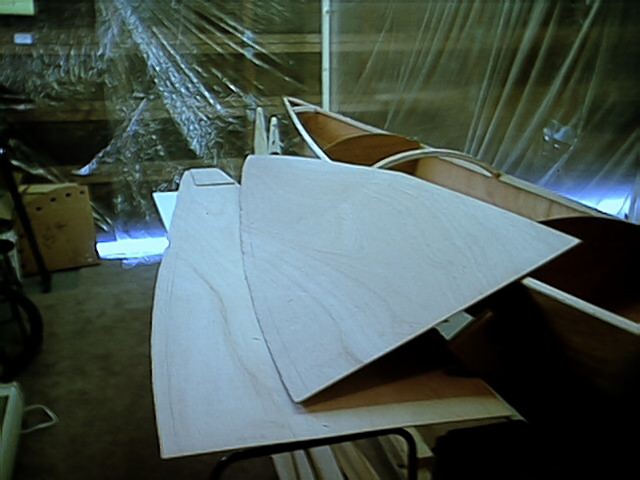
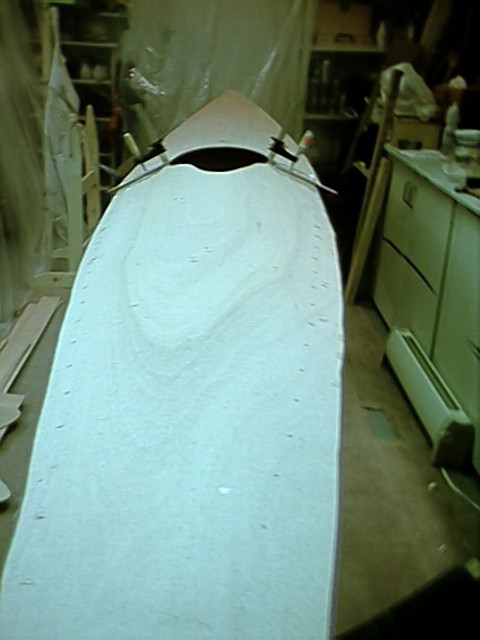
| Thursday, February 7. I discovered that my keel line had an undulating contour. I posted on the web forum at CLC and after getting some feedback I decided to try and level it as much as possible by sanding down the high spots, but I wasn't going to worry about it too much. It went well and I also rounded the chines, bow and stern. It looked good, the undulation is probably something only I will notice. 2H Saturday, February 9. It was time to plane down the sheer clamp. I had been dreading it: It seemed like it would be a lot of work. But I managed to borrow a power planer and boy was I glad I did. I used it to remove most of the wood and finished it off with the block plane and a palm sander. I would reccommend the power planer if you can get your hands on one, just be careful and you'll keep all your fingers! Then I cleaned up the shop and finished up by varnishing the inside of the hull. I had sanded it and wanted to give the whole thing a uniform finish. I used a exterior satin varnish. 3H Sunday February 10. I flipped the hull over and mixed up some epoxy to fill the hull seams. No big gaps so it was handy to be able to use a syringe to place the thickened material in the small space. I sucked the epoxy (wood flour added) up with the syringe, it was slow going but worth it for the tidy result which ultimately left me with very little sanding to do. I also cut the second beam that I had made; took enough for the seat back and glued & clamped it in place. Then to finish off I made up the stands for the kayak that were illustrated in the instruction book for stitch and glue construction. I had the parts pre cut (thanks Bernie!) so it went quite quickly. Look for them in pictures to come! 2H Tuesday February 12. Used a pull scraper to take the excess off the epoxy in the seams then sanded the whole hull down by hand. Cleaned up the shop that had become more than a bit messy! 2H Wednesday, February 13. After a good sanding with the palm sander it was time to lay the cloth on and soak it! I mixed 18oz, then 18 more and another 6 to finally saturate the weave. Only wasted a little. I spread it with a squeegee which worked really well though I do look forward to using a roller tomorrow. The end result was worth the wait! 3.5H Thursday, February 14. I know, I know, it's Valentine's day! I am taking my understanding wife away for the weekend. It was a short night's work as I applied the second coat of epoxy. I mixed 18oz and ended up with way too much. The roller worked well and made the job quick and easy. I also cut some strips for the bow and stern, two layers, bias cut, for extra strength, (thanks Lee at CLC). I was tempted to put the remaining epoxy on the bottom of the hull, in fact I tried a small amount but it just seemed to get messy. Maybe the first stuff was still too wet but I had visions of runs sagging down the sides. So I have decided to go with thin coats and take a few more days. I am sure it will save hours of sanding. 1H Friday, February 15. I sanded the hull with a palm sander and then mixed 12oz of epoxy. It turned out to be just the right amount as I rolled it on then tipped it off. I then made the mistake of putting the brush and roller in the freezer thinking I could re-use them. .75H Sunday, February 17. I dug the roller and brush out and reused them. They were soft and did the job. However, I checked my work the next morning and the finish was covered in small lines or wrinkles. They are nothing major as I can sand them out but it would seem that moisture in the roller did the damage. Lesson learned! .75H Tuesday, February 19. A pretty easy night: I trimmed and fit the beams but did not glue them. 1H Thursday, February 21. Dave came out and helped me. Thank goodness for his patience and extra hands! We glued the beams on to the hatch covers, glued & screwed the beams and filled the ends so that they will just need a bit of thickened epoxy when I put the deck on. The hatch covers proved to be a challenge as the 3 inch tape and the beams were keen to move around as we clamped them. It worked in the end and they assumed a promising shape! 4H Saturday, February 23. Time to cut the last sheet of plywood for the deck panels. Again, Dave, my son, was a great help and we cut the pieces with about an inch extra all round. Then we scarfed a small piece on for the bow and called it a day. 1.5H Tuesday, February 26. It was time to put the deck on! Geoff, a friend, came over to help with the bending and holding. First of all we put the footbraces on. I thought it would be easier to do it now and save reaching in to the cockpit. I had toyed with trying to attach them without going through the hull but in the end it was so much easier to make the small sacrifice and drill the four holes. And besides, I am painting the hull so the screw heads will hardly show. I am using 'Keepers' footbraces and they did go on nice and easy. I cut 4mm backing plates, glued them in place and then screwed the braces on. It was simple and painless. Then it was on to the deck pieces. I used the little measuring device for placing the nails and as instructed we alternated the nailing from side to side as we worked from the bulkhead, aft. Goeff squeezed and pressed and we ended up with a nice camber almost all the wat aft. Then we put the fore-deck on starting from the deckbeam. This one took more pressing and squeezing but the end effect is very pleasing. We finished off the night by cutting where the panels overlapped. I glued a butt block in place and clamped and them we turned what now definitely looks like a kayak upside down to stop the epoxy from oozing down the hull. Done for the night! 9H Thursday, February 28. I went with a small back saw to trim the deck to the hull. I probably could have cut closer but elected to do more planing! It didn't take long and I had the shape I had been waiting for! Then I enlarged the cockpit opening to almost full size; I just love the way the wood bends around the opening, its so smooth and graceful. Finished off by mixing a little fillet material and filled the seam between the deck and hull. Done! 2H |
 |