

The Starmaker boasted a "square" bore and stroke at 68mm, instead of the traditional Villiers long-stroke design. A full-circle crankshaft with a stepped crankpin, rode on on two lipped roller bearings, with an additional needle roller on the drive side. An austenitic iron liner was fitted in an alloy cylinder barrel, with single intake port, two transfers, and a bridged exhaust port. An alloy head with wide squish band, center mounted plug and 12:1 compression ratio was spigoted to the barrel; no head gasket was used. The magneto was also new; an energy transfer type with a separate HT coil. A duplex primary chain transferred power to a unique all-metal clutch with single diaphragm spring. While the Villiers practice of "semi-unit" construction continued, (with the transmission a separate unit bolted to the back of the engine) the four speed transmission was all-new, with needle bearings throughout. In MX trim, with twin Amal Monobloc carburetors, the engine was rated at 25 hp at 6500 rpm; the road race model with Amal GP was rated 32 hp at 8000 rpm. Low compression trials engines and road-going powerplants with lighting coils were also offered.
Small British manufacturers such as Cotton, DOT, and DMW put the new engine to work at once, and Greeves used it for about a year before deciding to build their own engine. The engine also appeared in Rickmans. In motocross, the Starmaker-powered Cotton Cobras, DOT Demons, and DMW scramblers, (along with rivals Greeves, CZ, and MZ), began the two stroke MX revolution that would eventually drive the four-strokes from the race tracks for many years.
In roadracing, sometimes fitted with a six speed gearbox and special ignition system, the engine had great success at both the amateur and pro levels. In 1966 a Starmaker-powered special, prepared and ridden by Villiers engineer Peter Inchley, took 3rd in the Isle of Man TT, bested only by the works Hondas ridden by legendary Mike Hailwood and Stuart Graham. Mr. Inchley would later be part of the AJS MX effort at Norton-Villiers, where the Starmaker designation was dropped and the unit became known simply as the AJS engine.
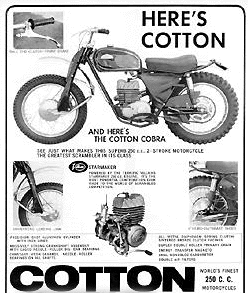
Cotton also produced Starmaker-powered street bikes such as the "Conquest" and "Telstar."
