
Page 2
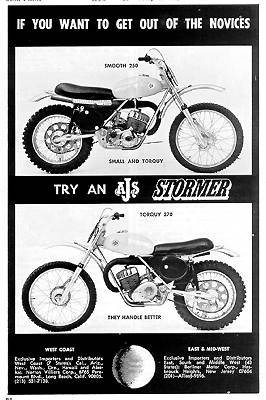
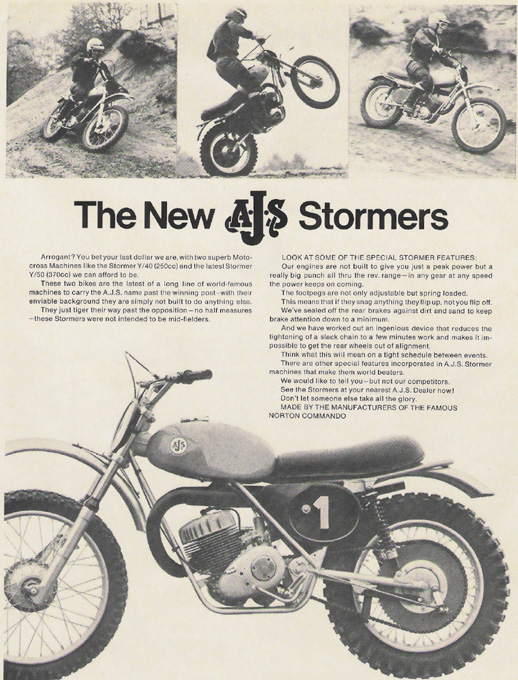
As AJS's parent company, Associated Motorcycles (AMC) was tottering towards bankruptcy in the mid-60's, its competition shop was experimenting with Starmaker-powered scramblers, which appeared variously under its Norton, AJS, James and Francis Barnett nameplates. These prototypes are said to be the forerunners of the AJS Stormer.
In 1967, with the ailing AMC and Villiers absorbed into the new Norton-Villiers (N-V) empire, the first prototype Stormers were prepared and raced late that year. Development continued with some promise in 1968, as AJS won the 250cc British MX championship. In 1969, N-V released the production Y4 250cc Stormer MX. This was followed in 1970 by the Y5 370cc Stormer. (Designated Y40/Y50 in the USA.) The machines were basically identical, but with the 250's 68mm bore enlarged to 83mm, to produce a 368cc engine. A "410" (actually 400cc) Y51 was released in 1971. This engine shared the 370's bore but had a slightly longer stroke at 74mm. A trials machine was also marketed briefly, with a different frame and powered by the Villiers 37A engine.
The handsome yet purposeful appearance of British motorcycles is appreciated by fans throughout the world, and the Stormer was no exception to this tradition, with its slim fiberglass tank, contoured seat, and polished hubs, forks, and engine components. The excellent welding, paint and plating throughout resulted in a level of finish that was uncommon on off-road machines of the era. The beginnings of the suspension revolution that was soon to come could be seen, in the forward-axle front forks and slightly forward-mounted shocks. There was a long list of unique features that contributed to the Stormer's race-worthiness:
Heavy backbone Reynolds 531 frame, similar in design philosophy to the legendary Norton Commando frame.
Chain adjustment via eccentric cams at the swingarm pivot; rear wheel alignment is automatically maintained during chain adjustments.
Conical hubs with dirt-excluding piston-ring seals.
Strong 40-spoke wheels with Akront rims (some early 370's had steel rims).
Points and condenser easily accessible, not buried under the flywheel.
Rubber-mounted exhaust system.
Sealed ball bearings at wheels and steering head.
Long life nylon-steel bushings at swingarm.
In the late 60's and early 70's, the AJS works team had its share of success, competing against the powerhouse teams from Husqvarna, CZ, BSA. and Greeves. Malcom Davis won the 250 British MX championship in 1968, and again in 1970, with teammate Andy Roberton taking second. The Stormer was also campaigned in the USA, piloted by Doug Grant on the MX circuit and Mike Jackson in the desert races of the West.
