salary
being
received
by
domestic
helpers
in
Singapore
at
the
time.
She
saw
however
how
other
Filipinos
were
being
maltreated.
"Araw-araw
may
dinadalhan
ako
ng
pagkain
kasi
ang
ipinapakain
sa
kanila
ay
panis"
(Everyday
I
brought
food
to
another
Filipino
domestic
helper
because
the
employer
gave
her
only
spoiled
food),
Connie
recalled.
When
her
employers
decided
to
leave
the
country,
Connie
decided
to
go
home
as
well,
not
wanting
to
end
up
like
other
Filipino
migrants
in
the
area.
Although
she
survived
her
stint
in
Singapore
unscathed,
her
marriage
though
was
not
so
lucky.
Her
husband
decided
to
work
in
Saudi
Arabia
where
he
got
involved
with
another
woman
which
led
to
their
break
up.
Separations
though
are
not
uncommon
among
OFWs.
Connie
grins,
"Yung
mga
hiwalay
kapag
tinatanong
kung
nasaan
ang
mga
asawa,
ang
sagot
ay
'sumakabilang
bahay
na'!"
(Those
who
are
separated
when
asked
about
their
spouses
reply
that
the
latter
have
transferred
to
another
house).
Upon
her
return
in
the
Philippines,
Connie
became
involved
with
the
militant
women's
group
Gabriela
and
later
directly
helped
organize
peasant
communities
in
Southern
Mindanao.
But
when
economic
difficulties
intensified,
Connie
once
again
decided
to
work
abroad.
She
left
her
children
in
the
care
of
her
parents
and
younger
sister
and
in
March
1991,
boarded
a
plane
for
Hong
Kong.
Hong
Kong
experience
Connie
chose
Hong
Kong,
thinking
the
British
colony
had
a
better
policy
for
migrant
workers,
aside
from
being
near.
This
time,
she
had
to
shell
out
more
than
P100,000
for
placement
and
other
fees.
On
her
first
free
day,
Connie
went
to
a
Lutheran
church
called
"Church
of
All
Nations,"
where
even
non-Lutheran
members
could
go.
It
started
her
involvement
with
the
church
activities,
particularly
in
its
ministry
for
migrant
workers.
She
later
sat
in
its
Board
of
Social
Ministry
which
looks
for
ways
how
the
church
could
assist
welfare
institutions.
The
following
year,
Connie
joined
the
United
Filipinos
in
Hong
Kong
(UNIFIL),
a
militant
organization
that
has
a
record
of
consistently
fighting
for
migrants'
rights
and
welfare.
Two
years
later,
she
was
elected
chairperson
of
the
8,000-strong
organization.
"Grabe
ang
demand
ng
trabaho
sa
UNIFIL
and
I
had
to
leave
the
ministry,"
said
Connie.
Her
employer
was
thoughtful
enough
to
give
her
a
typewriter
for
her
use
so
she
could
prepare
the
papers
she
needed
for
the
Sundays
when
most
of
the
Filipino
migrants
would
be
converging
in
the
central
park.
Still,
organizing
overseas
Filipinos
was
very
difficult,
especially
the
first
years,
for
Connie.
"My
organizing
experience
was
among
peasants.
They
would
be
there
in
the
field
or
their
huts,
always
available,
if
you
wanted
to
see
them.
But
with
the
migrants,
you
only
have
the
Sundays
to
talk
with
them
and
that
would
be
their
time
to
write
letters,
make
calls
to
their
kids,
send
remittances.
I
asked
the
veterans
in
Hong
Kong,
'Bakit
ganito,
ang
hirap
hirap.'"
The
only
answer
she
got
was,
"Talagang
ganyan
ang
migrante."
Thirteen
years
in
Hong
Kong
and
six
employers
later,
Connie
recognizes
that
the
same
difficulties
continue.
But
this
time,
she
has
more
confidence,
born
out
of
the
years
of
painstaking
work
among
the
OFWs
and
deeper
knowledge
of
their
problems
and
situation.
She
also
talks
about
the
importance
of
organizing
the
families
of
OFWs.
"They
too
must
realize
the
issues
that
their
loved
ones
confront."
Migrants'
legislative
agenda
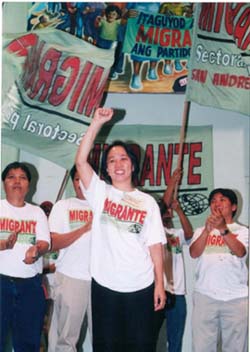
Connie
believes
that
having
a
representative
in
Congress
would
allow
them
push
the
interest
of
OFWs
in
legislation.
"Ang
nangyayari
kasi,
nalalaman
na
lang
namin
pag
lumabas
na
kaya
reactive.
Sa
kadami-dami
na
ng
nailabas
na
policies,
puro
anti-migrant
although
sinasabi
nila
na
for
the
protection
of
migrants.
If
we
are
in
congress,
there
would
be
opportunity
to
review
the
legislations
being
passed
as
well
as
offer
alternatives."
Concretely,
two
of
the
major
agenda
of
MSP
in
Congress
would
be
the
passage
of
an
OFW
Charter
and
the
ratification
and
implementation
of
the
United
Nations
Convention
for
the
Protection
of
the
Rights
and
Welfare
of
Migrants
and
their
Families.
MSP
also
seeks
to
ensure
adequate
and
appropriate
government
services
to
all
OFWs;
protection
and
immediate
assistance
to
distressed
overseas
Filipinos
everywhere;
imposition
of
heavy
penalties
and
punishment
of
all
agencies
engaged
in
the
sex
trafficking
of
Filipino
women
and
children;
and
to
pressure
the
government
to
act
decisively
via
diplomatic
intervention
for
the
immediate
release
and
repatriation
of
unjustly
imprisoned
Filipinos
abroad.
New
arena
Connie
however
clarifies
that
participation
in
the
elections
does
not
mean
they
have
illusions
that
victory
would
mean
the
end
the
Filipino
migrants'
sufferings.
Our
members
know
that
exercising
their
right
of
suffrage
does
not
end
with
the
casting
of
ballots.
There
is
in
fact
greater
responsibility
afterwards
because
we
need
to
ensure
that
the
migrant's
agenda
would
be
pursued
by
whoever
gets
voted.
The
feisty
migrant
leader
also
said
that
any
entry
into
the
parliamentary
arena
would
not
succeed
if
not
supported
by
a
vibrant
migrants'
movement.
The
key
therefore,
she
says,
is
still
organizing
the
ranks
of
OFWs
and
their
families.
A
new
chapter
For
Connie,
her
sudden
entry
in
the
unfamiliar
but
exciting
electoral
struggle
ushers
a
new
chapter
in
her
life.
Whether
MSP
wins
or
loses
in
the
elections,
Connie
plans
to
stay
in
the
Philippines
for
good
when
her
contract
expires
in
August
this
year.
She
would
then
have
more
time
to
spend
with
her
children
and
grandchild.
Or
maybe
not.
For
Connie
intends
to
see
to
it
that
MSP
chapters
-
now
numbering
over
a
hundred
worldwide
-
would
continue
to
expand,
in
various
countries
where
Filipino
migrants
are
concentrated
as
well
as
in
the
various
regions
in
the
archipelago.
Whether
she
gets
to
do
it
in
the
session
hall
of
Congress
or
in
Mendiola,
migrant
Filipinos
would
always
have
Connie
to
fight
for
their
rights
and
welfare.
Excerpted
from
"HK
Migrant
takes
road
to
Congress"
by
Rowena
Carranza
of
Bulatlat.com |





 Philippine
News
Philippine
News