Revenue Changes Due
to a Change in Price
Consider the question posed at the beginning of this chapter. How can we explain the the difference in income and employment in two different industries when both cut price. We now know that a change in price does not have the same effect on the change in the quantity demanded. Can this effect the total amount of revenue that a firm receives? Yes, it can.
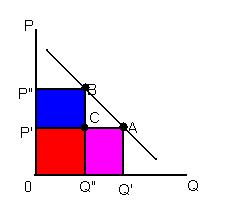
Look at the demand curve in the graph below. Revenue is defined as the price multiplied by the quantity sold. This is area 0P'AQ' in the graph. The value of the area is P' * Q'. Consider a change in price from P' to P". The quantity demanded changed from Q' to Q". Notice what happened to revenue, we added area P'P"BC and took away area Q'Q"AC.
Revenue Changes Due
to a Change in Price
So has revenue increased or decreased? Actually we can't tell. If area P'P"BC is larger than area Q'Q"AC then total revenue has increased. If area P'P"BC is less than area Q'Q"AC then total revenue has decreased. The change in revenue occurred because of a change in price and quantity. Since elasticity is the responsiveness of changes in quantity because of changes in price could we use elasticity to tell us what happened to total revenue?
Elasticity
and Revenue
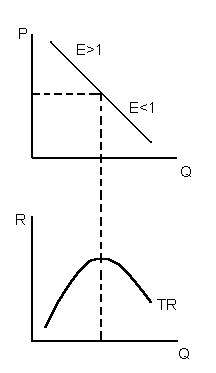
Look at the graph above. On the left side of the dashed line we see that a decrease in price would increase total revenue. The downward slope of the demand curve and the upward slope of the revenue curve shows that revenue and demand is inversely related when demand is elastic (E>1). This means that increases in price are insufficient to compensate for the fall in the quantity demanded. Therefore increases in price cause a fall in total revenue and that decreases in price cause an increase in total revenue when demand is elastic.
Now look at the right side of the dashed line. We see that a decrease in price would decrease revenue. The downward slope of the demand curve and the downward slope of the revenue curve indicates that revenue and demand is directly related when the demand curve is inelastic (E < 1). This means that increases in price are more than sufficient to compensate for the decrease in the quantity demanded. Therefore, increases in price cause a increase in total revenue and a decrease in price causes a decrease in total revenue when demand is inelastic.
Unitary elasticity exists when the percentage change in price is equal to the percentage change in demand. The percentage change in the price is exactly equal to the percentage change in quantity so total revenue does not change.
These outcomes have been summarized in a table for you.
| Type of Demand | Price Change | Revenue Change |
| Elastic | Increase | Decrease |
| Decrease | Increase | |
| Unitary | Increase | No change |
| Decrease | No change | |
| Inelastic | Increase | Increase |
| Decrease | Decrease |
Do not confuse total revenues and total profits. Elasticity can tell us the change in total revenue but it does not tell us the change in profits.

