The Arc Formula
There are also times when we do not know the original price or quantity
of a good. When this occurs we use an average to substitute for the
original price and quantity. The way to calculate an average for
the price elasticity of demand is to add together the numbers for quantity
and divide by 2. Mathematically this is written as;
Q1 + Q2 = Average value of Q
2
We place this into the denominator for each part of the equation
to obtain the new formula.
Q2 - Q1
= %DQ
(Q2 + Q1)/2
P2 - P1
= %DP
(P2 + P1)/2
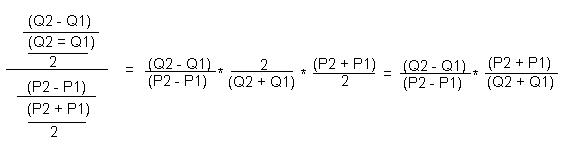
This formula requires a lot of work, fortunately it can be simplified
as is shown below;
Example: Assume that a company can sell 400 widgets at $5
and 300 widgets at $7. What is the price elasticity of demand?
Using the simplified formula:

Recall that the price elasticity of demand is positive. This
tells us that a one percent increase in price of widgets would decrease
the quantity demanded by 0.857%.
The procedure for measuring the price elasticity of demand is:
-
Determine the percentage change in quantity. If you do not know
the start point use the average, otherwise use the start point.
-
Determine the percentage change in price. If you do not know the
start point use the average, otherwise use the start point.
-
Divide the percentage change in quantity demanded by the percentage
change in price.
The formula that gives us the price elasticity of demand is a ratio
of the percentage change in quantity demanded to the percentage change
in price. If you have two of these three factors you can calculate
the value of the remaining item. This procedure is used frequently
in industry and government. For example, if you know the change in
price and the price elasticity of demand you can calculate the change in
quantity demanded. The equation becomes
%DQ = EQd,P * %DP.
This equation will give an accurate reflection of the change in
quantity for small changes in price and quantity. You can also determine
what the change in price needs to be to increase the quantity demanded.
This is written as:
%DP = %DQ/EQd,P.

