|
Home | |
Maya Culture | |
Natural Treasures | |
About Us | |
 |
 Copan :: Tikal :: Quirigua |
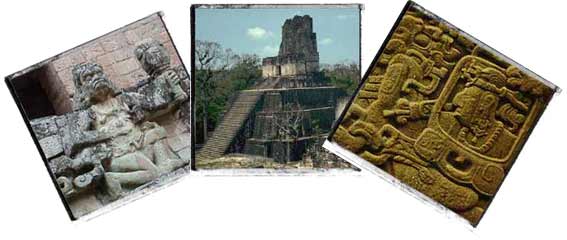
| MIDDLE AMERICA TRAVEL can take you to Copan, Tikal, Quirigua, or any of the several Maya ruins found throughout Guatemala. Because of our familiarity with the regions, the archaeology and the local tourist offerings, we can arrange a tour to suit your needs. WE RECOMMEND a tour that includes Copan, Quirigua and Tikal, with possible side trips to the ruins of Ceibal, Uaxactun, Aguateca, and more. You may wish to include some of the cultural sites such as Esquipulas, home of the famous Cristo Negro, or the wildlife preserves of Sierra de las Minas. Whatever your choice, Middle America Travel can arrange your journey. MIDDLE AMERICA TRAVEL has guided tours to Copan, Honduras for many years. We have worked with some of the world's leading Maya scholars, including the late Dr. Linda Schele, David Freidel, Peter Mathews, Nikolai Grube, Gillett Griffin, Kathryn Josserand and Nick Hopkins, Barbara McLeod and more. Our guides have experience and expertise in Guatemala's archaeological treasures, and we are ready to share them with you. FOR MORE INFORMATION on Maya ruins around Guatemala, read below - or contact Middle America Travel to help you arrange your own personal tour. |
 |
RECENTLY, University of Pennsylvania researchers discovered what is believed to be Yax-K'uk'-Mo's tomb deep within one of the pyramids. From his garments and other artifacts associated with Yax-K'uk'-Mo', he appears not to have been a Copán native, and may have come from Central Mexico. Copán's best- known ruler was 18 Rabbit (also known as Waxak-Lahun Ubah-K'awil in Mayan). 18 Rabbit was responsible for much of the building that the visitor sees today in Copán, as well as the stunning stelae that stand in the plaza before the Temple of the Inscriptions. |
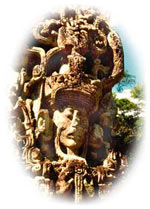
| IN SOME of these stelae, he depicts himself in the costume of the Mayan Maize God and shows himself performing rituals and sacrifice for the well-being of his people. From these stelae, you can tell how elaborate the formal costumes must have been. Epigraphers can now read the glyphs on the sides and back of many of these stelae, and they provide such information as the dates of 18 Rabbit's birth, accession to the throne, and important astronomical events. But the glorious 18 Rabbit was eventually captured and beheaded by K'ak-Tiliw, the king of nearby Quiriguá. |
 |
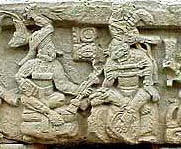
THE BALLGAME was sacred to the ancient Maya, and the ballcourt at Copán where the game was played is one of the most beautiful and important of all. The ballcourt was believed to be a portal to the Underworld, where the spirits of gods dwelled. The story of the ballgame is told in the Popol Vuh, a book recounting the Maya creation myths. The legendary Hero Twins defeated the Lords of the Underworld in the ballgame. It is thought that the ballgame was played as a paradigmatic battle and a reenactment of the Popol Vuh's legends. This marker, and others like it, were found at the ballcourt in Copán and are displayed in the nearby museum. |
| WHILE IT IS possible to see the highlights of Copán in a day, most visitors prefer to spend two or three days examining the site, the two museums, and the nearby ancient residential area, Las Sepulturas. |
| IN ADDITION, archaeologists have tunneled under the existing pyramids to discover several layers of earlier buildings with well-preserved sculptures and paintings: these tunnels are now accessible to the public. Therefore, we recommend that you plan to spend a few days exploring this marvelous site. The town of Copán Ruinas offers several very comfortable hotels with pools and interior garden courtyards, and there are many good restaurants in town. Middle America Travel's experienced guides can help make you trip to Copán delightful and unforgettable. [back to top] |
| THE STRUCTURES were made to appear
even taller and more imposing by the use of roof combs, lattice-like
structures on the temple roofs which visually extended the height
of the building. This structure faces Temple I in a spacious plaza in which several carved stelae were planted.
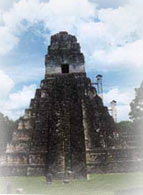
The view above is from the North Acropolis, which has been partially excavated to reveal older buildings beneath. Visitors may enter one of the excavated tunnels, where imposing stucco masks of the Sun God greet them. TEMPLE I has undergone considerable restoration, but in recent years it has been closed to tourists because of its steep and dangerous stairway. It is situated opposite Temple II in the Great Plaza. Tikal was a political and military powerhouse, skirmishing frequently with its neighbors and eventually conscripting them into its alliance. TIKAL HAD a centuries-old rivalry with Calakmul (in modern-day Campeche, Mexico), and battles won and lost are recorded in hieroglyphs on its monuments. In the early stages of its fluorescence, Tikal was apparently strongly influenced by Toltec visitors from Central Mexico. The kings shown on the stelae wear Toltec-style garments, and several of its buildings use typical the tablud-tablero design that is characteristic of northern Mexican cities. |
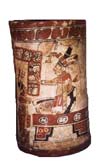 |
TWO MUSEUMS at Tikal display many of the artifacts and monuments found when archaeologists excavated the site, including carved jade and stone monuments, and several well-preserved polychrome pots. One of the best-known artifacts is a carved deer bone depicting the journey of the Maize God, in a canoe propelled by the Sting Ray Paddler God and the Jaguar Paddler God, as he sets up the three stones of creation in the sky.
About 20 km from Tikal is the site of Uaxactun, a city defeated in A.D. 378 by a Tikal lord known as "Smoking Frog." Middle America Travel can take you to Uaxactun. [back to top] |
| QUIRIGUA |
| QUIRIGUA, located east of Guatemala City in the Motagua River Valley, has some of the largest and most beautifully carved stelae (stone monuments) found anywhere in the Maya world. The towering pillars, together with zoomorphic altars, record the Mayas' cosmic view of the world around them and tell the creation story from their point of view. |
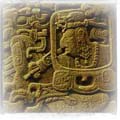 |
THE FULL-FIGURE glyphs on a Quiriguá stela at are a tribute to the Maya sculptors' remarkable accomplishments. Without metal tools, they achieved incredible detail and artistic design. The Maya read the glyphs on the stelae as they recounted the creation of the world: the setting of the Jaguar Throne, The Waterlily Throne, and the Serpent Throne, which the Maya saw as the stars in the constellation Orion, and which they commemorate with three hearthstones in their home fires. |
| THE CREATION DATE depicted on the stelae is defined in the Maya calendar as 13.0.0.0.0 4 Ahaw 8 Kumk'u - August 13, 3114 B.C. by our calendar. Quiriguá's sculptors carved zoomorphic ("animal-form") altars out of single, large boulders, letting the shape of the native rock influence the final design. Altars may represent gods, animal spirits or important events in the Mayas' cosmic view. The stelae at Quiriguá are the largest in the Mayan realm, some towering more than 12 feet high. |
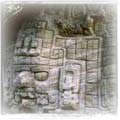 |
MANY OF the stelae represent one of Quiriguá's greatest rulers, K'ak-Tiliw, who was best known for having captured 18 Rabbit, king of the nearby site of Copán. Despite the fact that Quiriguá was under the rulership of Copán, K'ak-Tiliw mounted a campaign for independence. Just 6 days after his capture, 18 Rabbit was decapitated. |
| QUIRIGUA'S monuments celebrate the city's victory over its rival, and also speak of political alliances and intrigue. Quiriguá, it seems, was allied with the city of Calakmul (in present-day Campeche, Mexico), the arch-rival of Tikal to the north. Although it was once thought that the Maya were a peaceful race of gifted astronomer-priests who spent their days contemplating the heavens, we now know that they engaged in frequent and protracted wars. Powerful kingdoms like Tikal and Calakmul garnered allies among the smaller cities like Quiriguá. |
| A TRAVELER should count on spending a day at this site. While it lacks towering pyramids and complex temples, its carved monuments are among the most beautiful and aesthetically pleasing. [back to top] |
| Middle America Travel 2a. Avenida "A" 28-62 Zona 3 Guatemala City, Guatemala Central America Phones: (502) 440-4740, (502) 440-4717 E-mail: [email protected] © 2001 Middle America Travel. All rights reserved. |