E-Brochures
Previous ACU2000d PG2000d BEW2000a DAC2000 SSC2000
ACU2000d Automatic Controller Unit
Table of Contents
OVERVIEW The ACU2000d is a microprocessor based, 4 Channel, 9-Step, automatic controller unit that is designed primarily to provide on-board automation of auxiliary functions for an R/C model.It can be used in any type of models that exhibit many operational features: e.g. scale aircraft, ships, land vehicles, and even animatronic robots.
The ACU2000d automates the position sequences of up to 4 devices on a model, in up to 8 discrete PROGRAM STEPS, and requires only one receiver channel to provide this automation.
There is also a FAILSAFE feature, which allows the same devices to be programmed into a safe configuration that would not further endanger the model during the loss of the transmitter signal.
There are 5 operational MODES to choose from, each allowing for a different type of command input from the hand-held transmitter of an R/C set.
The PG2000d Programmer is required to setup and program the ACU2000d unit. During programming, the ACU2000d stores the programmed parameters in its memory chip. Programming the ACU2000d is very easy and straightforward with the PG2000d Programmer.
The compact size of the ACU2000d allows easy, unobtrusive, installation within a model.
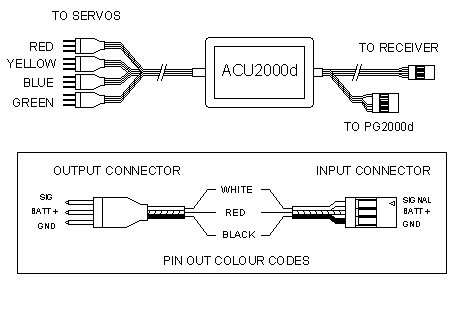
Connections to servos are via 4 pre-harnessed male header connectors to fit the variety of servos that are easily available. These male header connectors eliminate the need to match the variously shaped female connectors that come with the servos of different manufacturers.
The ACU2000d unit takes its command signal from a single receiver channel. Connection to the receiver is via a pre-harnessed 3-pole female connector.
FEATURES
- Microprocessor based design- Totally programmable by the user
- Controls up to 4 servos (Channels are identified by colors: red, yellow, blue, green)
- Requires only 1 receiver channel for command signal
- Programmable up to 8 Program Steps + FAILSAFE
- 5 Modes of operation to choose from
- Extremely easy to program and use
- Stores operating parameters in its permanent memory chip
- Small size allows easy, unobtrusive, installation
- Pre-harnessed male header connectors for connection to servos
- Operates from receiver power supply
- Low power consumption
- Requires PG2000d Programmer for setting up and programming.
FUNCTIONAL OBJECTIVES The ACU2000d Automatic Controller Unit is designed primarily to aid the R/C enthusiasts achieve, through a single channel, functional goals that would normally use up to 4 channels of an R/C set.
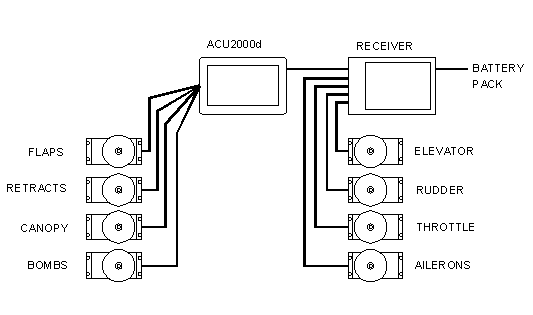
For example, a modeler wants to add Flaps, Retracts, Opening Canopy, and a Bomb Drop Mechanism to his sport-scale model of a North American P-51D Mustang. He would thus require a total of 8-Channels to realize these functions (including the 4 primary Flight Control Channels for Elevator, Rudder, Throttle, and Ailerons).
However, if we consider the fact that the Flaps, Retracts, the Canopy, and the Bombs are operated in fixed position sequences during the different phases of a flight, then there exists a possibility to automate these sequences to reduce the transmitter workload for the R/C flyer.
The ACU2000d makes this possibility a realty.
A typical application of the ACU2000d in a scale model airplane is given in the example that is shown in Table 1:
Table 1: A typical ACU2000d application. Flight Phase Flaps Retracts Canopy Bomb Taxi Full Down Full Down Full Open Lock Landing Full Down Full Down Full Open Lock Take Off Half Down Full Down Full Close Lock Just Airborne Half Down Full Up Full Close Lock In Flight Full Up Full Up Full Close Lock Mission Full Up Full Up Full Close Release
In the above example, there are 6 Flight Phases (Program Steps). When the model is sent into the air, the 4 functions are put through their position sequences, step-by-step, from the Taxi Phase through to the Mission Phase.When the model is brought back in for landing, the 4 functions are put through their position sequences again, but this time in reverse: from the Mission Phase to the Taxi Phase.
By controlling these sequence steps from a single command signal, the pilot’s transmitter workload is greatly reduced. The ACU2000d automatically sets the 4 functions to their required positions for each of the sequence step.
Whether a modeler decides to use a medium cost FM radio or an expensive PCM computer radio, the ACU2000d offers the modeler the possibilty of creating models with many operational features without the handicap of the channel limitations of the R/C set.
MICROPROCESSOR BASED DESIGN The ACU2000d is built around a 12 MHz microprocessor chip to provide the “Intelligence” that is required to achieve the Automation Principle.It contains all the necessary interfacing and buffering circuitry to ensure safe connections to the R/C receiver and servos.
All the components in the ACU2000d are low power devices. This makes it possible for the unit to consume less than 18mA from the receiver pack (this does not include the servos that are connected to the unit).
USER PROGRAMMABLE Because it is totally user programmable, the ACU2000d is highly flexible and can be programmed for use in a wide variety of modeling applications. With the PG2000d Programmer, programming the ACU2000d is extremely easy, straightforward, and totally hassle-free.The user can set the maximum number of PROGRAM STEPS for the program, and the MODE in which to operate. The POSITIONs of each of the 4 Channels for each program step are also user programmable. All these program parameters are then stored in the memory chip of the ACU2000d.
Once programmed, the ACU2000d retains these parameters permanently in the memory chip until it is reprogrammed again.
INPUT/OUTPUTS The ACU2000d requires only a single R/C Channel to operate. This signal commands the unit to sequence up, hold, or sequence down, through the program steps.The input signal must be a Pulse Width Modulated (PWM) pulse, with a pulse width range of between 1.0ms to 2.0ms. This type of signal is typical of most R/C receivers.
The ACU2000d produces 1.0ms to 2.0ms PWM pulse outputs on all of its 4 output channels. These Full Proportional outputs can directly drive most commercially available servos.
Power to the servos that are connected to the ACU2000d is channeled from the receiver battery pack.
PROGRAM STEPS The ACU2000d provides up to 8 PROGRAM STEPS that are sequentially stepped up, or down, when the unit is in operation.The number of steps can be programmed from anywhere between 2 and 8 to suit the particular application. The servo positions for each of the 4 Channels are user programmable for each PROGRAM STEP.
There is also a FAILSAFE step; called STEP 0, to ensure that the devices assume a safe configuration that would not further endanger the model during the loss of the transmitter signal. The servo positions for STEP 0 are also user programmable.
The ACU2000d also remembers the last step it was in, before entering FAILSAFE. This will allow it to return to this step should the loss of the transmitter signal be temporary.
OPERATIONAL MODES The ACU2000d can operate in any one of 5 OPERATIONAL MODES. These MODES are shown in Table 2:
Table 2: Operational Modes of the ACU2000d. MODE TYPE OF OPERATION CATERS FOR MODE 0 Monitors presence of TX signal (STEP 0 and STEP 1 only) Failsafe Devices: Model Locators, Engine Cut-Off and Ballistic Parachutes MODE 1 Program Step equals Stick Position (STEP 0, STEP 1 up to STEP 8) Full Proportional TX input types: knobs and joysticks (non-centering types) MODE 2 Count Down / Hold / Count Up (STEP 0, STEP 1 up to STEP 8) ON-OFF-ON input types: Momentary type 3 Position SPDT Switches, or self centering joysticks MODE 3 Auto Reverse Count Up/Down (STEP 0, STEP 1 up to STEP 8) Push ON, Release OFF input types: Momentary type Push-Buttons MODE 4 OFF / ON STEP 0, STEP 1 and STEP 2 only OFF-ON input types: 2 Position Toggle Switch
For each MODE, the ACU2000d recognizes the following signal values:
MODE 0 Can be used to add safety to a model by using this Mode to trigger an engine
- A PWM pulse of at least 1.0ms equals STEP 1.
- No pulse equals STEP 0.
cut-off or open a ballistic parachute, when the radio link fails.
MODE 1 This Mode is perfect for interlocking auxiliary functions to another function.
- STEP equals pulse width of anywhere between 1.0ms and 2.0ms.
- No pulse equals STEP 0.
For example: Low Throttle can open Cowl Flaps and switch on Glow Heat, or
Reverse Throttle can turn on Warning Lights/Horns, or Full Flaps can lower
down and switch on Landing Lights...etc.
MODE 2 The default Mode for sequential programs. This is the Mode that the ACU2000d
- Between 1.0ms to 1.3ms equals DECREMENT STEP.
- Between 1.4ms to 1.6ms equals HOLD STEP.
- Between 1.7ms to 2.0ms equals INCREMENT STEP.
- No pulse equals STEP 0.
comes pre-programmed in when delivered from factory. Perfect for aircraft and
ship model applications.
MODE 3
- Low defined as between 1.0ms to 1.4ms.
- High defined as between 1.6ms to 2.0ms.
- A TRANSITION from Low to High activates a STEP. When maximum STEP is reached, the steps will then decrement until STEP 1 is reached, whereupon the steps will then increment until maximum STEP again. (AUTO REVERSE).
For Auto-Reversing sequential programs. R/C Battleship Wargamers will find
- No pulse equals STEP 0.
this Mode perfect for firing their BB canons in rotating sequences.
MODE 4 Functions like an On-Off Controller with FAILSAFE option.
- Between 1.0ms to 1.4ms equals OFF (STEP 1)
- Between 1.6ms to 2.0ms equals ON (STEP 2)
- No pulse equals STEP 0.
TECHNICAL SPECIFICATIONSGeneral
Type Microprocessor based, 9-Step Programmable Automatic Controller Unit Model ACU2000d Total Outputs 4 Independent Channels. Color-coded for identification. Total Inputs 1
Physical
Dimensions 54mm (W) x 35mm (D) x 15mm (H) Weight 1 oz
Connections
Outputs 4 Independent Pre-Harnessed 3-Pole Male Header Connectors.
200mm Lead Length. Color Coded Leads for Channel IdentificationInput 1 Pre-Harnessed 3-Pole Female Connector. 150mm Lead Length Programmer 1 Pre-Harnessed 8-Pole Female Connector. 50mm Lead Length
Electrical
Supply Voltage 4.8VDC to 6.0VDC. Powered from the Receiver Battery Pack Supply Current Less than 18mA without any servos connected Input Signal Single PWM pulse. 1.0ms to 2.0ms pulse-width range Output Signal 4 Independent PWM pulses. 1.0ms to 2.0ms pulse-width range each Output Voltage Equals output of Receiver Battery Pack Output Current Depends on Servo Specifications Specifications are subjected to change withour prioir notice.
PACKAGE OUTLINE
TYPICAL CONNECTIONConnection for the example mentioned in Table 1.
APPLICATION EXAMPLES
Example 1: A WW2 Single Engine Fighter-Bomber
Jim wants to build a sport scale model of the Republic P-47D Thunderbolt with all the external functions found on the real aircraft. With the ACU2000d, he only needs a 5 Channel R/C set to obtain the following functions: Elevator, Rudder, Throttle, Ailerons, Flaps, Sliding Canopy, Retracts and Bomb Release. He decides on the following ACU2000d configuration.
STEP STEP NAME FLAPS RETRACTS CANOPY BOMB 0 FAILSAFE Full Up Full Up Full Close Release 1 TAXI
- From Landing
- For Take OffFull Down Full Down Full Open Lock (Bombs Snap On) 2 LANDING
- Taxi during Take Off
- On Finals during LandingFull Down Full Down Full Open Lock 3 TAKE OFF 1
- Take Off Roll during Take Off.
- Base Leg during LandingHalf Down Full Down Full Close Lock 4 TAKE OFF 2
- Just after Rotate during Take Off
- Downwind Leg during LandingHalf Down Full Up Full Close Lock 5 IN FLIGHT Full Up Full Up Full Close Lock 6 MISSION Full Up Full Up Full Close Release
Note that STEP 1 to 4 play dual roles for both the Take-Off and Landing phases of the flight. There are a total of 6 PROGRAM STEPS for this application. Step 0 is activated if the transmitter signal is lost.Jim chooses to operate the ACU2000d in MODE 2 so that he can move or down the program steps at anytime he requires to do so.
The safety feature in operating the ACU2000d in MODE 2 for this application is that for example: should the engine quit during take-off at STEP 4 (Retracts Up), Jim can easily move to STEP 3 by clicking the switch down once to lower the retracts to Down position. Similarly, he can move from STEP 3 to STEP 4 for a belly-landing should the engine quit during landing.
Example 2: A R/C Wargamer Battleship
Charles is building a 1/144th scale model of the Battleship Bismark, which shall be armed with 4 gas powered ball bearing (BB) canons. Club rules state that the canons can only be semi-automatic, firing only one shot before re-loading. To comply to the rules, Charles wants to fire each canon in rotating sequence: while one is firing, the previous one is reloading, etc. He also adds an Arming channel for safety purposes: this channel has to be ON before any of the canons can fire.Charles decides to use Mode 3 and programs the ACU2000d to the following configuration.
STEP STEP NAME CANON 1 CANON 2 CANON 3 CANON 4 0 FAILSAFE Off Off Off Off 1 FIRE 1 Fire Off Off Reload 2 FIRE 2 Reload Fire On Off 3 FIRE 3 Off Reload Fire Off 4 FIRE 4 Off Off Reload Fire
Before he can use the sequence, Charles has to ensure that the canons are Armed by switching ON the arming channel. After firing a canon, that canon will not reload if Charles does not advance to the next STEP of the program.In this application, Charles will fire the canons in the following sequence: Canon 1, Canon 2, Canon 3, Canon 4(*), Canon 3, Canon 2, Canon 1(*) Canon 2, Canon 3....etc. The auto-reverse happens at the point indicated by (*).
To use this sequence in MODE 3, Charles installs a pushbutton on his Transmitter to control the ACU2000d.
Example 3: A Tugboat
Mike is building a R/C model Tugboat to be equipped with a horn and 4 water jets, which he wants to turn on or off, one-by-one, to simulate fire-fighting scenarios. He decides on the following ACU2000d configuration.
STEP STEP NAME HORN WATER JETS 0 FAILSAFE Off All 4 Jets Off 1 STANDBY Off All 4 Jets Off 2 WARN On All 4 Jets Off 3 1 JET ON Off No: 1 On No: 2, 3, and 4 Off 4 2 JETS ON Off No: 1 and 2 On No: 3 and 4 Off 5 3 JETS ON Off No: 1, 2 and 3 On No: 4 Off 6 4 JETS ON Off All 4 Jets On
Since Mike wants to be able to move up or down the program steps at any time, he chooses to use MODE 2 for his ACU2000d.This example uses only 2 Channels of the ACU2000d. If Mike decides to add Flasher Lights and perhaps launch a free-running Rescue Dinghy, he still has 2 more Channels and 2 more Steps to do it. He does not even have to change his R/C set at all.
Technical and Application Questions Do you want to know how the ACU2000d can be applied in your current or next project? Ask Alan any questions you may have about the ACU2000d and its application possibilities. Personal Attention Guaranteed!Copyright (c) 1999, Micro Avionics. All Rights Reserved