<script> <!--function donothing(){ //--><center><table><tr><td width=120 bgcolor="#00FF00" text="#00FF00"><pre> </pre></td><td width=400 bgcolor="#FFFFFF" text="#000000"><center><h1>Alessio's of Acri in America</h1></center></td><td width=120 bgcolor="#FF0000" text="#FF0000"><pre> </pre></td></tr></table></center> <!--}--> </script>

Where do we come from?

A short history of our family as a whole.
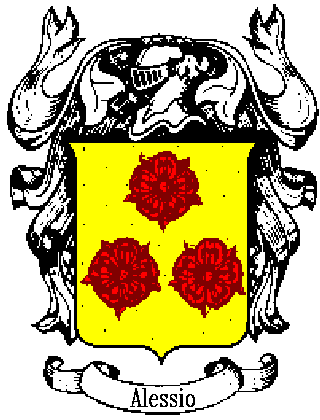
Alessio Coat of Arms
D'or a trois roses mal-ordonees de gu
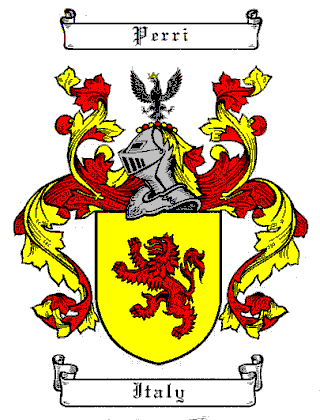
Perri Coat of Arms
Or, a lion gules with a crest of an eagle displayed sable crowned or

Our Name and Coat Of Arms

The Reitstap Amorial General has the Alessio Coat Of Arms as "Gold: Three red roses, one over two". To find more about our coat of arms, try
An Illustrative and Educational Guide to Heraldry and Blazoning in our Current Middle Ages.
The Instituto Onomastico Italiano says that the name "Alessio" has Greek origins, and signifies "Defender" and "Protector". It translates into English as "Alexis" or "Alexander". People with the name Alessio are supposed to be generous, impulsive, and possessive over their loved ones.
The Historical research center in Venice has this to say about the Perri surname:
The Italian family name Perri is classified as being of personal name origin. According to scholars the "oldest and most pervasive type of surname is that derived from a given name". such family names may be derived from a parental first name or from the first name of the grandfather or indeed from a remote ancestor of the original bearer of the surname. With regard to the family name Perri, it's origin derives from the name Pietro, rendered in English as Peter, ultimatly derived from the Aramaic "Kephas", taken from "kefa", which means "stone", "rock". There is evidence to suggest that at least some Italian "bynames" had become fixed, if not completely hereditary, by the tenth century as revealed in early medieval Venetian records. Variants of the surname Perri include Perrelli, Perrello, Perrini and Perrucci. One of the earliest references to this name or to a variant is a record of one Felice Perri, a chemist mentioned in 1779. However, research is of course ongoing and this name may have been documented even earlier than the date indicated above. Notable bearers of th surname Perri include Francesco Perri, a physician from the region of Calabria that was published in 1869. References to this family name are found in the archives of the city of Marano Marchesato (Cosenza), where the birth of Ignazio Perri, son of Carmine Perri and Arcangela Chiapetta, was recorded on April 7th, 1802. We also read of the marriage of Antonio Perri and Terresa Sellara, celebrated in San Giovanni in Fiore (Cosenza) on March 23rd, 1813. Evidence of the existence of the surname in America is substantiated by the "Italians to America", which notes that Saverio Perri arrived in New York on April 8th, 1881 aboard the "Vincenzo Florio". However, the name could have been introduced there at an earlier date.
To find out more about Italian names, try Pursuing Our Italian Names Together
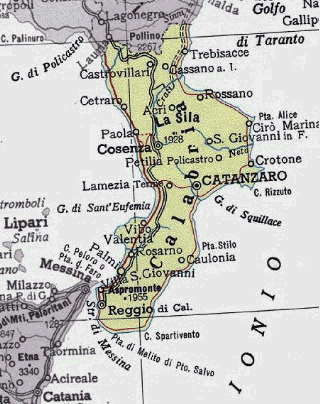


Map of Calabria
Calabria is located in southern Italy;
the toe of the boot.

Calabria

Our family originated in Southern Italy, in the town of Acri, region of
Cosenza, province of Calabria. Regio Cosenza is named for the largest town in the region; Cosenza. The entire region has a population of about 750,000, a good number of which live in the city of Cosenza. While Acri is not a big city, it is large enough to appear on maps of the entire country. Acri lies just south of the river Crati, and just east of Mount Scla at 39°30'N 16°15'E. It's position high in the hills and mountains of Southern Italy make it likely to snow in the winter.
2500 years ago, Southern Italy was a glowing part of Greek civilization, it was where adventurous Greeks went to make a fortune, a place visited by Pythagoras, Herodutos, and Plato. When the Roman age overtook the world, it became a land of large farming estates. This golden age would soon come to an end, as it would pass through the hands of many foreign rulers; Byzantines, Arabs, and eventually the Normans who would carve kingdoms out of Southern Italy. The Normans would rule "The Kingdom Of Two Sicilies" from medieval times until 1860 when Giuseppe Garibaldi would lead thousands of troops in a bloody civil war that eventually unite all of Italy under one flag.
The violence didn't stop then. Even today in Calabria, there is a strong presence of organized crime, called �Ndrangheta. While not as famous as the Mafia of Sicily, the 'Ndrangheta is just as violent, if not more so, indeed, the yearly death toll relating to organized crime in Cosenza regularly tops 60! (not too long ago, 14 people were killed in a two week period).


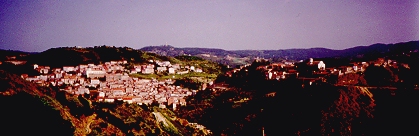
Photo of Acri
View of Acri in 1994

Acri

Acri is an old Italian hill town, with the houses perched precariously atop the peaks, and farms in the valleys. Acri was the birthplace of St. Angelo of the Beatitude, and has existed in it's current location since ancient times.
An old
Angelo Alessio described his home town to his grandchildren as a poor and dirty place, where his family lived above their farm animals, the streets were full of mud and everyone was poor. He didn't want to return and visit because of the poverty and corruption.
In 1994 when Angelo's son Raymond and grandson Michael drove through Italy and visited Acri, they found a very different place. Instead of mud filled streets, we found beautiful cobblestone walks up narrow alleyways. Instead of houses above stables, we found trendy shops full of Guci, and other designer clothing. Instead of poverty, we saw expensive cars filled with smartly dressed women sporting classy jewelry. Acri has turned into a trendy little shopping village. A lot can change in 100 years.
The corruption? Still there. We noticed it by the general paranoia of leaving a paper trail that the inhabitants had. Southern Italy is a cash based economy; no credit cards or ATM's. Apparently what the government can't trace, it can't tax.
As to the people? There is no doubt that our roots hail from here. While we enjoying a nice, cold gelato, a young man cycles up, flirting with the beautiful girls near by, and every mannerism, every facial feature and all his expressions were a dead on match for Michael's younger brother Chris.


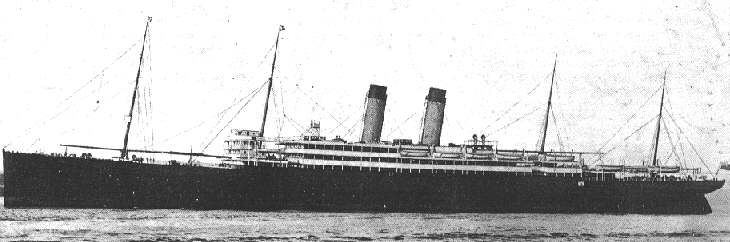
The Cedric
The vessel that most of our ancestors made the Atlantic crossing on, The Cunard lines Cedric

The New World

It is not surprising that millions of Italians left Italy for New York around the turn of the century, Calabria was a poor, violent and oppressing place. The streets of New York was rumored to be "paved with gold" a place where the adventurous could go to make their fortune. What they found instead, was that the streets were not paved at all, and that they were expected to pave them.
New York was not a bad place though, it did offer a better chance at making a fortune than Calabria. After being poked, prodded, and questioned to death at
Ellis Island, they found that the neighborhood where they would eventually settle to be full of Italians, making the transition to a new country easier.
Our ancestors probably traveled on the cheapest tickets available; steerage. The trip over was probably horribly crowded, with hundreds of people crowded into a room less than eight feet high, divided down the middle by a blanket hung on a rope to separate the men from the women and children. With no portholes, little ventilation, and skimpy and carelessly maintained toilet facilities.
Inside the steerage cabin there were probably two or three tier high bunk beds, with filthy, lice filled mattresses. Women traveling with children tried to make sure they got the bottom bunk; less distance for a child to fall from the bed while the boat was rocking.
As the ship steamed into New York Harbor, eager to catch sight of the new land, steerage passengers would hurry up on to the deck. In Italy they had heard of the Statue of Liberty, although they weren't exactly sure what it was. More than of few of them believed it was Columbus' grave. Still, to all of them, the first sight must have been unforgettable.
From the harbor the ship steamed up the Hudson River to a pier where the first- and second-class passengers, native or immigrant, debarked. Their passage through immigration would be quick and courteous. While they were being cleared, the steerage passengers were kept waiting. And waiting. Working a twelve hour day, the Ellis Island staff could process five thousand immigrants. But in 1906, at immigration's peak, two or three times that number might arrive in a single day. The steerage passengers had to wait in the ships that brought them. Passengers had to verify that they were not polygamists, anarchists, or indentured laborers, and had never been in a poorhouse or insane asylum.
When the immigrants finally debarked, they were harshly commanded to hurry. Bulky in their layers of clothing, carrying infants, bedding, pots and pans, even cuttings from a home vineyard to transplant in America, they scrambled from their boat and onto the barge that would transport them to Ellis Island.
Finally landing on Ellis island, the passengers would line up in front of the main door, standing under an enormous metal canopy that was about 50 feet wide. Entering the entrance, they would climb the immense stairway to the huge Registry Room where the next ordeal would begin. The room was divided into iron-railed aisles into which the new arrivals were steered (or shoved) to wait some more.
They would be checked for a "steady" gait and a "normal" demeanor. Doctors would thump their chests, inspect their skin and fingernails (for blue nails which might indicate heart trouble), and listened for hoarseness or labored breathing. When they reached the most feared inspector, the eye doctor, the doctor would invert their eyelids with a crochet hook, looking for signs of trachoma. The slightest hint of the disease would result in the letter E being marked on the immigrants clothing. E for eyes. That meant certain rejection.
After passing the medical examination they moved through the back of the room to meet the "primary" inspector, the man who would finally give or withhold permission for them to go ashore. The inspector would ask a total of twenty-nine questions. What was your name? Age? Can you read and write? What's your occupation and destination?
The most difficult question was one that men often stumbled over: Have you got work waiting for you in the United States? The correct answer was, "No." The importation of contract labor was illegal, and, over one thousand contract laborers each month were deported from Ellis Island. But men were always tempted to answer, "Yes." Relatives in America had assured them that jobs were available and easy to get. And many were eager to make it clear that they would be self-supporting and would not end up as public charges.
After leaving the primary inspector, they went back to the baggage room to pick up their belongings. With their papers stamped at the primary inspector's desk, they were now free to enter the United States.
A ferry to the Battery was $3.65, another 5 cents bought a subway ride once they were on Manhattan. Princely sums for those days.

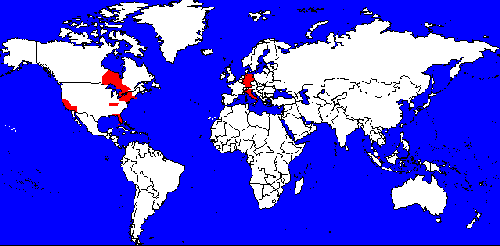
World Map
Where our family lives today

Where We Are Today

Like other ethnic groups emigrating to America, many Italians eventually drifted away from the initial place of immigration. Our family provided no exception to this rule. Many of our relatives did not stay in New York, they moved on to California, Kentucky, Florida, New England, and Canada. Some of us even have returned to Europe. Probably not for good, but at least for the time being.
<script> <!--function nothing(){ //--><center><font size=-1><nobr><a target="docFrame" href="AAAIntro.html">Introduction</a></nobr> | <nobr><a target="docFrame" href="VincenzoAlessioTree.html">Alessio Family Tree</a></nobr> | <nobr><a target="docFrame" href="AAA0.html">About Our Family</a></nobr> | <nobr><a target="docFrame" href="AAA1.html">The Italians</a></nobr> | <nobr><a target="docFrame" href="AAA2.html">Our Common Ancestors</a></nobr> | <nobr><a target="docFrame" href="AAA3.html">The Immigrant Family</a></nobr> | <nobr><a target="docFrame" href="AngeloRae.html">Children of Angelo</a></nobr> | <nobr><a target="docFrame" href="AAA4.html">Other Sons and Daughters of Immigrants</a></nobr> | <nobr><a target="docFrame" href="RayMarilyn.html">Children of Raymond</a></nobr> | <nobr><a target="docFrame" href="GloJoe.html">Other Decendants of Angelo</a></nobr> | <nobr><a target="docFrame" href="AAA5.html">Other Second Generation Americans</a></nobr> | <nobr><a target="docFrame" href="AAA6.html">Other Third Generation Americans</a></nobr> | <nobr><a target="docFrame" href="AAA7.html">Our Youngest Generation</a></nobr> | <nobr><a target="docFrame" href="AAAUnknown.html">Mysteries</a></nobr> | <nobr><a target="docFrame" href="AAAIndex.html">Index by Name</a></nobr> | <nobr><a target="docFrame" href="gengstbk.html">Guestbook</a></nobr></font></center><HR><A HREF="http://www.webcom.com"><IMG SRC="../webcom_tiny.gif" ALT="Webcom Logo" WIDTH=80 HEIGHT=50><BR>This site hosted by Web Communications - sign up today</A><BR><H6>Copyright &#169; 1992-1997</H6> <!--}--> </script>
Hosted by www.Geocities.ws

1