QUASICRYSTALS
|
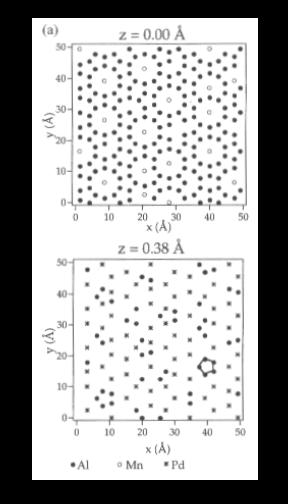
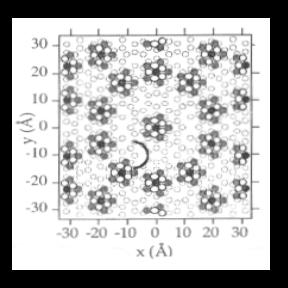
What are Quasicrystals (QC)? QCs were discovered in 1982 by Shechtman. Unlike regular metals that have a periodic crystal structure that is infinitely repeatable and can be represented by a single unit cell, QC's are materials that are quasiperiodic and not repeatable and therefore cannot be represented by a single unit cell as shown on the right and below. QC's have shown to possess superior properties to pure metals such as low friction, adhesion, and surface energy and high wear resistance and hardness.
|
![]() |
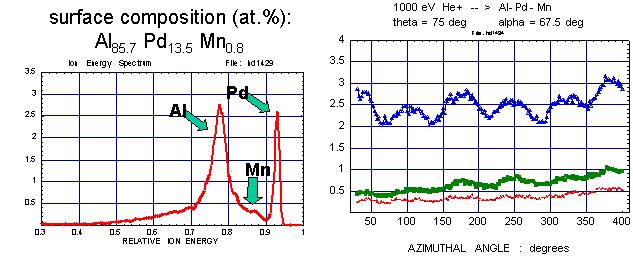
The research I have been apart of is investigating the surface structure of the AlPdMn quasicrystal using LEIS. By comparing experiments and simulations we are atempting to create a unit cell that represents most of the quasicrystal surface. Jecks et al measured the AlPdMn quasicrystal surface composition and structure with LEIS. The composition was found from the area of the peaks in the diagram below, and it was determined that there is 85-86% Al, 13-14%Pd and 0-2%Mn on the surface. The structure was also determined to have a five-fold symmetry by rotating the sample. |
![]() |
![]() |
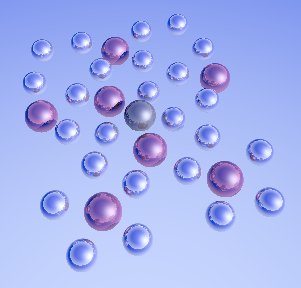
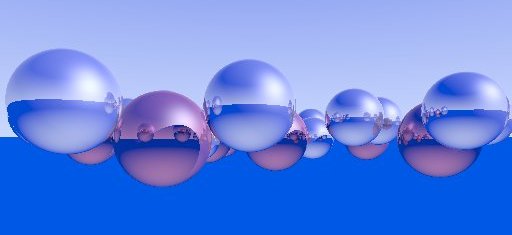
Using this knowledge an example of a unit cell to represent the quasicrystal is shown on the left (top) and below (side). The silver spheres are Al atoms, the grey sphere is Mn and the purple spheres are Pd atoms.
|