LOW
ENERGY ION SCATTERING
| |
|
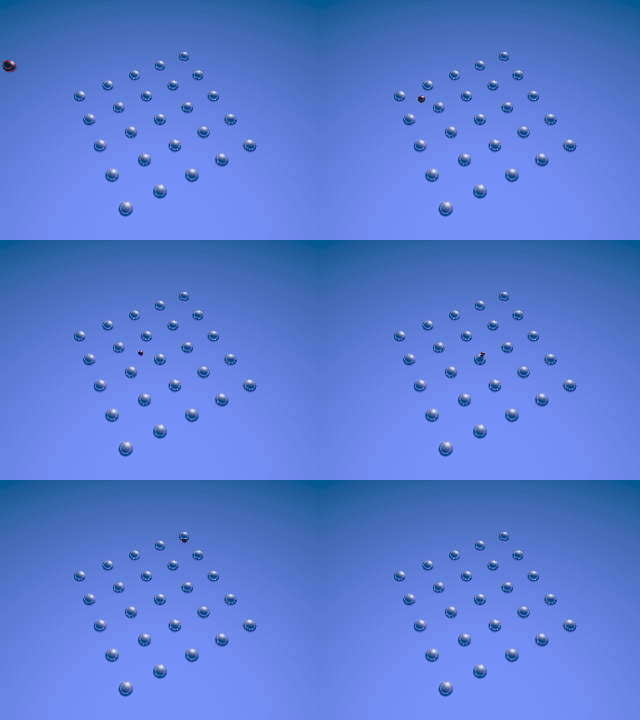
| Single Scattering | Double Scattering |
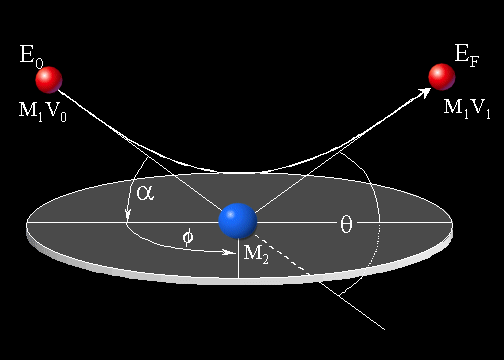
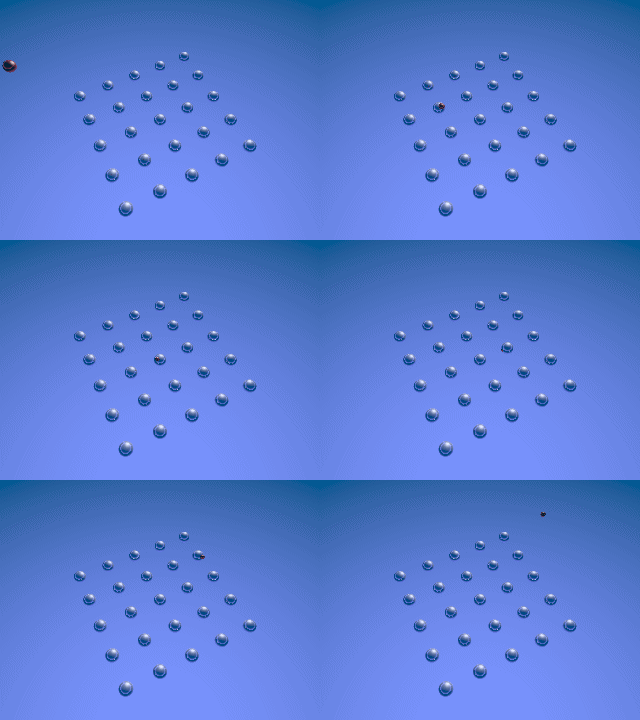
Low Energy Ion Scattering (LEIS) was derived from the groundwork of Bohr's theory of atomic structure and Rutherford's alpha particle experiments a century ago. It had taken until the late 60's to inspire the development of ion scattering surface analysis technique by D. P. Smith. LEIS involves the interaction with an ionised particle (He+) with atoms on the surface of materials, particluarly metals. As the incident ion approaches an atom core, the repulsive electric force repels the two positive charged ion cores in some scattering geometry dependant on their momentum and energy as shown below. Due to the relatively low speed of incident ions, there is a complete lack of necessity for relativistic theory to explain the collision of atomic particles and allows an accurate description to be made by classical mechanics. |
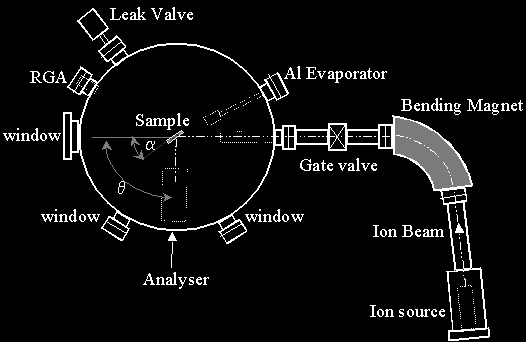 |
At the University of Newcastle Physics Department, the LEIS apparatus looks like the schematic shown here. A beam of He+ ions are gererated at the ion source and are accelerated toward the sample via a bending magnet. Ions other than He+ are eliminated through the use of this magnet as it can be tuned to allow only atoms with specific mass and energy.
|
|
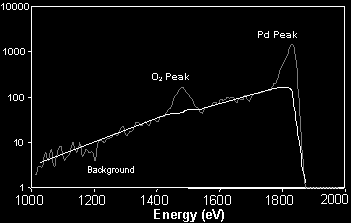
When the ion beam hits the sample it is then scattered and its energy is measured by the analyser. The low energy of the ion (typically between 500eV and 5keV) allows very surface sensitive measurements to be made. The energy of the scattered beam depends on the atom on the surface that the ion beam hits. Therefore, the composition of the surface can be determined.
|
|
||
| Energy Scan |
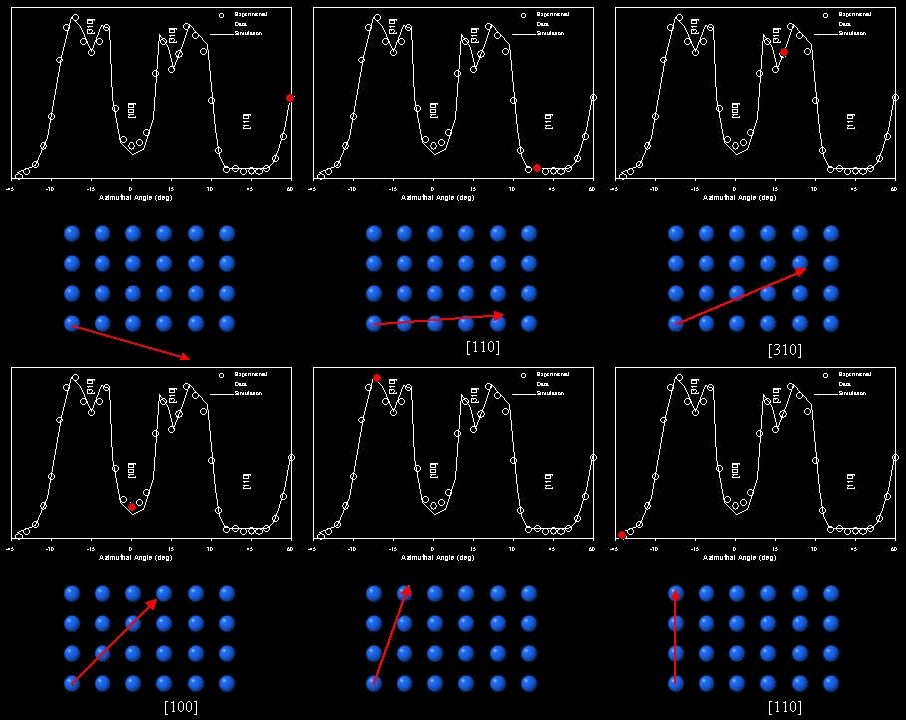 |
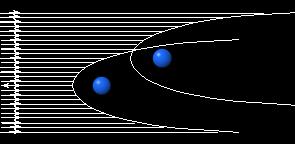
The positions of the atoms can be determined by rotating the sample through phi (the azimuth). Just like light causes a shadow, the ion beam is shadow behind an atom on the surface in the form of a shadow cone shown below. As the sample azimuth is rotated, as shown on the left, adjacent atoms can move within this shadow cone. As a consequence, the intensity of the scattered atoms decreases since there are less atoms to scatter off. The animation on the left shows the relationship between the intensity of the scattered ions (red spot) as the ion beam (red arrow) is rotated across the surface. Notice the large troughs indicating the low index crystal directions (e.g. [110], [100], [310]).
|
Azimuthal Scan |
Shadow Cone |