SURFACES OF Pd(100)
![]() |
![]() |
![]() |
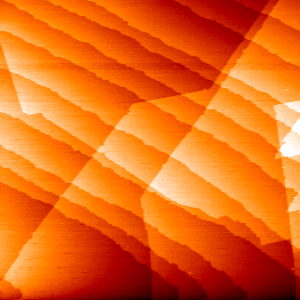
This page shows the investigatations of Pd(100) using STM when exposed to different conditions. The stability of the Pd(100) surface changes when impurities diffuse through to the surface at temperatures slightly lower than the nominal annealing temperature of 1100K. It is interesting to note that as the temperature is increased to 1100K these formations are annihilated and the typical Pd(100) structure returns. |
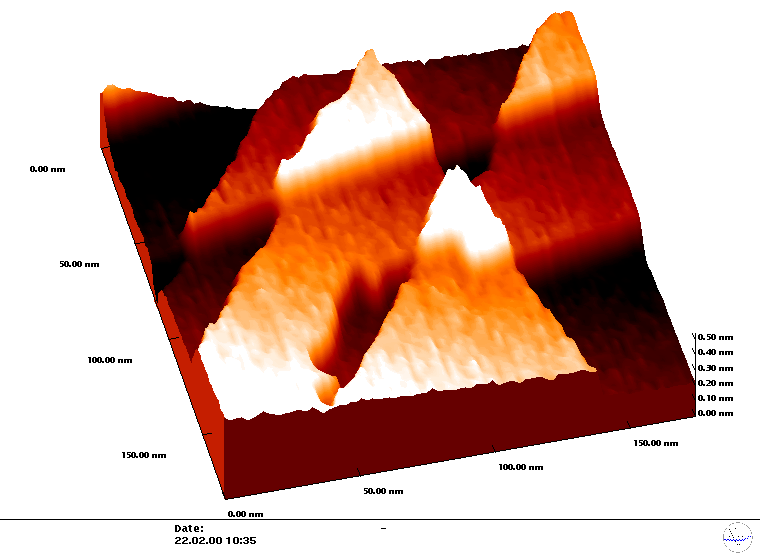
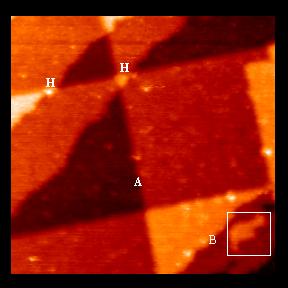
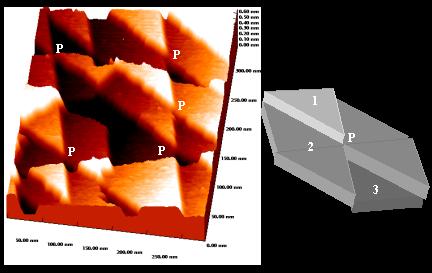
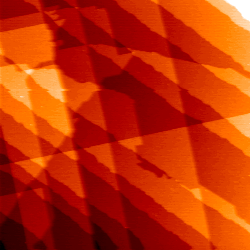
Steps marked A, have the same step height (1.80 ± 0.05Å) however, steps marked B have a different height (2.00 ± 0.05Å). This difference in step height indicates an unusual and independent growth mode for these steps or an unusual electronic effect. Taking a closer look at the island with the area enclosed by the white square, the hypotenuse of the island triangle actually consists of growth in two low index directions. If the island continued to grow, the growth of this step would change to replicate the steps seen at B. Three dimensional images of this surface is shown above. Each step is measured to be approximately 1.95 ± 0.05Å (1 atomic step for Pd). A fascinating characteristic of this image is that every point where the triangles meet (marked P), the step height is two atomic layers, i.e. there is a double step change instead on one. |
![]() |
|
The nexus of the triangular patterns for the Pd(100) surface reveal a hotspot, denoted H in the figure. The main contaminates for Pd are carbon and sulphur. An AES spectrum revealed both carbon and sulphur present on the surface, but as will be seen later in this section, increased carbon on the surface (without sulphur) does not cause this reconstruction. Therefore it is concluded that sulphur impurities are segregating to the surface and causing the observed triangular pattern with the sulphur visualised at an origin for step edge growth. Other impurities can be seen on the surface, at points along several step edges. These contaminates could either be from normal segregation from the bulk, adsorption of gas molecule from vacuum or sulphur atoms that have initiated the triangular pattern and diffused across the surface. |
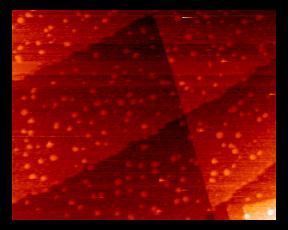
O/Pd(100) Oxygen islands are formed instead of the random blanket expected and seen for many oxygen covered metal surfaces. The islands have an average diameter of 10nm ± 3nm with an island density of one every 1200nm 2 and have no preferred adsorption site, i.e. nucleation at step edges is not preferred. The islands may be in fact an O/Pd reconstruction.
|
![]() |
![]() |
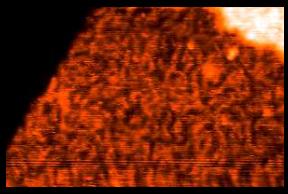
C/Pd(100) At a slightly different annealing temperature, 900K, another formation appeared on certain areas of the surface and is shown in figure 8.16. An almost brain-like structure is observed on the Pd(100) surface. Auger spectroscopy of this surface revealed a significant increase in carbon concentration on the surface. |