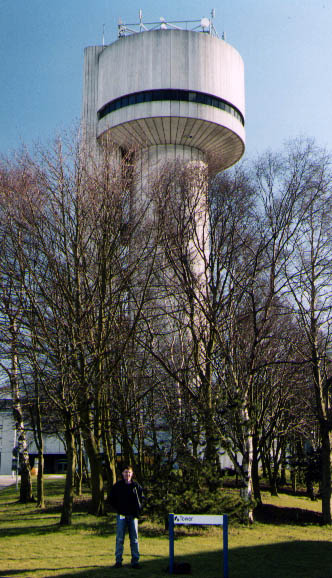
Daresbury MEIS Facility
MEDIUM ENERGY ION SCATTERING
|
|||||||||||||
Daresbury MEIS Facility |
Information Links | ||||||||||||
MEIS Lab |
|
| The MEIS technique allows the determination of the composition and atomic structure of crystalline surfaces and interfaces. It typically uses H+ or He+ at incident energies in the 100-400 keV range. Similar to Rutherford Back Scattering (RBS), MEIS involves the energy analysis of scattered primary ions but generates
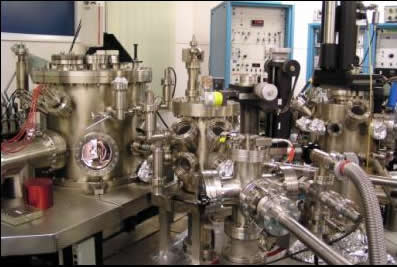
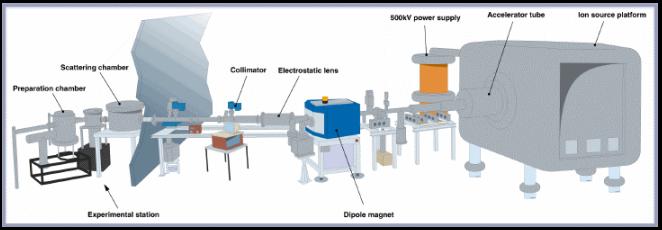
much finer depth resolution. The picture on the left shows the analysis chambers for the MEIS facility at Daresbury, UK whereas the diagram below illustrates the whole MEIS setup at Daresbury. The picture actually shows three chambers, intro, preparation and analysis. |
 |
 |
|
 |
The MEIS technique exploits the use of elastic 'shadow cones' in both the incident and backscattering parts of the ion trajectory. The shadow cones are at much higher energies than in LEIS therfore they are much narrower. Narrower shadow cones makes it possible to probe deeper into the subsurface than in LEIS. Combined with improved structural sensitivity MEIS has the ability to obtain subsurface compositional information through the inelastic energy losses incurred as the ions penetrate further into the solid.
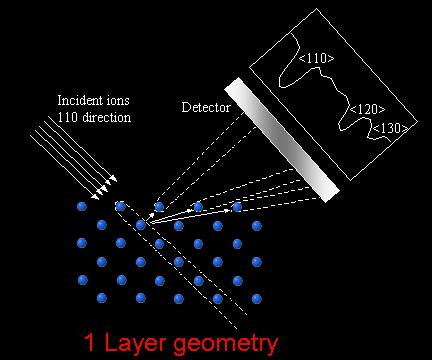
When the ion beam is aligned with a crystallographic axis(as shown on the left) the surface atoms shadow deeper atoms from the ion beam.
This alignment therefore makes the technique surface specific and, for a particular crystal, certain ingoing directions can allow the ion beam to illuminate only the top one, two, or three layers according to choice. Ions scattered from the second layer will have their outward paths blocked at certain angles by first layer atoms as illustrated on the left. These blocking cones are represented by dips in the spectra. |
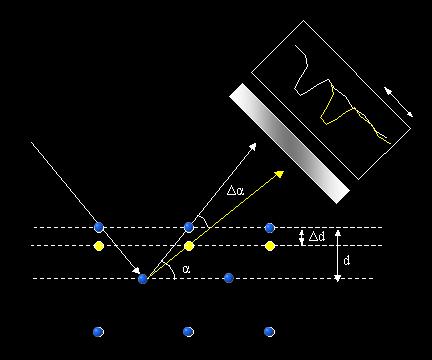 |
Atoms on surfaces relax to adjust to the sudden interface or lack of atoms on one side. Atoms on metal surfaces have a tendency to relax inwards, i.e. toward the bulk, but sometimes outwards or even a combination of the two, called corrugation. The MEIS technique is an excellent tool for measuring this phenomenon as shown in the diagram on the left. The blocking dips change position relative to the position of the surface atoms. An exact determination of the surface atoms position can then be made. |