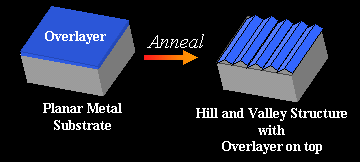
Certain planar metal
surfaces, when covered by particular overlayers and then heated, experience
a massive restructuring of the surface and form nanoscale hill and valley
structures as shown below.
FACETING OF SURFACES
What is Surface Faceting?
The faceting of objects has a long tradition.
Most predominately, the faceting of gems became the cornerstone of jewelry making
as early as 4000 BC and developed the foundation for global market trading.
Before gemstone cutting was born the chiseling of rock to produce weapons such
as arrowheads, spears and axes has been documented a great deal earlier. In
more recent times, faceting of surfaces has taken a slightly altered interpretation.
|
|
Certain planar metal
surfaces, when covered by particular overlayers and then heated, experience
a massive restructuring of the surface and form nanoscale hill and valley
structures as shown below. |
|
|
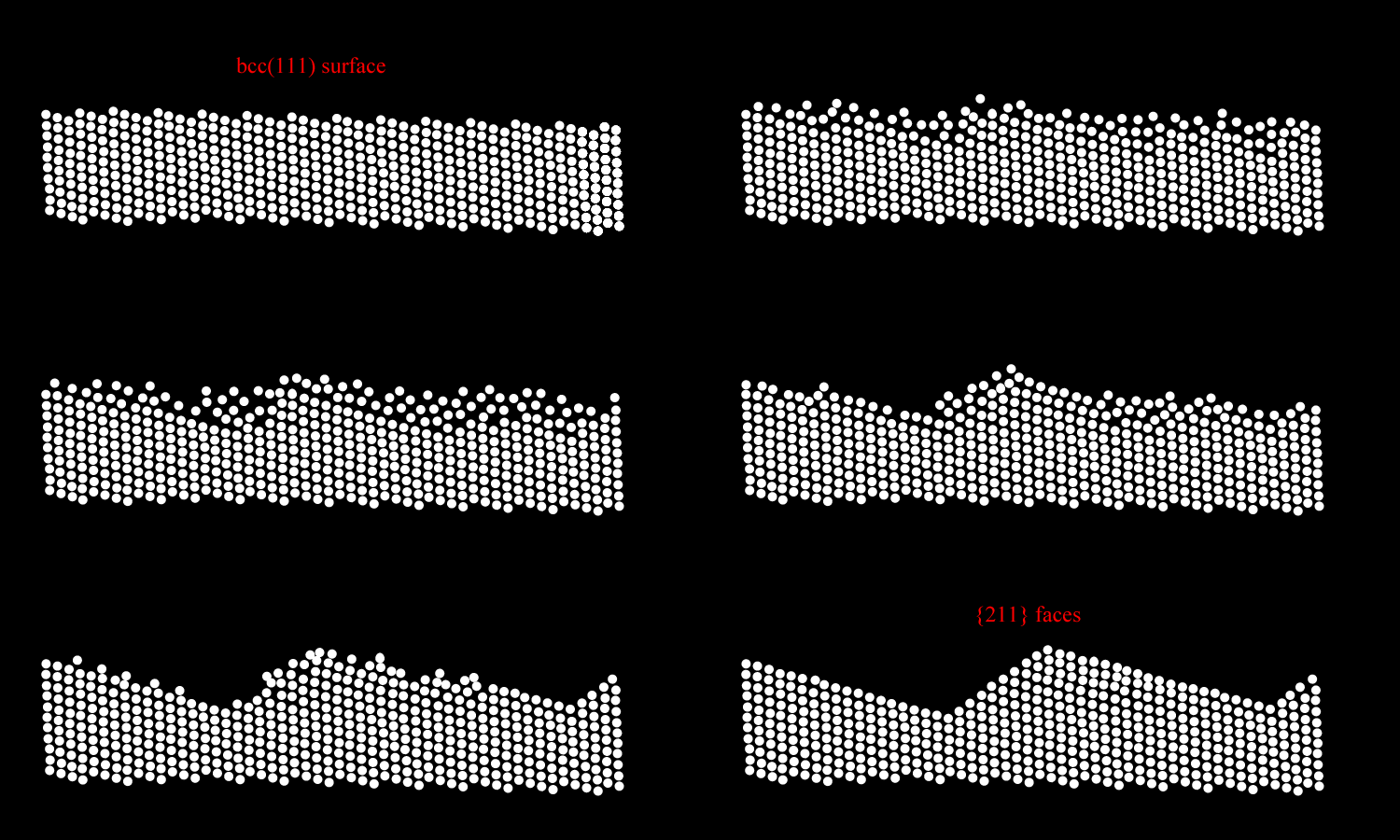
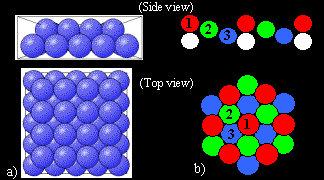
The majority of metal surfaces that comprise published papers are atomically smooth, close-packed substrates as illustrated by the Pd(100) surface in (a). The metal surfaces that have been induced to facet are atomically rough, morphologically unstable surfaces. Some of the substrate metals that have been shown to facet are W(111), Mo(111), Pt(210) and recently Cu(210). The tungsten and molybdenum surfaces have been the most extensively examined surfaces shown to facet. Figure (b) exhibits the atomic model of the bcc W(111) planar surface which forms three-sided pyramidal facets when heated with a particular overlayer on it shown below. In General - The more atomic layers visible to the surface, the more morphologically unstable the surface will be. |
 |
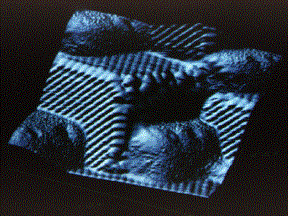 |
The picture on the left is an STM image of a faceted surface of W(111). The faceting was induced by placing 1ML of Pd on top and annealing to 800K. Below is a the d-shell metal periodic table showing in blue which elements have been shown to facet. |
| Ti |
V |
Cr
|
Mn |
Fe
|
Co |
Ni
|
Cu
|
| Zr |
Nb |
Mo
|
Tc |
Ru |
Rh
|
Pd |
Ag |
| Hf |
Ta |
W
|
Re
|
Os |
Ir
|
Pt
|
Au |