
Assumptions
For instance, scribble down last weeks winning lottery numbers, then time travel back 7 days, and place a bet on them turning up.
The result should be that you will win!
But if you do win, what happens to the you that initially lost?
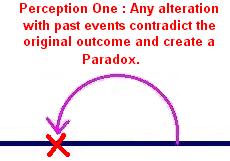
In a linear timeline, any interaction in the past which is likely to alter the future outcome, should bring about a paradox.
Since perception one suggests that time has already been written, both future and past, then NO changes can take place.
Any changes that do occur will undo the future timeline which you once belonged to, and should therefore reshape your knowledge so that you were only ever aware of the new outcome of events.
Consider this example.
Lets say we are sitting next to each other.
I leave the room to make a cuppa
Upon my return, I ask you to choose a number.
and you shout out loud " three ".
I scribble down on a piece of paper your chosen number and place it in my pocket.
then i travel a few minutes back in time to before I asked you the Question.
I rematerialise several minutes earlier where the original me is out making a cuppa.
I say to you "In a moment I shall ask you to choose a number, i want you to pick 'five' ".
Then I time travel back to my original destination.
Now, the tea-making me enters the room and asks you to choose a number.
What number would you shout out?
Assuming that you took on board my advice to choose 5,
then you should shout aloud 5.
I have altered the timeline, to no devastating outcome, but I have altered it.
If you choose 5, as I instructed, then the piece of paper on which i scribbled '3', should either vanish,
or change into a number '5'.
If you chose '5', then the tea making version of me, never even heard you utter the number '3',
so why would I go back in time to force you to choose '5' instead?
The confusion that has become apparent here, is called a paradox.
Paradox is basically a contradictory statement:
None of these statements make any sense.
They each contradict themselves.
Either something is one thing or the other, not both.
This is also described by the term Mutually exclusive.
Mutually exclusive being two opposite things that cannot both be true.
It's either one way, or the other.
Never both.
As in the number example above, it doesnt really matter wether you chose '3' or '5',
but since I only asked you to choose a number once, then you could only have given one answer, not both.
The Main problem with time perception One, is that by allowing alterations in the past, and by assuming a linear timeline,
confusion always exists, and Paradoxes crop up everywhere.
In the film Back to the Future 2, the scientist Dr Brown suggests that such a paradox confuses everyone and everything
and will result in a complete collapse of space / time / and everything in existence.
In short, Time perception one is a load of bollocks.
it has a plausability factor of zero.
This implies that even if Time travel were possible, then how can anything be altered?
Especially if even the smallest of changes in the time line would produce a paradox
and therefore result in anihalation of everything in a millisecond.
Unfortuneately Back to the Future part one bases most of its storyboard on perception one,
which is why i gave it such a Scientific slagging here.
So whats the answer?
How do we allow time travel, with permission to alter past events without causing universal demise?
To avoid paradoxical scenarios existing, I have laid out a different perception of time.