 |
| @ |
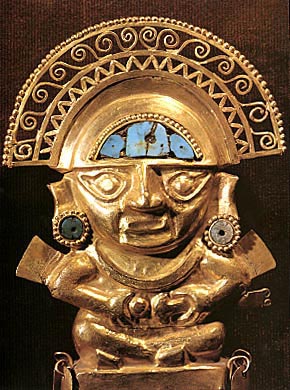
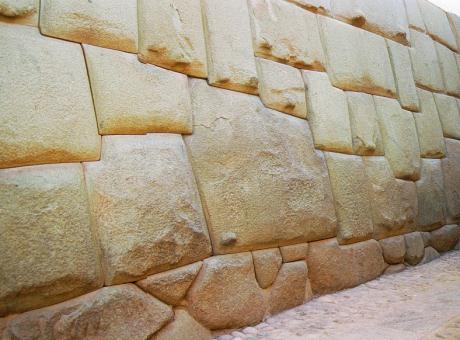
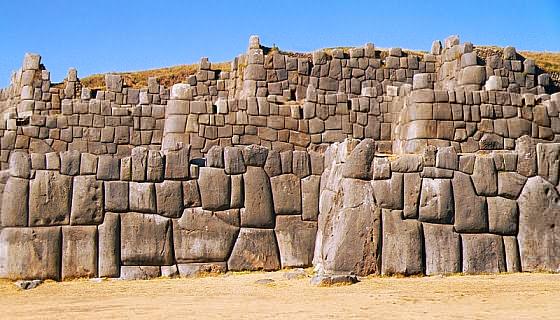
In the early decades of the 15th century, an obscure people whose rulers claimed descent from the sun embarked on a series of conquests that would enable them to dominate the last hundred years of Andean history. Although their subsequent supremacy was often achieved through diplomacy, the Incas boasted one of the most well organized and ruthless armies of the ancient world. The Incas maintained their realm with astonishing efficiency. They called their empire Tahuantinsuyu, "the land of the four quarters," reflecting a fourfold geographic division that was in turn subdivided into more than 80 provinces. Taxpaying citizens in carefully documented groups populated these provinces. The use of Quechua, the Inca language, as the common tongue of administration helped to unify the patchwork population, as did commerce and the institution of the Inca pantheon as the official state religion. Pachacuti a military strategist, statesman, and diplomat of enormous skill, structured and commanded the armies. Armies under Pachacuti and his son (and successor), Topa Inca, conquered the entire mountainous area from Quito south past Lake Titicaca. Topa Inca also subjugated the coastal kingdom of Chimor, and extended the Inca domain farther south, as well as east to the fringes of Amazonia. The ''Unique Inca," (the emperor) stood at the apex of power, a divine representative of the sun. From him control filtered downward through an elite class of nobles. Some were hereditary. Other select groups in conquered lands who were willing to cooperate with their new leaders became "Incas by privilege." The majority of the empire's able-bodied citizens sustained its economy with the Mita (service tax), in the form of agricultural work, labour in government-owned mines, or the building of bridges, buildings, and roads. In return, the system guaranteed that every individual even the old or disabled would receive his or her basic needs. A highly authoritarian bureaucracy controlled the diverse peoples of the empire. Potentially rebellious groups were transplanted into the midst of loyalists, while trustworthy subjects were moved to areas of dissent. The military garrisons that dotted the land served as constant reminders of Cuzco's might. Inca roads in the highlands were especially designed for the challenging terrain. Switchbacks scaled the steepest slopes, much like their modern counterparts. Sometimes paved with stone, the thoroughfares were often supported by retaining walls that have lasted for more than 500 years. To bridge rivers, the Incas lashed balsa-reed boats together or built sturdy stone spans. The deepest ravines they conquered with the worlds first known suspension bridges, swinging constructions of braided fibre and vine anchored to pillars on opposite sides of a chasm. The anonymous Inca engineers achieved artistic immortality with the design of massive masonry walls that incorporated stones weighing more than 100 tons. The irregular but fastidiously finished blocks interlock so perfectly the joints between them appear as mere hairlines. Such walls make up fortresses of sophisticated military design, like Sacsahuaman on the outskirts of Cuzco, and temples whose remains lie undisturbed beneath modern towns. The stonework even provides the foundation for great cities like Machu Picchu, the spectacular outpost of Inca culture that still crowns its mountaintop site high above the turbulent Urubamba River. A vast network of highways (thoroughfares) linked all parts of the Inca Empire. Often the Inca himself, borne on a golden litter, travelled along the roads, followed by an elaborate entourage of courtiers, entertainers, soothsayers and concubines. Also using these thoroughfares (highways), were mobile army units (accompanied by pack trains of llamas) and Chasquis, specially trained runners who relayed memorized news and the orders of the empire between carefully spaced Tambos, or way stations. These messengers formed a communications system that could guarantee one-day delivery for every 140 miles of road. Topa Inca's son, Huayna Capac, pushed the boundaries of his realm even farther north and ruled over the greatest period of Inca magnificence. But Huayna Capac died suddenly in 1524. Infighting over succession followed, spurred by the spread within the royal line of contagious diseases introduced by the earliest European explorers. These factors, coupled with a growing number of rebellious subjects throughout the far-flung Inca territories, rendered the empire particularly vulnerable to the armies of Francisco Pizarro in 1532. The earliest systems of irrigation canals eased the lives of settlers along the strip of desert coast, where the only sources of water were narrow rivers. In the highlands massive stone terraces transformed the steep Andean slopes into fertile fields. The most amazing achievements of engineering, however, are to be found in the roads, bridges, storehouses, fortified towns, and way stations built by the Incas. Given the raw materials and tools available to them and their predecessors, these accomplishments seem almost miraculous. What they did achieve was largely due to their organizational abilities. As soon as the Spaniards had disrupted the state's monolithic bureaucracy, the sun began to set on ancient South America's most spectacular civilization. There were six Inca gods, Viracocha, the mother and father of the sun and moon god, Inti, the sun god, Quilla, the moon god, Pachamama, the earth goddess, Illapa, the god of thunder and lightning, and Mamacocha, the sea goddess. The Incas �were� highly skilled architects, yet they did not have the wheel or a written language. With the invention of the Quipua, (a string counting device used by tying knots with different colours of ropes representing different meanings) and the Chasquis, they were able to communicate their wishes. The Incas also carried agriculture and animal breeding to great heights. The traditional use of the cocoa leaf dates back to the pre-colonial days. Inca legend has it that the son of the sun god delivered the leaf to them when he magically appeared on the Isla del Sol in Lake Titicaca. Cocoa leaves were chewed by the Incas to combat the effects of altitude and fatigue. They developed the white potato, several types of corn, a wide variety of beans (including the lima bean), and drugs such as quinine and cocaine. Orchids were grown for medicine. The Incas also showed great skill in domesticating animals. They bred the llama and alpaca from the guanaco (the native American camel.). Machu Picchu - This lost city was discovered five hundred years after the Inca�s had abandoned it. |
| Inca Culture |
|
 |
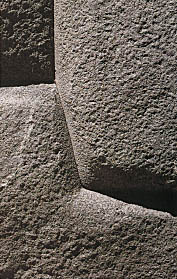 |
| An Inca wall of carefully cut masonry that formed part of the palace of Inca Roca in Cuzco. In the centre is the famous twelve-angled stone. |
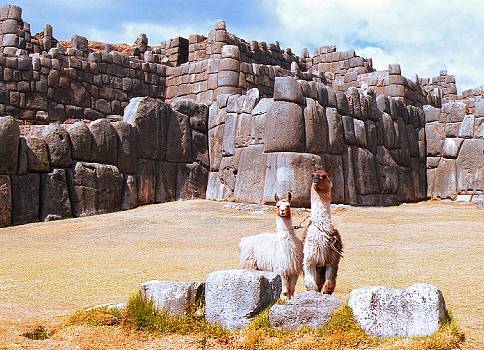
| Remains of the huge Inca fortress of Sacsayhuaman on a hill overlooking Cuzco, Peru. |
 |
 |