

![Microsoft Visual FoxPro version 8 [1]](images/MicrosoftVisualVisualFoxPro8.jpg)
![Microsoft Visual FoxPro version 8 [2]](images/MicrosoftVisualVisualFoxPro8_2.gif)
![Microsoft WORD 2003 Beta -------------- [HOT]](images/MSOffice2003_Beta_Word.jpg)
![Microsoft WORD 2003 Beta Splash-Screen -------------- [HOT]](images/MSOffice2003_Beta_WordSplash.jpg)

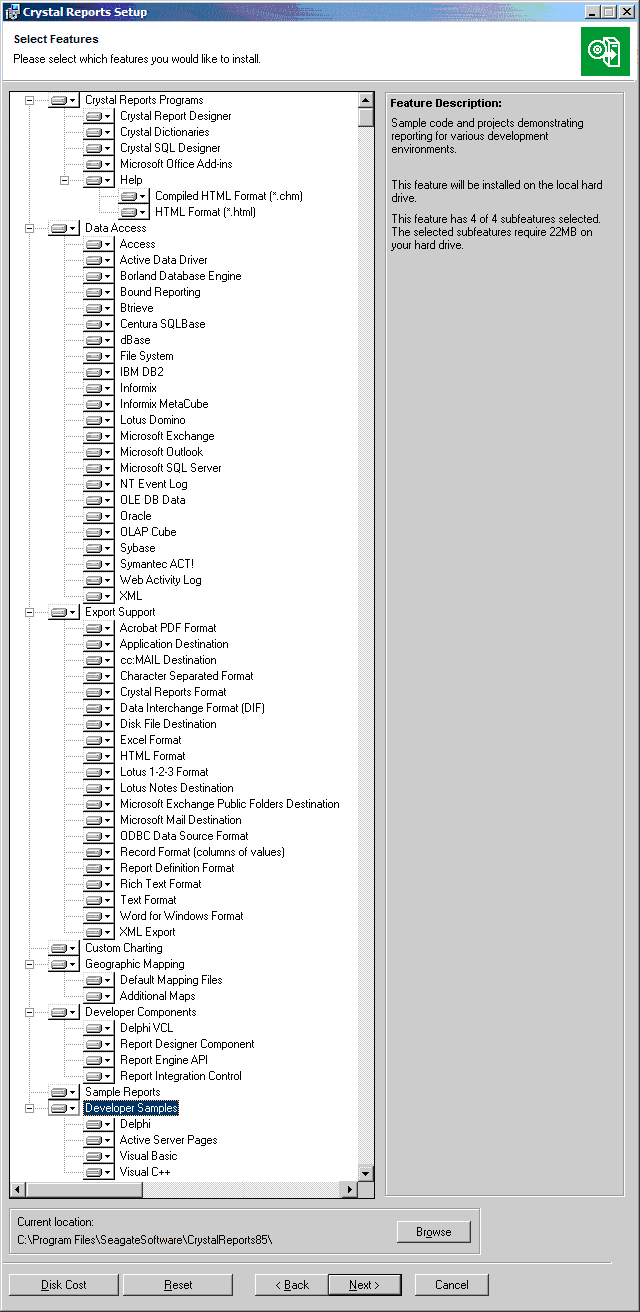
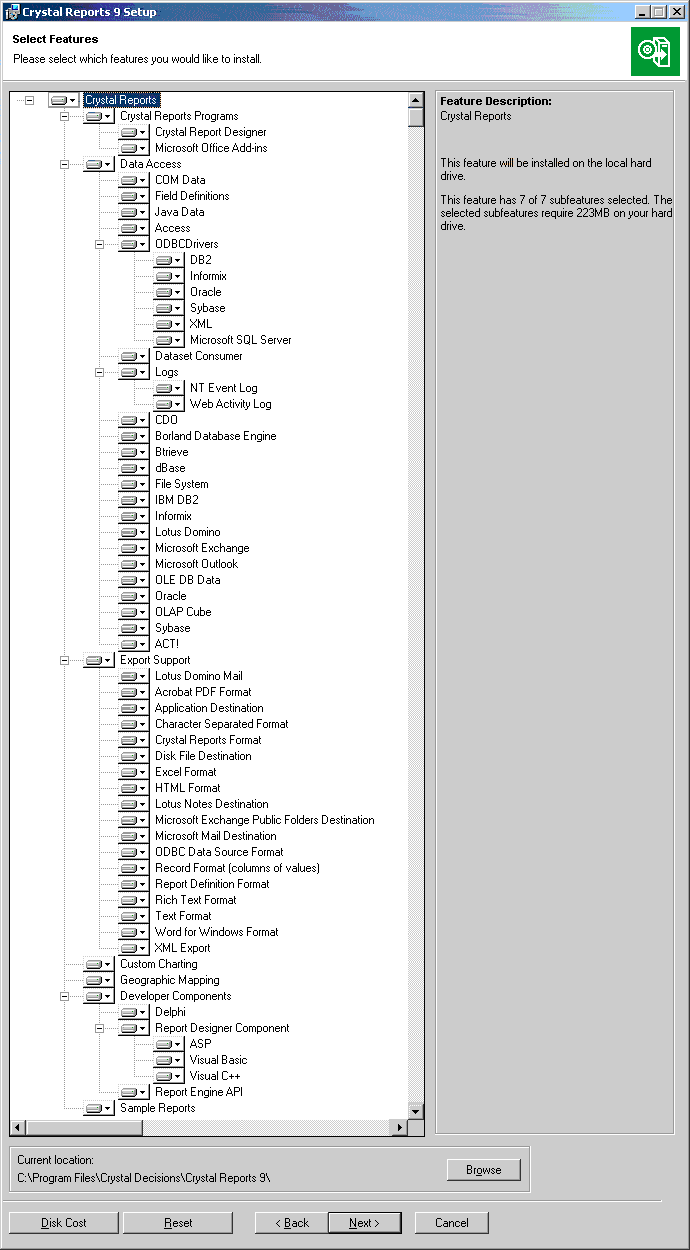
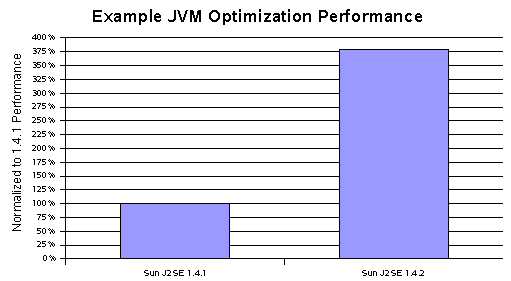
Illustration 3: JVM Machine Optimization performance running thread micro-benchmark on Red Hat Linux 7.3
| « HOME » | Home | Knowledge | Curriculum vitae | Album | About | Contact me |
Downloads:
Flash Disk Drivers (win98)
File Cutter (a useful utility to chop large files into fragments)
Java TM Platform 1.4.2 PerformanceWhitePaper
75 MB
ftp://ftpc.borland.com/pub/jbuilder/jb9enterprise/extras.zip69 MB
ftp://ftpc.borland.com/pub/jbuilder/jb9enterprise/jb9docs.zip158 MB
ftp://ftpd.borland.com/download/jbuilder/jb9enterprise/jbuilder9.zip45 MB
http://download.microsoft.com/download/8/7/5/875e38ea-e582-4ee2-9485-b459cd9c0082/sql2kasp3.exe57 MB
http://download.microsoft.com/download/8/7/5/875e38ea-e582-4ee2-9485-b459cd9c0082/sql2ksp3.exe71 MB
http://download.microsoft.com/download/8/7/5/875e38ea-e582-4ee2-9485-b459cd9c0082/sql2kdesksp3.exe7 MB
http://download.microsoft.com/download/5/3/7/537a88e5-0fbe-4a02-b8b2-20b2acc0134f/sql2000samples.cab37 MB
http://download.microsoft.com/download/e/9/8/e9860f9d-87e5-4c0f-9c11-243616a61efa/sqlbolsetup.cab
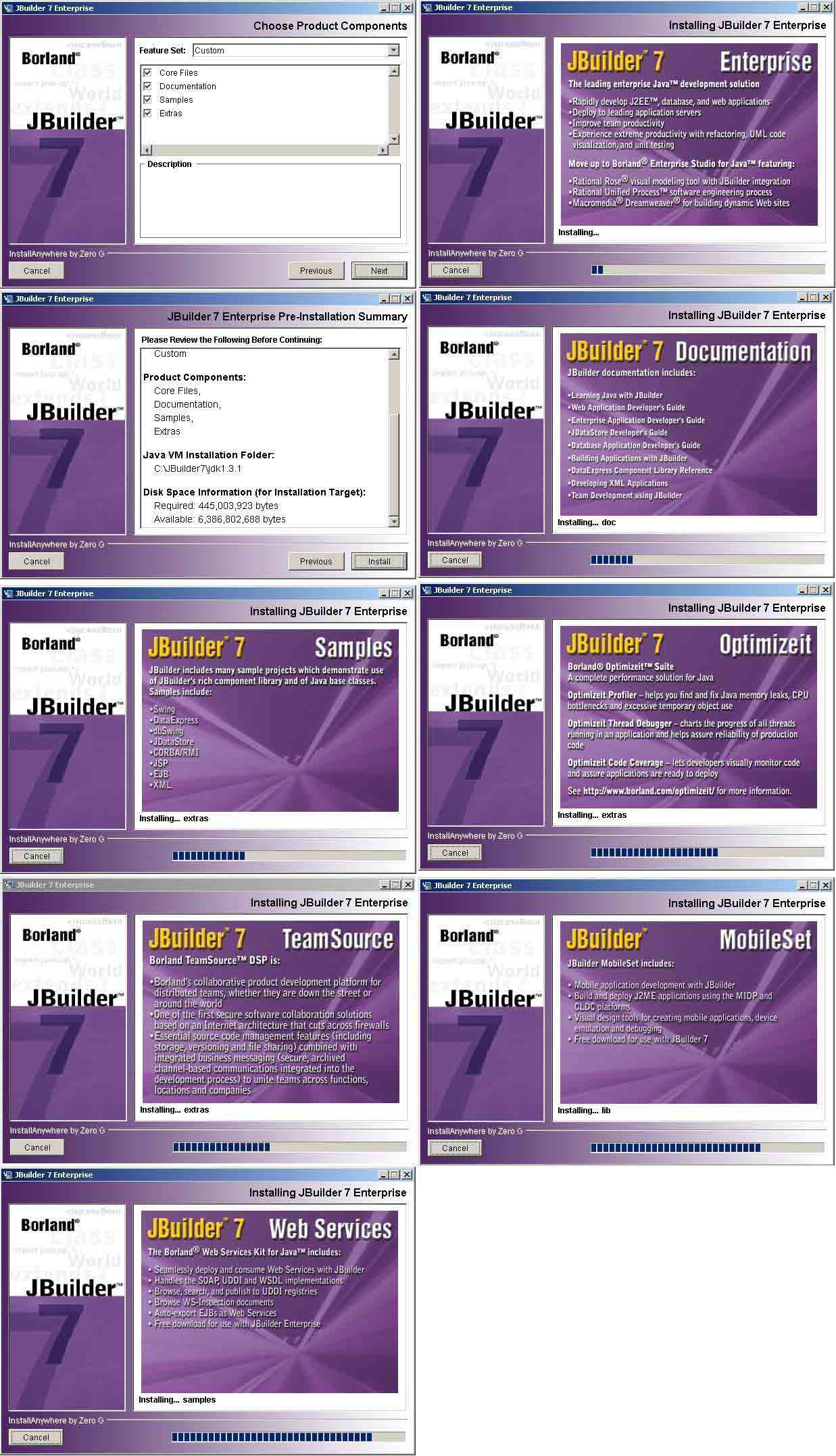
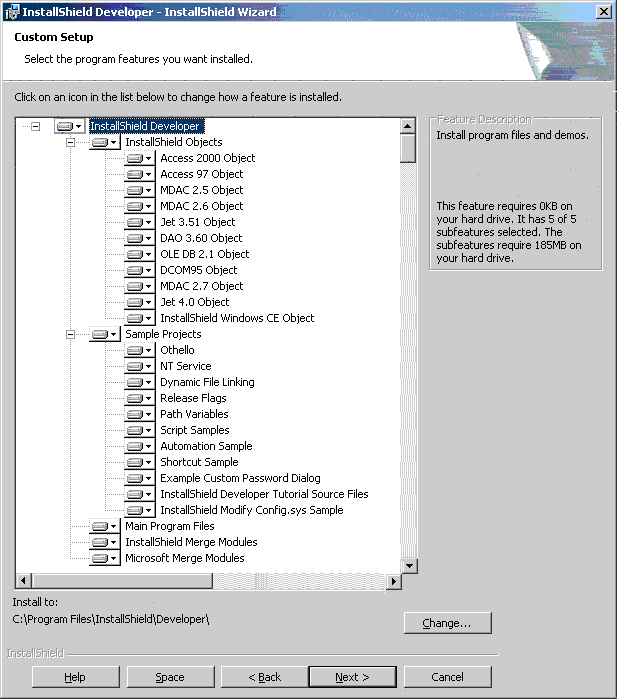
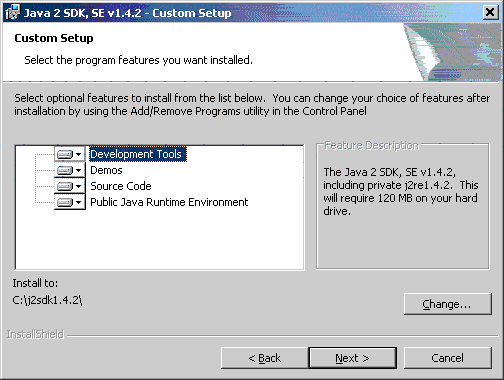
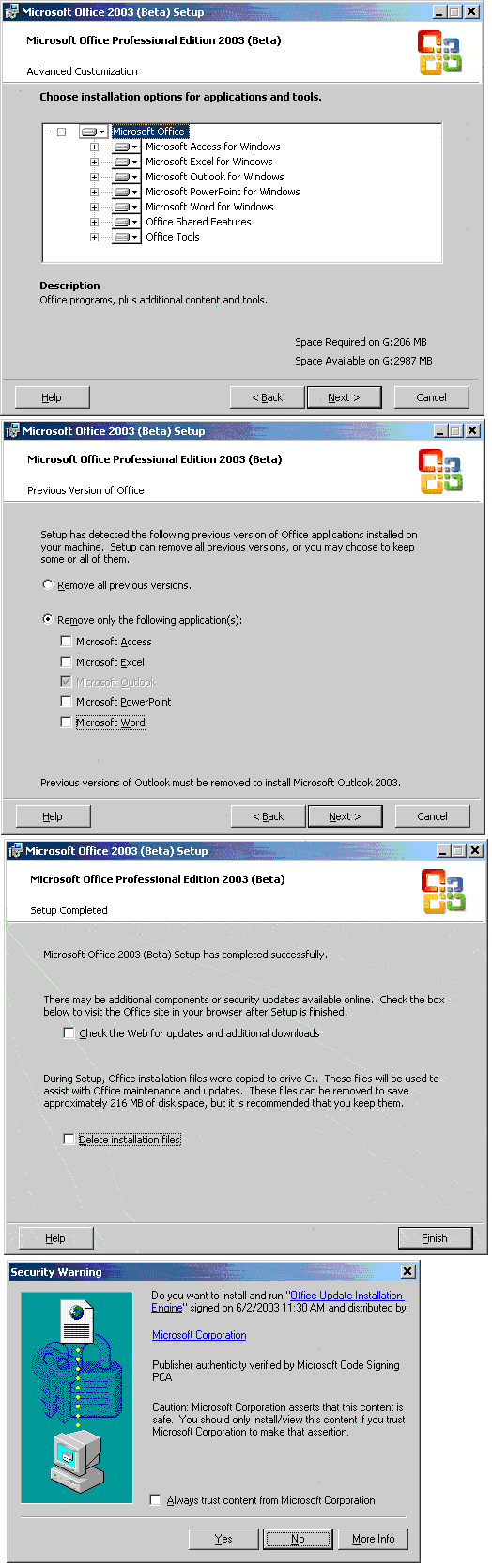
Screen Shots of major Soft-wares from start to end of their Installation
****************************************************************
A
Quick Time (.mov) Movie converted to Flash !
It took quite a processor and effort some two years ago.
(right-click on the movie and select "play" to start movie)
****************************************************************
Microsoft Vs. Sun
Microsoft's new operating system, Windows XP, promises a lot. It's
supposed to be less buggy and crash prone than previous operating systems and
comes bundled with a lot of new functions supposed to make life easier for users.
However, one function is missing: the latest version of Java Virtual Machine
(JVM) from Sun Microsystems. Instead, users have the option to download JVM
and install it themselves.
This is due to a long-running licensing dispute between Sun and Microsoft dating
back to Explorer 4.0. Microsoft wanted to change Java by adding hooks that would
tie it more closely to Windows operating system. Sun resisted because the central
tenet of Java was its interoperability. It was to be software that would run
on everything from a PC to a coffeepot.
The settlement allowed Microsoft to distribute older versions of JVM for 7 years.
So whether you bought your PC last week or last year, you probably have an old
JVM version. In an industry where last year's products are already out-of-date,
a 7-year-old software application is about as useful as a charcoal drawing on
a cave wall.
****************************************************************
Are you Confused
Between JVM and JRE
(read the second matter i wrote to Click-Online on Sunday,
March 09, 2003 10:24 PM)
% Date: 00-00-2002 Time: 00:00 .M
% Assalam O Alaikum!
Dear Click Online staff i like to express my thoughts on Click Online.
following are the 2 matters on which i like to talk. i hope u'll include them in
ur following program.
======================================
1. Red Hat Linux Vs Microsoft Windows:
======================================
If i have to compare Linux with Windows then i will say that Linux
itself doesnot want be popular and just want to be praised in the books and in
online litratures by Linux Fanatics. the major reason is the it does not have
those what we may call "Engines of Entertainment" e.g Hyper Extreme level
Quality of Sound, Incompatibilty with Latest VGA cards and lackness to fully
"cash" these hardwares. i've not heard of DirectX (Direct3D, OpenGL) kind of
Engines in Linux or Direct Sound kind of things. what Linux keep on doing is
non-optimised Fancy stunts with Window styles i.e dispite of making "Window
Border" metalic from all sides which would need a simplest code behind it, they
have made Linux windows to show their is special code to draw every corner of
the window, they should go for "Sleekness" like Microsoft and not go for
processor hungry activities like moving mouse over an icon causes it do
"Aerobatics". KDE and GNOM still like to crash in protest because of these
activities.
================================================================
2. From January 2004, Microsoft will drop Java support entirely.
================================================================
There is a misconception growing in some people that by 2004 JAVA on
Microsoft Platforms will die. i want to tell them this is not the case.
Microsoft says ... "Microsoft will stop including the Microsoft VM in
new releases of Windows and other products, and we will stop distributing
Microsoft® Visual J++® as well. many customers have invested in programs that
make use of the Microsoft VM. this is because Sun does not authorize Microsoft
to make any changes to the Microsoft VM, even security fixes, after January 2,
2004.
We have started removing the Microsoft VM from new products going into distribution. Specifically, this means that we will not include the Microsoft VM in any Windows releases from this point forward, including service packs. We will also not distribute new versions of the Microsoft VM via download from our Web site. We will, however, continue to provide security fixes to the Microsoft VM to existing customers until January 2, 2004.
We are currently developing a
solution that works with SMS or other deployment technologies that you can use
to lock down the Microsoft VM on systems and prevent it from loading. We will
announce the availability of this solution when it is completed."
Actually as u people know Microsoft is very good and fast at making its own
engines for emerging tecnologies from XML to Web-Servers. to run Java on
Microsoft Windows platforms, microsoft thrusted its self concieved engine to run
Java on windows rather SUN's own developed and recomended engine now called as
JRE (Java Runtime Environment), previously called JVM which can be confused cuz
many people dont treat it separate from MSJVM making microsoft Happy. this MSJVM
is going to die in 2004. this is also why Visual J++ died far earlier.
Because ....... Sun filed a private federal antitrust suit against
Microsoft, accusing the software maker of using its monopoly in the market for
PC operating systems to undermine the success of Java. Now Microsoft is not
permitted to ship a newer version of its Java Virtual Machine (MSJVM), it is
including its 1997 version of the software instead. it has many bugs along with
eight security holes.
Microsoft says ... "if you are using the Microsoft VM in your environments
or developing software that uses the Microsoft VM, you should plan now to
migrate to an alternate solution by January 2004. We are committed to helping
you with that migration and have listed some options below
(
http://www.microsoft.com/windowsxp/pro/evaluation/news/jre.asp ) to make the
process as painless as possible."
regards
imran
Islamabad (Pakistan)
% --------------------------------------------
% Signatures:
% Muhammad Imran
% Mob: 923005114730
% [email protected]
% [email protected]
% www.geocities.com/mi1400
%
http://members.msn.com/[email protected]
****************************************************************
Several optimizations and bug fixes are in included in the J2SE platform version1.4.2 Java Virtual Machine for the Java platform (JVMTM) Runtime which have improved overall performance, and in some cases, show substantial performance improvement. Note that the terms "Java virtual machine" and and "JVM" mean a virtual machine for the Java platform.
Illustration 3: JVM Machine Optimization performance running thread
micro-benchmark on Red Hat Linux 7.3
An example of such improvement was to make system dictionary reads lock-free. The system dictionary is an internal JVM machine data structure, and holds all the classes loaded by the system. It helps a lot for calls like Class.forName(), which do lookups into this data structure at the lowest level. Before this change, both readers and writers took out a lock to look at the system dictionary. Illustration 3 above highlights the performance gain of system dictionary locking improvements described above, as measured by a heavily threaded micro-benchmark running on Red Hat Linux 7.3 with traditional pre-NPTL Linux threads. The micro-benchmark measures 400 threads all accessing the system dictionary simultaneously.
****************************************************************
Visitors Blame Java Applets
PC manufacturers have the option to include JVM on their products and most
do, but few visitors upgrade their JVM version that came with their computer.
And those consumers who upgrade their existing system to run XP will find that
a clean install of XP wipes out the JVM. A new version is not supplied with
IE 6.0 and Win XP. In addition, if users set up Windows to run at high security
level settings, Java applets will be disabled. Users will have to go to Explorer
preferences menu and manually edit their security settings to enable Java applets.
For years, Explorer users have been frustrated by slow-loading Java applets
that often don't work. They blame the applets when the real problem is often
the old copy of JVM that came as standard equipment on their new PC.
Older JVM versions can slow page load time considerably and a delay can cost
you up to 1/3 or your visitors! Ever wonder how many visitors get spooked and
leave at the first sight of the status bar message that notes "loading
Java applet?" If you use applets on some of your pages, study your server
logs to see if you could be losing visitors because of it.
When Windows XP was first released last year, ISVs were dismayed to find that
it was the first version of Windows since the early days of Windows 95 not to
include a Java Virtual Machine (JVM).JVM allows Java applets to run in Microsoft's
Internet Explorer browser.
At the time, this wasn't a complete show-stopper, because Microsoft continued
to provide the JVM as an automatic 5MB download that was triggered the first
time a Java applet was encountered in the browser. This was, nevertheless, a
significant barrier to dial-up users for whom a 5MB download could take over
an hour in some cases.
Sun Microsystems (the original developers of Java) obviously had a thing or
two to say about this. In March of this year, they filed a lawsuit (http://www.sun.com/lawsuit/)
against Microsoft. Their chief complaint was that Microsoft was unfairly hurting
the Java platform by continuing to distribute an out-of-date JVM, instead of
releasing Windows with Sun's latest Java 2 Runtime Environment (JRE) built-in.
In particular, the lawsuit pointed out that Microsoft were not licensed to distribute
the old Java 1.1 JVM as a separate download, and sought to force Microsoft to
distribute Sun's JRE instead.
As a preemptive move to fend off this lawsuit, in June Microsoft pulled the
download of the JVM from its site and promised to re-integrate it into Windows
XP with the release of SP1. While the news of the re-integration was welcomed,
the pulled download was like curing a cold by killing the patient.
For the past few months, Java applets designed to use Microsoft's JVM simply
would not work on Windows XP machines unless the user manually downloaded and
installed Sun's JRE. A Web page containing a Java applet can be coded to auto-install
either Microsoft's JVM or Sun's JRE, but not both. And, as previous versions
of Windows always had Microsoft's JVM built-in, the former has consistently
been the most common setup -- despite Sun's JRE offering many more features
to developers.ISVs who relied on Java support in Internet Explorer could either
scramble to update to Sun's JRE (forcing users of older Windows releases to
download the JRE as well), or weather months of incompatibility until the release
of SP1.
This week's release of SP1 ensures that Windows XP users will gradually return
to the fold of Microsoft JVM compatibility; however, this is only a temporary
reprieve or ISVs. Microsoft's license for the ageing JVM expires in January
2004, at which time it intends to cease its distribution entirely. With many
more features and much less uncertainty, the Sun JRE is set to take the lead
as the target platform of choice for client-side Java. Unfortunately, the latest
version is a 9-12MB download, depending on the multi-language support required.
This is obviously a big ask for dial-up users who simply want to see a live
news ticker or play online card games.
It seems to me that Java's future on the client side hinges on Sun's ability
to legally coerce Microsoft into distributing the latest JRE with Windows, or
to get the JRE onto everyday users' desktops by some other means (e.g. a Java-based
"killer app" that will necessarily include the JRE in its installation).
****************************************************************