POINTS, LINES, PLANES
In geometry, you have to represent something physical in a non-physical way, by either illustrating it on a piece of paper, or illustrating it by writing to describe it. Below are the three basic representations of the geometric physical realm.

Point- a point is exactly what it states, a single place in existence. There is nothing below the point, a.k.a. there are no points in a point. A point has no dimensions, it is merely there.
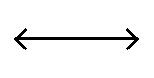
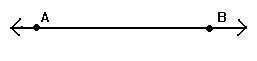
Line- a line is difficult to explain as well. It is a straight physical object, forever continous in two directions, unstopping, infinite. A number of points can actually be found on a line. (note: a line cannot be physically drawn as anything infinite is, therefore it is drawn as a line with two arrows of both ends to signify that it is infinite)
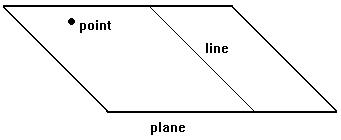
Plane- a plane is a flat, two-dimensional existence in which both planes and points exist. A plane is also infinite as well, forever extending in all directions.
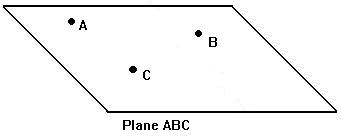
Points, lines and planes are designated by letters given to them. For instance, point A and point B could be used to make Line A B. This also works to designate a plane as well. When three points exist on a plane, suppose they are points A, B and C. The plane would be designated as Plane A B C.
The following physical representations in geometry are actually made from the previous. These are what I like to call "spin-offs", like on television how a series can be started from one that is already running.
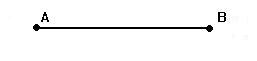
Segment- a sectioned off part of a line, with actual bounderies. It is not infinite, and is restricted to exist within two points. It is also designated in letters, such as Segment AB.
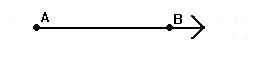
Ray- a ray is an interesting thing. It is basically a line that has a beginning point, and extends off in one direction forever. It is also designated in letters as well, such as Ray AB.(the order in which the letters of a ray are stated is crucial as the designation determines which way the ray goes. For instance, if you say Ray BA instead of Ray AB it would be completely different as Ray BA would go in the opposite direction from Ray AB)
It is important that whenever you are refering to any geometric physical representations that you call them by their exact names. Don't call line AB line BA if its really AB. This applies to all of the previously mentioned criteria.
Alright, now that you know all of the above, I can begin to explain just how all of these things are used in Analytic Geometry.