POINTS, LINES, PLANES PART 2
Segments can be measured because they are not infinite; they have a limited dimensional space, and are designated by the points at either end. Also, numbers can actually substitute points on a segment, and thus be used to measure it. The best way to show this is through the
Ruler Postulate. It basically states that if you want to measure a line, use a ruler. Now, another thing about Segments is that more than one point can exist within one, just like a line. So being able to measure the distance between the segments is a useful ability.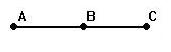
(Also, points on a segment have to be collinear, a.k.a. on the same line to be measured in relation to one another.)
Now, when segments and points on segments are used to measure something, the distance between the internal segments added together will make the whole segment.
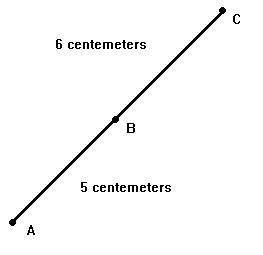
As seen in the illustration, segment AC is 11 centimeters long. You can tell this because segment AB is 5 centimeters long, and segment BC is 6 centimeters long. By adding them together you get the length of segment AC.
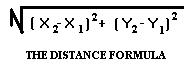
Now, this same prospect also works on the coordinate plane as well. If you have a segment on a coordinate plane, and have the coordinates of the two endpoints, you can find the length through the distance formula.
The Distance Formula is actually much easier than it appears to be. You take the X coordinate sub 2 minus the X coordinate sub 1 then square it, while at the same time taking the Y coordinate sub 2 minus the Y coordinate sub 1 and squaring it as well. You then add the two and take the square root of the sum, giving you your length of the segment.
Now you have learned the basics.