POSTULATES AND THEOREMS
Listed here are the Postulates and Theorems. They will be shown by their name, the text book definition, an explanation of the definition, and an illustration further clarifying it. Also, a postulate is an unproven rule of Geometry that is still used never the less, while a Theorem is a proven law.
Green = Theorems
Blue = Postulate
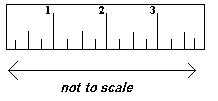
Ruler Postulate- The points on a line can be matched one to one with the real numbers. The real number that corresponds to a point is the coordinate of the point. The distance between points A and B, written as AB, is the absolute value of the difference between the coordinates of A and B.
-This basically states that you can use a ruler to measure distances between points on a line.
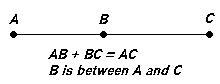
Segment Addition Postulate- If B is between A and C, then AB + BC = AC, then B is between A and C.
-If you got 3 points on a segment, and one is in between, the one segment plus the second will equal the whole, thus proving that the middle point is in the middle.
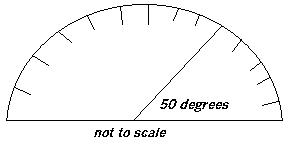
Protractor Postulate- Consider a point A on one side of Line OB. The rays of the form Ray OA can be matched one to one with the real numbers from 0 to 180. The measure of <AOB is equal to the absolute value of the difference between the real numbers for Ray OA and Ray OB.
-Use a protractor to measure angles.

Angle Addition Postulate- If P is in the interior of <RST, them m<RSP + m<PST = m<RST.
-This is similar to the segment addition postulate. Basically, if there is an inside side to an angle it makes two separate angles inside. So if you add the two inside angles, you will get the whole big angle.
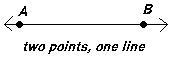
Through any two points there exists exactly one line.
-This is pretty simple too. Two points, and you got one possible line, which means only one, not two, just one.
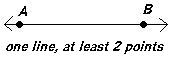
A line contains at least two points.
-This is similar to the previous one, except it defines a line, and not two points. A line is infinite, and can have any number of points along it, but it needs at least two to exist.
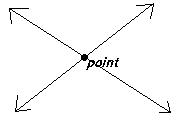
If two lines intersect, then their intersection is exactly one point.
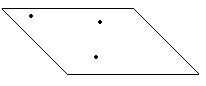
Through any three non-collinear points there exists exactly one plane.
- If you got 3 points that aren't on the same line, then you got a plane.
A plane contains at least 3 non-collinear points.
-In order for a plane to exist, it needs three points that aren't on the same line.
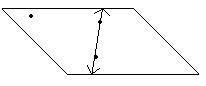
If two points lie in a plane, then the line containing them lies in the plane.
- A line has to exist on the points that define it, so if the points are on a plane then so is the line.
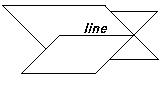
If two planes intersect, then their intersection is a line.
-Seeing as planes are infinite, they can only come together at a line, and not a point.

Linear Pair Postulate- If two angles form a linear pair, then they are supplementary.
- Two angels on the same line will add up to 180 degrees, also known as being supplementary.
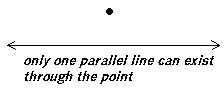
Parallel Postulate- If there is a line and a point not on the line, then there is exactly one line through the point parallel to the given line.
- If you got a point off a line, then there is only one possible parallel line that can exist through that point.
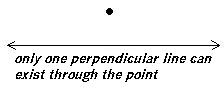
Perpendicular Postulate- If there is a line and a point not on a line, then there is exactly one line through the point parallel to the given line.
- Similar to the one above. You got one point off a line, then you got only one possible perpendicular line that goes through it.
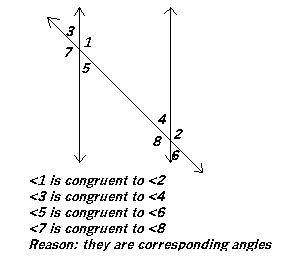
Corresponding Angles Postulate- If two parallel lines are cut by a transversal, then the pairs of corresponding angles are congruent.
- If you got 2 parallel lines cut by another line, then the corresponding angles are the same.
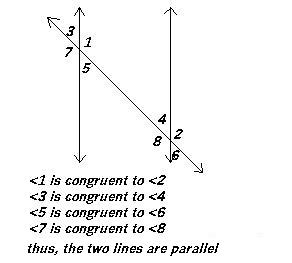
Corresponding Angles Converse- If two lines are cut by a transversal so that the corresponding angles are congruent, then the lines are parallel.
- If you don't know that two lines are parallel, and if they are cut by a transversal (a line that goes through both of them) you then try to find out if the corresponding angles are the same, because if they are, then the lines are parallel.
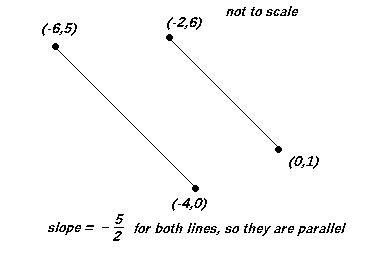
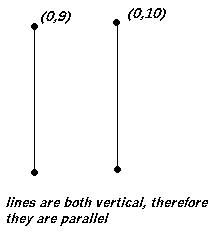
Slopes of Parallel Lines- In a coordinate plane, two non-vertical lines are parallel if and only if they have the same slope. Any two vertical lines are parallel.
- If you have two lines that have the same slope they're parallel. If you got two lines that are vertical they're parallel.

Slopes of Perpendicular Lines- In a coordinate plane, two non-vertical lines are perpendicular if and only if the product of their slopes is -1. Vertical and horizontal lines are perpendicular.
- If you take the slopes of any two lines that aren't vertical, and if you multiply them together and their product is -1, then the lines are perpendicular. Also, any vertical line and horizontal line are perpendicular.
The following postulates are all different methods of proving a triangle congruent to another triangle.
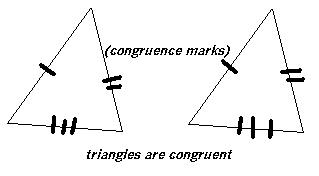
Side-Side-Side (SSS) Congruence Postulate- If three sides of one triangle are congruent to three sides of a second triangle, then the two triangles are congruent.
- Basically just what it says, if you got three sides of one triangle congruent to three sides of another, the triangles are congruent.
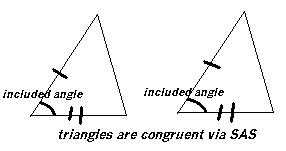
Side-Angle-Side (ASA) Congruence Postulate- If two sides and the included angle of one triangle are congruent to two sides and the included angle of a second triangle, then the two triangles are congruent.
- If you got 2 sides and the angle between those two sides the same as two sides and the angle inside those sides of another triangle, then they are congruent triangles.
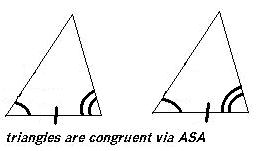
Angle-Side-Angle (ASA) Congruence Postulate- If two angles and the included side of one triangle are congruent to two angles and the included side of a second triangle, then the two triangles are congruent.
- If you got 2 angles and the side between them the same as 2 angles and the side between them of another triangle, then they're congruent.
There are more postulates in Geometry, however these are the ones I have yet to learn.