POSTULATES AND THEOREMS
Listed here are the Postulates and Theorems. They will be shown by their name, the text book definition, an explanation of the definition, and an illustration further clarifying it. Also, a postulate is an unproven rule of Geometry that is still used never the less, while a Theorem is a proven law.
Green = Theorems
Blue = Postulate
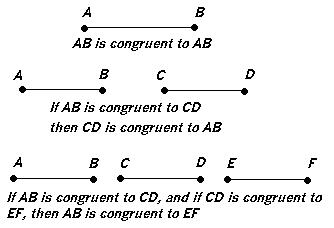
Properties of Segment Congruence- Segment congruence is reflexive, symmetric, and transitive.
Reflexive: For any segment AB, Segment AB is congruent to Segment AB.
Symmetric: If Segment AB is congruent to Segment CD, then Segment CD is congruent to Segment AB.
Transitive: If Segment AB is congruent to Segment CD and Segment CD is congruent to Segment EF, then Segment AB is congruent to Segment EF.
- Basically all this is stating that Segments are logically sequential. A segment is the same as itself. If it is the same as something else then that something else is the same as it. Finally, if a Segment is the same as something, and that something is the same as something else, then that segment is the same as that something else.
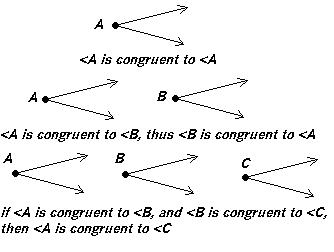
Properties of Angle Congruence- Angle congruence is reflexive, symmetric, and transitive.
Reflexive: For any angle A, <A is congruent to <A.
Symmetric: If <A is congruent to <B, then <B is congruent to <A.
Transitive: If < A is congruent to <B and <B is congruent to <C, then <A is congruent to <C.
- Same as the above, but instead dealing with angles. An angle is the same as itself. If it is the same as another angle then that other angle is the same as the angle. Finally, if an angle is the same as one angle, and that one angle the same as another angle, then the angle is the same as that other angle.

Right Angle Congruence Theorem- All right angles are congruent.
- Just what it says, all right angles are both perpendicular and measure to 90 degrees, therefore they are all the same.

Congruent Supplements Theorem- If two angles are supplementary to the same angle (or to congruent angles) then they are congruent.
- Basically if two angles are supplementary to another angle (adding up to 180 degrees) then they are the same.

Congruent Complements Theorem- If two angles are complementary to the same angle (or to congruent angles) then they are congruent.
- Similar to the one above, except it deals with complementary angles (angles that add up to 90 degrees). So, if two angles are complementary to another angle, then they are the same.
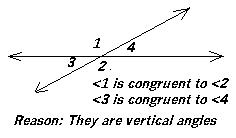
Vertical Angles Theorem- Vertical angles are congruent.
- Just what it says, vertical angles are congruent.
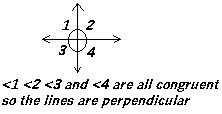
If two lines intersect to form a linear pair of congruent angles, then the lines are perpendicular.
- If two lines cross and all the angles are the same, then the lines have to be perpendicular.
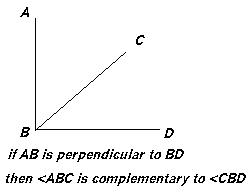
If two sides of two adjacent acute angles are perpendicular, then the angles are complementary.
- If the two adjacent sides of acute angles are perpendicular, then the angles inside have to make a right angle.
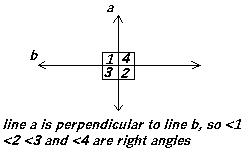
If two lines are perpendicular, then they intersect to form four right angles.
- If lines cross and are perpendicular you have four right angles.
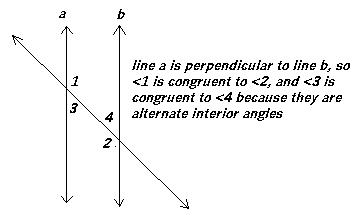
Alternate Interior Angles- If two parallel lines are cut by a transversal, then the pairs of alternate interior angles are the congruent.
- If you got a set of parallel lines cut by another straight line, the alternate interior angles will be the same.
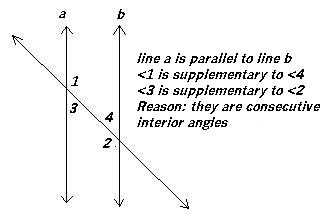
Consecutive Interior Angles- If two parallel lines are cut by a transversal, then the pairs of consecutive interior angles are supplementary.
- If you got a set of parallel lines cut by another straight line, the consecutive interior angles will add up to 180 degrees.
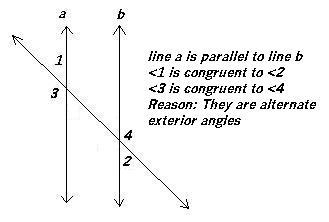
Alternate Exterior Angles- If two parallel lines are cut by a transversal, then the pairs of alternate exterior angles are congruent.
- If you got a set of parallel lines cut by another straight line, the consecutive interior angles will be the same.
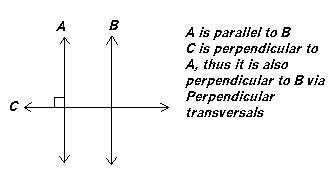
Perpendicular Transversal- If a transversal is perpendicular to one of two parallel lines, then it is perpendicular to the other.
- If line A is parallel to line B, and line A is cut by a Perpendicular line, then that line will also be perpendicular to line B.
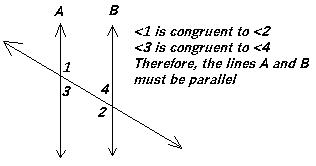
Alternate Interior Angles Converse- If two lines are cut by a transversal so that alternate interior angles are congruent, then the lines are parallel.
- If you cut two lines with another line and the alternate interior angles are the same then the lines are parallel.
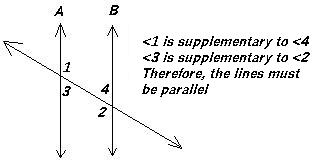
Consecutive Interior Angles Converse- If two lines are cut by a transversal so that consecutive interior angles are supplementary, then the lines are parallel.
- If you got two lines cut by another line and the consecutive interior angles add up to 180 degrees then the lines are parallel.
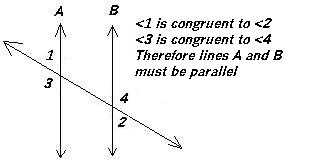
Alternate Exterior Angles Converse- If two lines are cut by a transversal so that alternate exterior angles are congruent, then the lines are parallel.
- If you got two lines cut by another line and the alternate exterior angles are the same then the lines are parallel.
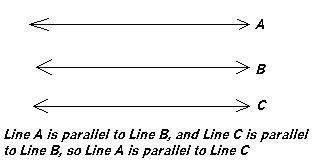
If two lines are parallel to the same line, then they are parallel to each other
- Just what it ways, if you got two lines parallel to the same line, then they're parallel to one another.
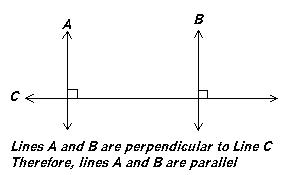
In a plane, if two lines are perpendicular to the same line, then they are parallel to each other.
- Just what it ways, if two lines are perpendicular to the same line then they're parallel. (Lines have to be on the same plane for this to apply)
A Corollary is like a sub-theorem, an addition that can speak of other circumstances, exceptions, etc. that apply to that specific theorem.
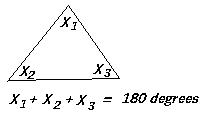
Triangle Sum Theorem- The sum of the measures of the interior angles of a triangle is 180 degrees.
- Just what it says, all inside angles of a triangle add up to 180 degrees.
Corollary- The acute angles of a triangle are complementary.
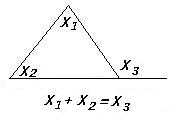
Exterior Angle Theorem- The measure of an exterior angle of a triangle is equal to the sum of the measure of the two non-adjacent interior angles.
- The outside angle will equal the sum of the two inside angles that aren't next to it.
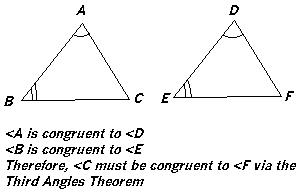
Third Angles Theorem- If two angles of one triangle are congruent to two angles of another triangle, then the third angles are also congruent.
- If you got two triangles with 2 out of 3 angles already congruent to one another respectfully, then the 2 remaining 3rd angles will be the same.
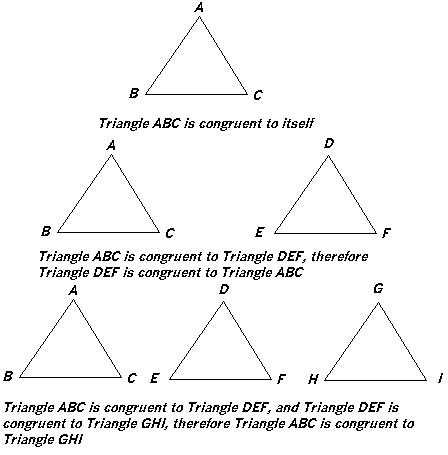
Reflexive Property of Congruent Triangles- Every triangle is congruent to itself.
Symmetric Property of Congruent Triangles- If Triangle ABC is congruent to Triangle DEF, then Triangle DEF is congruent to Triangle ABC.
Transitive Property of Congruent Triangles- If Triangle ABC is congruent to Triangle DEF and Triangle DEF is congruent to Triangle JKL, then Triangle ABC is congruent to Triangle JKL.
- Fairly simple stuff: a triangle is the same as it self; if a triangle is congruent to another triangle then that other triangle is congruent to the first triangle, and finally, if a triangle is congruent to another triangle, and that triangle is congruent to yet another triangle, the first triangle will be congruent with that lastly mentioned triangle.
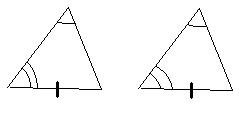
Angle-Angle-Side (AAS) Congruence Theorem- If two angles and a non-included side of one triangle are congruent to two angles and the corresponding non-included side of a second triangle, then the two triangles are congruent.
If you got two angles and a side not in-between those two angles the same as two angles and a side not in-between those two angles of another triangle, then the triangles are congruent.
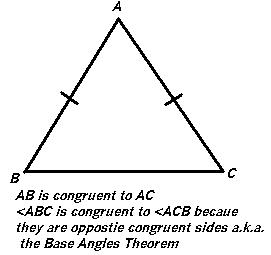
Base Angles Theorem- If two sides of a triangle are congruent, then the angles opposite them are congruent.
- If you got two sides of a triangle congruent, the angles directly across from them will be the same.
Corollary- If a triangle is equilateral, then it is equiangular.
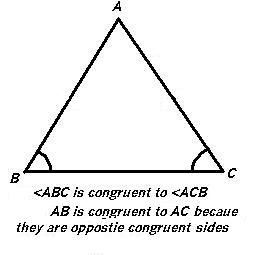
Converse of the Base Angles Theorem- If two angles of a triangle are congruent, then the sides opposite them are congruent.
- If you got two angles of a triangle congruent, the sides directly across from them will be the same.
Corollary- If a triangle is equiangular, then it is equilateral.
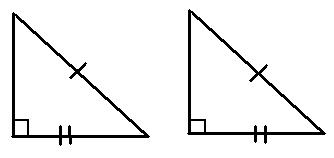
Hypotenuse-Leg (HL) Congruence Theorem- If the hypotenuse and a leg of a right triangle are congruent to the hypotenuse and a leg of a second right triangle, then the two triangles are congruent.
- This only applies to right triangles. If a hypotenuse and a leg are the same as a hypotenuse and leg of another right triangle then the triangles are congruent.
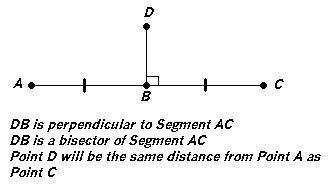
Perpendicular Bisector Theorem- If a point is on a perpendicular bisector of a segment, then it is equidistant from the endpoints of the segment.
- If you got a bisecting line that is perpendicular to the line on which it intersects, any point on the bisector will be equal distance from either end of the segment.
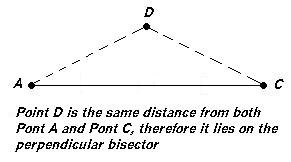
Converse of the Perpendicular Bisector Theorem- If a point is equidistant from the endpoints of a segment, then it is on the perpendicular bisector of the segment.
- If you got a point that is the same distance from the ends of a segment, it lies on the perpendicular bisector.
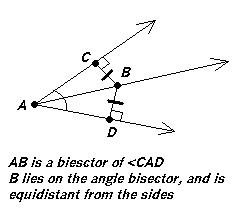
Angle Bisector Theorem- If a point is on the bisector of an angle, then it is equidistant from the two sides of the angle.
- If you got a point on an angle bisector it will be of equal distance to the sides of the angle.
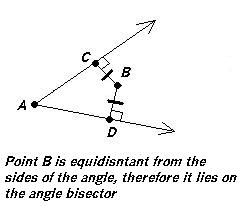
Converse of the Angle Bisector Theorem- If a point is in the interior of an angle and is equidistant from the sides on the angle, then it lies on the bisector of the angle.
- If you got a point inside an angle that is the same distance from the two sides then it lies on the angle bisector.
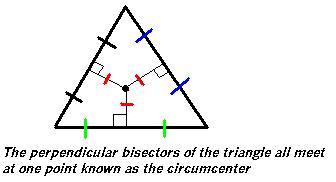
Concurrency of Perpendicular Bisectors of a Triangle- The perpendicular bisectors of a triangle intersect at a point that is equidistant from the sides of the triangle.
- If you take the perpendicular bisectors of the 3 segments in a triangle they will meet at one point that is equidistant from all the sides.
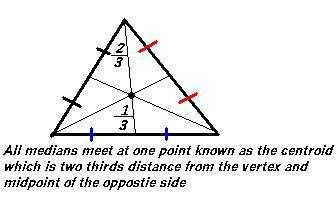
Concurrency of Medians of a Triangle- The medians of a triangle intersect at a point that is two thirds of the distance from each vertex to the midpoint of the opposite side.
- Every side in a triangle is bisected and meets at the opposite verticy. These lines will meet at a point. This point, from one of the vertexes of the triangle to the midpoint of the opposite side will be two thirds.
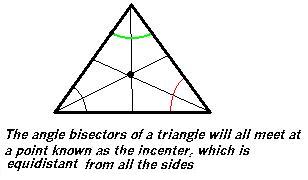
Concurrency of Angle Bisectors in a Triangle- The angle bisectors of a triangle intersect at a point that is equidistant from the sides of the triangle.
- If you draw the angle bisectors of all 3 angles within a triangle, they will meet at one point that is of equal distance to all sides.
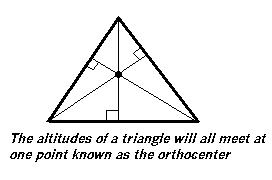
Concurrency of Altitudes of a Triangle- The lines containing the altitudes of a triangle are concurrent.
- Just what it says, the altitude lines of a triangle are concurrent.
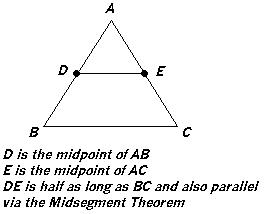
Midsegment Theorem- The segment connecting the midpoints of two sides of a triangle is parallel to the third side and is half as long.
- If you take the midpoints of two sides in a triangle and connect them, the segment drawn will be half as long and parallel to the third side.
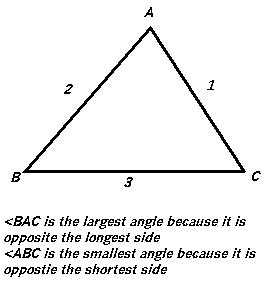
If one side of a triangle is longer than the other side, then the angle opposite the longer side is larger than the angle opposite the shorter side.
- Just what it says, if you got a side of a triangle longer than another side, the angle opposite it will be larger than the other angles.
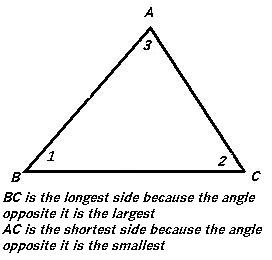
If one angle of a triangle is larger than another angle, then the side opposite the larger angle is longer then the side opposite the smaller angle.
- Converse of the one above. If you got an angle larger then any of the others, the side opposite will be the longest side.
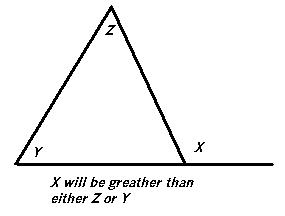
Exterior Angle Inequality- The measure of an exterior angle of a triangle is greater that the measure of either of the two non-adjacent interior angles.
- The Exterior angle of a triangle is bigger than either of the non-adjacent angles.
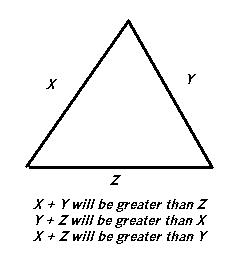
Triangle Inequality- The sum of the lengths of any two sides of a triangle is greater than the length of the third side.
- Any two sides of a triangle should add up to be more than the third side, because if they don't it's not a triangle.
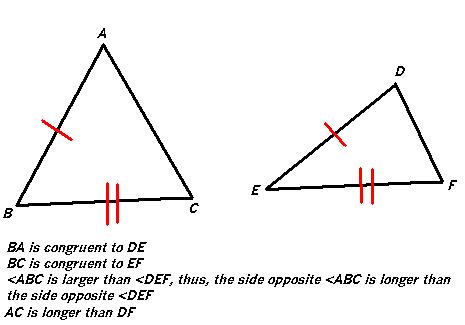
Hinge Theorem- If two sides of one triangle are congruent to two sides of another triangle, and the included angle of the first is larger than the included angle of the second, then the third side of the first is longer than the third side of the second.
- If you got a set of triangles that have two congruent sides and an inside angle of the first is larger than the inside angle of the second, the third side of the first will be longer than the third side of the second.
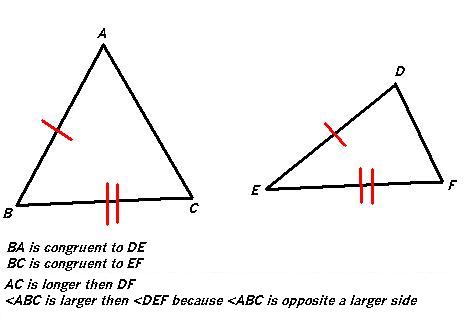
Converse of the Hinge Theorem- If two sides of one triangle are congruent to two sides of another triangle, and the third side of the first is longer then the third side of the second, then the included angle of the first is larger then the included angle of the second.
- If you got a set of triangles that have two congruent sides and a third side that is greater then the side of the other, the angle opposite the triangle with the longer third side will be larger then the opposite angle of the triangle with the shorter side.