| Very few americans it seems, (outside of a handful of cities) are aware of the fact that there was a very real competitor to the GM vision of Post-War America. General Motors in 1939 had invested heavily in "indoctrinating" the public about it's particular view of "Things To Come". Most cities of significant population still had functioning, (tho financially struggling) streetcar systems. The automobile was "established" as a 'serious' means of mobility in the 1920's. Prior to that time......most people who purchased Automobiles were viewed by the majority of Americans as somewhat "extravagent" if not outright "frivolous" characters! America had led the world into the era of rapid mobility, and the "vested-interests" who owned the tools, machinery, and the factories of automobile production were a 'mixed-bag' of "social-engineers", "visionaries", "salesmen", "circus-showmen", "inventors", "tinkerers", "old-world craftsmen", and 'hard nosed' investment bankers. The latter two groups, being the most "conservative" members of this new "transportation revolution", formed a kind of 'uneasy' symbiotic 'partnership' as the backbone of a new industry... ...firmly and comfortably ensconsed within a 'functioning' urban environment!!! But there was a 'wild-card' in the mix, in the personage of Henry Ford, who happened to be a little bit of ALL of the above mentioned categories. But Henry Ford was NO great fan of the "urban" environment! He was a product of rural America, and he was acutely sensitive to the feelings of the Farmers scattered in isolated Homes across the American Continent. He was no doubt, the most ideologically firm beleiver in the technology of the automobile, and he became, a sort of "self-appointed" Doctor of the 'psychological-wounds' of the American Rural Community. And there were alot of wounds to heal, he reasoned, so why shouldn't one bandage work for everyone? Henry Ford was indeed, it could be argued, the most "socially-conservative" technocrat of the group. In the 1920's while the majority of the american populace was still 'unconvinced' of it's NEED for automobiles, The Ford Motor Company began to mass-manufacture it's version of the 'one-shoe-fits-all' called the "Model-T". Most roads across the american countryside were still rather primitive, and the Model T was by necessity a kind of 'all-terrain' vehicle. It was essential for the Auto Industry to conduct very "Public" demonstrations of it's ability to traverse the varied terrain of the American Continent. |
 |
| There were many trans-continental races in the early years of the Automobiles' History, because, the purchase of an auto- mobile was a private and individual decision, and there was still, at this time, No Governmental Agency responsible for the 'fixed-costs' associated with automobile mobility. Additionally, the "rules" of conduct once one became a member of this "new- democracy-club"... ...were at best defined by the ancient trad- itions of the "good-neighbor" policy. It may be helpful, in this discussion, to consider the hard realities of automobile mobility. An automobile, when moving at maximum speed, is a serious threat to the safety of human life. This applies to the Driver, as well as anyone in his immediate vacinity. Common-Sense would seem to suggest that this would "dis-qualify" the automobile as a Technology appropriate for the Urban Environment. But this was hardly the conviction of General Motors in 1939. |
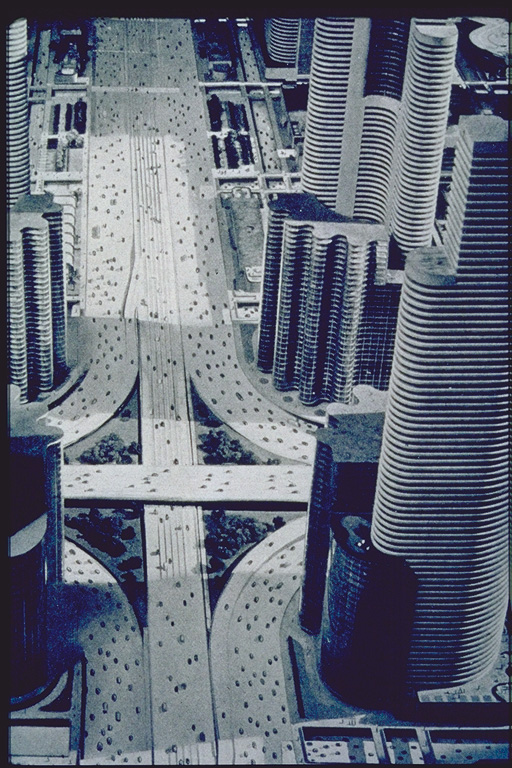
| Presumably... ...this must have been projected to be the "cross-roads" of a major city, but, do any of these people plan to ever get out of thier cars? If not, then perhaps this is GM's idea of the "potemkin-metropolis"? Where are ALL the parking spaces we now know are so essential for a cars' happiness!' |
| The St. Louis Car Company & The PCC Car |
| This page is maintained by Bryan Denbecke and was last modified on 2002.09.28.16:00 I am solely responsible for it's content. If you have any questions, or would like to express an opinion concerning the subject matter you can email me at: [email protected] |
 |
| Contrary to popular belief today, opposition to the auto- mobile is as old as the automobile itself. You can sense this by reading a typical newspaper from the decade of the 1920's. A great number of people were more than a little apprehensive about the proliferation of the automobile. Like today, death by automobile crashes were a common occurance, but many people seemed to understand, as early as 1929, the inherent problem of everyone trying to bring an automoble into a typically crowded urban center. Here is an advertizement from a 'small-town' newspaper just before the Stock Market Crash. |
| Most Advertizing from this era seems very polished. The automobile was extolled as the very essence of "modernity". It was the publics' way of participating in the remarkable pioneering acheivements of that other 'transportation-revolution' being conducted in the skies. Early twentieth century Aviators were at the pinnacle of America's hierarchy of heroes and celebrities. Prior to the "commodification" of automobile owner- ship, it would not have been unnusual to see someone driving across the countryside wearing the same outfit worn by World War I flying Aces. In the heady boom years of the 1920's, Henry Ford mad a very public announcement to America that he intended to make it possible for "everyone" (who had a decent job...) to dream of owning one. But there were obviously many 'dissenters' from this vision. However frustrated they might have felt, at being "behind-the-times", they eventually achieved a consensus, and organized a concerted response to the flood of automobiles pouring out of the rapidly consolidating industry in Detroit. Their answer to GM and Ford was the Presidents Conference Committee cars (otherwise known as the PCC Streetcars.), designed over a five year period with the guidance of Street Railway Company Presidents gathered from 25 cities across America. |