| To most people in the world... ....it seems positively absurd to have to make an argument for the support of public transportation, but that's the reality of living in a society where the automobile dominates the lives of most people. They live with it, and tolerate the necessary inconveniences of using it, and enjoy the economic benefits of a more vital urban environment. They would never allow the dismantling of such a fundamental public service. Imagine a situation where a single corporate entity, say a "beverage" company, were so successful at marketing and distributing their product that they managed to seize control of 80% of the market. Should they be allowed to "Diversify" into the Realm of "PUBLIC" Water utilities, and proceed to dismantle all the major pipelines of city water systems? Such are the accusations now facing the corporate entity we refer to as "General Motors" ...and if they prove to be founded upon truth, then it seems we have little choice but to reconsider the value of "laizzare fair" economic policies. Planning... for the NEEDS of our society, rather than for the profits of any one industry... ...is simply a necessary evil. |
 |
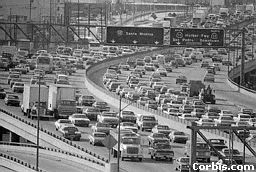 |
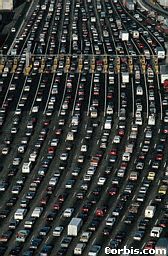
| Aside from the purely mathematical analysis of the problem of human mobility... ( ...and that IS really the most important issue, certainly, we need to have some means of transporting goods, bothe raw and finished, but the reason we choose to live in cities is to interact with other humans... ...NOT to occassionally pass their 1.5 ton rolling status symbol!) for a little clarity, if you are unfamiliar with the arguments, simply think about how much an automobile weighs. Quite often you will find that the "machinery" of mobility outweighs the occupant by a factor of 10 to 1. That means that 90% of the precious energy of petroleum gets spent transporting the weight of the mobile infrastructure. Put in another rider, and the "efficiency" of moving by automobile doubles. Busses and Trains, of course, weigh much more, but the ratio of machinery to occupant weight greatly increases with full ridership. As anyone who has ever used transit knows, you don't always get dropped off within a few feet of your intended destination. This is exactly why transit produces "cities" that are much more human. We have a chance to interact with other people as pedestrians, and it encourages all different kinds of human-scaled planning. Here's another factor to consider the next time you find yourself stuck in traffic. How many "old" cars do you see around you? Very few. Virtually our entire transportation machinery must be replaced in a little less than 10 years. It comes at an incredible cost to society. Conventional transit systems can be designed and built to be in service for 50 years or more, but the real incentive to work towards is establishing a viable market for the"sustainable-transit-systems" now under development by some very forward-looking engineers. |
| Like most americans in the midwest and central portions of the united states, i had grown up quite ac- accustomed to thinking that the automobile was one of the essential needs of everday life. i actually started driving at the age of around 9. My father was an auto mechanic and was particularly proud of his technical abilities and his intimate familiarity with all the peculiar mechanical idiosyncacies of the nearly countless individual automobile parts from various manufacturers that have been produced during the age of the automobile. With many auto producers making model changes every few years or so, the maintenance of automobiles in thier latter few years of usable service can be quite a challenge. He serviced the lowest-end of the transportation sector, and quite often the clients simply did not have the money to pay for whatever parts might be needed. Often they drove vehicles that quite frankly, were neither safe nor roadworthy. i had grown up hearing the stories of how street cars used to run in our hometown, (a not too particularly dense town of about 40,000 in northern oklahoma) but that they had suddenly, quietly faded-away sometime after the Second World War. We lived right next to the shop, and it would be quite an understatement to call our world in the 1960's a world of the "greasers". Our whole lives seemed to be in a perpetual-orbit around these mostly broken down pieces of junk!!! Quite often, clients would simply ABANDON their automobiles because the repairs, (or simply the essential PARTS, used, "salvaged", "reconditioned" or new...) cost more than the automobile would EVER be worth! This impressed me in a number of ways. First of all, i wasn't too big a fan of the idea of "planned-obsolescence". (a concept, supposedly invented by the marketing department at General Motors, to keep people forever buying newer cars.) Planned-obsolescence, probably was never "intentionally" designed to push poor quality products onto the public. But that's what eventually happened. The goal was really just to sell more cars. By making visible design changes every few years, and always hyping the particular features of the current crop of new cars, customers are more likely to consider replacing a car that may be showing some signs of wear. As the competition between automakers grew more intense, the pressure to add "new" additional features probably increased, and when things are too rushed, quality ussually suffers, and practicality and common sense sometimes has to ride in the back seat... ...if they got invited at all. The other thing i found pretty hard to believe was that some people really believed that "somehow" cars could endow you with "sexuality" or possessing them imparted to you a transforming "aura" of mystical power!!! i found it pretty easy to be completely "un-emotional" in my thinking about all these rusting hulks of ugly metal surrounding our not-too-particularly attractive house!!! i really never imagined, that we had any choice in the matter tho, it seemed that the basic needs of life were: Food, Shelter, Automobile, and sometimes... Clothing. i first rode on a public city bus at the age of 23, and a few years later, got my first glimpse of a real "underground". i never got on, but i certainly was impressed! It wasn't until i found the book "The Future is Not What it Used to Be", by Warren Johnson, that i really began to "harden" in my attitude against the automobile. It is a VERY clear, straight-forward explaination of what is wrong with american thinking about the VERY REAL changes occurring in our rapidly "Globalizing" economy. Some of his arguments i have repeated in my opening remarks. If you have not YET fallen thru the cracks in the foundation of American Democratic Mobility... ...then you may be in for more than a few surprises... ...in many cities, there really is NO safety net beneath those wheels of yours anymore. |
| The Experiment of Democratic Mobility |
| This page is maintained by Brian Daniel Eck and was last modified on 2002.09.26.18:30 I am solely responsible for it's content, if you have any questions about modifications, please contact me at: [email protected] |
 |