
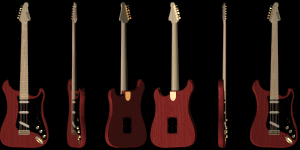






Electric guitars are amazing instruments that have created many different styles of music. There are numerous designs, but they all fundamentally work the same. The only real difference is the types of "pickups" you can have in your guitar. Pickups are what enables the sound of the guitar to be heard through an amplifier.
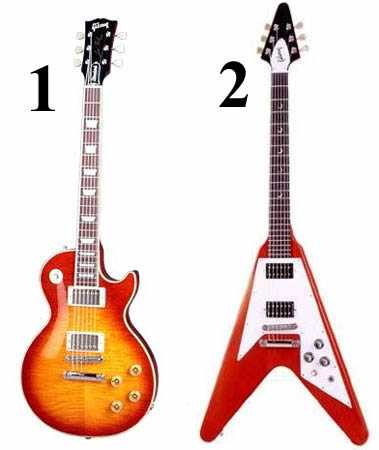
The picture to the right are two different designs of guitars with different pickups. Guitar #1 is a Gibson Les Paul which features a bar magnet for its pickups and guitar # 2 is a Gibson Flying-V which features separated magnets for each string for its pickups.
These pickups are magnetic and sense the vibrations of the strings electronically, thus if you don't have your guitar plugged into an amplifier it will hardly be audible.
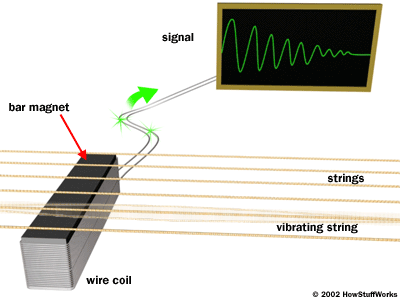
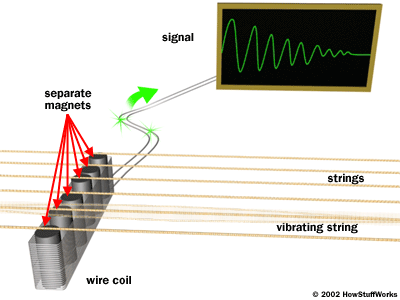
The real physics behind how the magnetic pickups work uses Faraday's Law of Magnetic induction. This law states that objects can influence other magnetic materials without touching them because the objects produce a magnetic field. Magnetic fields are represented by flux lines.
Therefore, when a guitar string is plucked it oscillates producing a magnetic field. These magnetic field is picked up by the magnetic pickups and transfered to an amplifier where audible sound is heard.

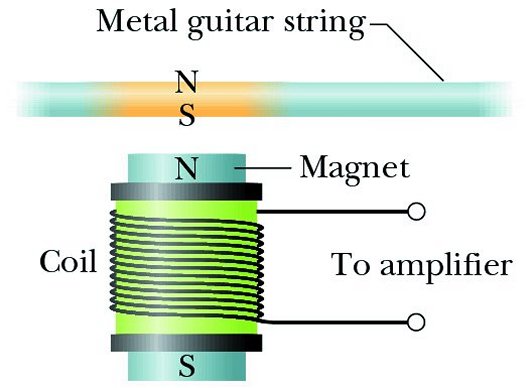
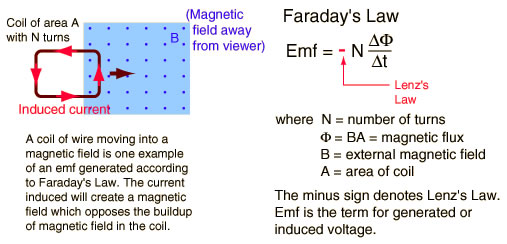
How is the guitar able to produce tones?
Guitar strings are fixed at 2 points and in between these points is a fretboard. The fretboard is used to change the tones of the strings.
Because v = f (wavelength), the speed of the wave depends upon the tension and linear mass density of the string. This relationship is shown in the formula, v= T/µ
Therefore, when a guitar is tuned lower than the standard EADGBE tuning it sounds lower because there is less tension in the strings. When you compare a bass to a guitar the bass is much lower sounding because it has much denser strings than an electric guitar, thus the bass produces a lower sound. When you move your hand up and down a fretboard you will get different tones because you are changing the tension of the strings which result in a different tone.
Why does each guitar string have a different density?
If you played a guitar with the strings all having the same density each string would produce the same sound. So, to get different sounds you would have to change the tension making the low strings very loose and the high strings very tight, which makes the guitar very difficult to play. Thus, if you have all the strings at the same tension, then to get different tones you would have varying densities of each string.



Last Updated: Nov. 17th 2005
© Andrew Olson