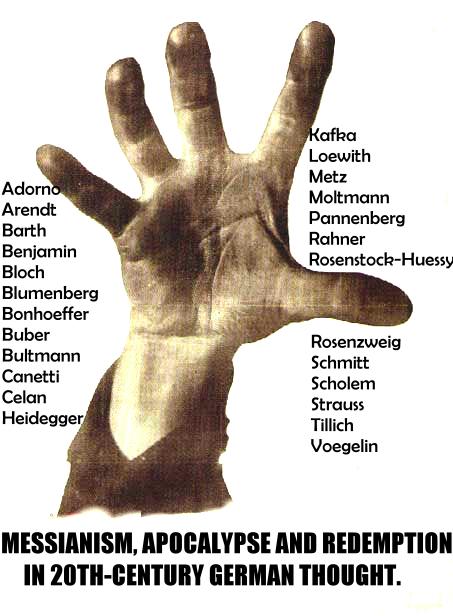
Abstracts
(in program order)Provisional as of 24/4/2004
Paul Bishop (Glasgow Uni): The Battle between Spirit and Soul: Messianism, Apocalypse, and Redemption
in the Thought of Ludwig Klages.
From his early fragments to his mature writings, especially Of Cosmogonic Eros and The Spirit as the Adversary
of the Soul (Widersacher), the works of the "biocentric" thinker Ludwig Klages (1872-1956) are saturated with images
of apocalypse. Messianic overtones, moreover, can be detected in his skilful use of citations in the Widersacher
from the poetic texts of the late German Romantic writer Nikolaus Lenau and, in 'Humankind and Earth', Klages deploys
a passage from another late German Romantic work, Joseph von Eichendorff's Premonition and Presence (1815), to paint
a picture of possible redemption. This paper traces the articulation of a need for redemption in Klage's philosophy,
relating it to his key theorum of the deleterious entrance of Geist into human life, and tackles the following
questions: can we come to live in harmony with Geist? Does Klages's theoretical methodology rely on an argumentative
rhetoric of inversion? And can we trace a link between the apocalyptic discourse of the Widersacher, argued from the
position of the right, and the left-wing critiques offered by Adorno, Horkheimer, and other representatives of the
Frankfurt School? The paper concludes by situating Klages's contribution to a redemption-via-ecology within the
Nietzschean appeal to 'remain true to the earth'.
Martin Travers (Griffith Uni): 'The Self Styled to Transcendence': Aesthetic Fundamentalism in the
Writings of Stefan George and his Circle.
This paper looks at the work of Stefan George (1868-1933) and his acolytes, and at the importance they attributed
to the aesthetic as a medium of personal transcendence. In the eyes of George and his followers, the aesthetic alone
was able to provide a way out of the travails of modernity, and, in an age of increasing rationalisation, mechanisation
and the 'Entzauberung' of personal feeling, allow the individual (or those who were called to 'the mission') to
embrace the comportment of a religious calling without the compulsion to accept its theological content. It was a form
of secular redemption whose central tenets included a focus upon new German youth and its idealism (but also its body
culture), the valorisation of a messianic leader, and the promotion of self-surrender and sacrifice, a system of values
given concrete form through the deployment of ceremonial gesture and ritual. Drawing upon the poetry of Stefan George
and the theoretical writings of his followers, this paper looks at the theory and practice of this sacerdotalised
aestheticism, and points to parallels with other movements in the political and cultural history of modern Germany.
Lisa Marie Anderson (Uni of Pennsylvania): 'In den Evangelien auffindbar und dort verhei�en': The
Claims of Modernity and Christian Messianism in German Expressionist Drama.
The central structuring device for key Expressionist plays is their numerous reflections of the life and death of
the Christian Messiah, Jesus. In his mission to redeem humankind, and in the Passion in which this mission culminates,
Jesus provides an apt exemplar for Expressionist articulations of messianic desire. Those belonging to this cultural
movement modelled their messianic expectations primarily on Christian teachings, co-opting the familiar iconography of
Jesus' Crucifixion and Resurrection. As a result, their work is shaped significantly by biblical rhetoric and messianic
imagery. While a messianic understanding of Heilsgeschichte shaped the work of the Expressionists, their culture was
far too secular to embrace a messianic mentality borrowed literally from a sacred text. Instead, the Expressionists
plotted their secularized messianic desires onto a biblical model, an effective literary model by nature of its
lingering familiarity with audiences. In addition to articulating and analysing the Modernist brand of messianism
that constitutes Expressionist ideology, this paper also addresses the problematic, intertextual relationship between
sacred and secular in modern literature. By illustrating how religious themes remain ingrained in even such avowedly
profane texts as Expressionist plays, the paper demonstrates a surprisingly prevalent longing for messianic redemption
in Expressionist and indeed all modern literature. This presentation employs an interdisciplinary approach to address
the literary-historical debate surrounding the definition of 'Expressionism'. It is argued that what commentators
traditionally call "Expressionist" style or thematics is actually a secularized manifestation of messianism.
Geoff Thompson (Trinity Theological College): Karl Barth.
Karl Barth's break with the liberal theology of the 19th century shares some of the apocalyptic contours current
in other discourses dominant in early 20th century German thought. As widely documented in Barth scholarship, Barth's
theology did not remain in this mode for long: it gave way to an elaborate and extensive engagement with the church's
dogmatic tradition. The apocalyptic language of 'crisis', 'disruption' and 'destruction' gives way, in Barth's later
systematic reflection on hope, to the language of 'confident, patient and cheerful expectation'. This paper will trace
in outline some of the developments associated with that shift, but will focus at greater length on (a) an exposition
of Barth's later texts on hope and (b) an argument that Barth's later theology of 'cheerful expectation' offers a more
hopeful response than his earlier theology to the apocalyptic mood of the German thought from which he himself (in part)
emerged.
Cecil Schmalkuche: Martin Buber.
Throughout his life Martin Buber (1878-1965) affirmed the necessity of dialogue as essential for human survival.
This paper shows how this dialogical theme resonates in Buber's treatment of messianism, apocalypse and redemption.
For Buber the only real apocalypse or revelation is the bible, which expresses the greatest dialogue between heaven
and earth. With Franz Rosenzweig he translated the bible, endeavouring to preserve the earthy, Hebrew dialogue of
living voices. In his biblical writings Buber enters this dialogue and traces the origin and development of the
messianic theme, or better of 'anointing' and 'the anointed one'. The advent of earthly kings threatened not only the
kingship of YHWH, (God's revealed name), but also true dialogue. Prophets, who were anointed to speak and live God's
word, challenged the monologue of the monarch. Their word outlived the monarchy and reached a climax as the suffering
servant of Deutero-Isaiah. Buber rejects the apocalyptic flight from crisis and history into another world, where
dialogue is impossible. For him redemption can only occur on the human level, where the 'decisive hour' is met and not
avoided, where a 'turning' takes place and dialogue grows out of trust. So redemption can happen when fearless dialogue
occurs, whether with nature, humans or with God.
Wayne Cristaudo (Adelaide Uni): Redemption and Messianism in Franz Rosenzweig.
Franz Rosenzweig is one of the most important Jewish philosophers of the twentieth century. In his magnum opus,
The Star of Redemption, he aims to clear the deck of what he sees as the totalising falsehoods deluding those
philosophies and human sciences which draw their nourishment from theoretical totalities. In doing this Rosenzweig seeks
to lead his reader to a more profound comprehension of what he argues are the six irreducibles (the two triads) of our
experience: God, man and world, and creation, revelation, and redemption. This paper focuses on Rosenzweig's conception
of redemption and his argument that a more theologically derived language is needed to adequately addresses the
experience of redemption, which is also at the heart of so many secular political movements of the time. It also
explores the notion of a special destiny, which Rosenzweig attributes to the Jews as a consequence of their faith in the
messiah. On the one hand, this position is contrasted with the Marxian notion of messianism, which had attracted
contemporaries of Rosenzweig such as Bloch, Benjamin and Adorno, and on the other with Rosenstock-Huessy, whose
'Christian' reading of history creates the alternative picture of redemption against which Rosenzweig frequently reacted.
Koral Ward (Murdoch Uni): Apocalypse And Martin Heidegger's Augenblick.
Drawing on Kierkegaard's notion of the moment, Heidegger developed the concept of Augenblick, or decisive 'moment',
into a core idea of existentialism. In Being and Time, the meaning of Augenblick is rendered as 'moment of vision',
assuming inescapably mystical overtones. This 'vision' is not reducible to mere eyesight, and nor 'moment' to a sudden
occurrence in a fleeting 'now' of time. Rather, it stands out ecstatically from ordinary time and vision as insight
(Einblick). These moments of vision are rare events in each lifetime, and must be sought and discovered, so as to be
resolutely seized and made significant to one's project of Being. The clarification, even revelation, of such a seized
moment can be exploited for genuine knowledge of one's self and one's time. This is Heidegger's way of avoiding the
theoretical freezing of the primary experience of Being. Immediate experience unhindered by theoretical contemplation
may uncover the hidden promise in the 'darkness of the just lived moment' and Dasein redeemed from lostness in the
everyday into which it is 'thrown', or has 'fallen'. Although sudden, these moments do not appear 'out of the blue' but
require a fundamental 'attunement' to the possibility of a moment sounding in one's being. In moods of authentic
attunement, one can be open to such moments, be attracted to them, invite them, and perhaps in some sense attract them.
In Heidegger's later work, the concept of the Augenblick is integral to the notion of 'event', or ereignis ('enowning'),
the enactment of one's ownmost (lived) experience of Being. Heidegger saw the early 20th century as alive with such
moments, with a mood of intensity and revolt, with an impetus toward revelation and the 'new', and he saw it as
underscored by a profound anxiety that one might miss the crucial moment. He wrote of making a radical new beginning in
philosophy, one reinforced by an adherence to the everyday situation of human Being-in-the-World. He went on to refer to
the 'advent of another truth' that 'has taken place in him'. There is something of the miraculous in this redemption of
Being from its 'fallen' state and its restoration to its (ownmost) self, transcending temporality and becoming master of
everyday being in the world. The moment orients Dasein not only towards the future possibilities of individual Being,
but to the transformation of human beings as a whole into 'coming future ones' prepared for the passing of 'the last
god'.
Kim Sorensen (University of Adelaide): Crisis, Redemption and Leo Strauss's Meditation on the
Revelation-Reason Question.
An abiding interest with political philosophy is at the core of the thought of Leo Strauss. The question of the
dichotomy of revelation-reason is central to an understanding of his thought. This question poses two fundamental
alternatives-religion and philosophy-for understanding the good life. Strauss identified his lifework as a commentary
on classical political philosophy. Nonetheless, as a critical engagement with the precepts of Biblical religion, it was
a contribution to philosophical tradition. Strauss's open, if not precarious, stance with respect to these two
traditions is fundamental to understanding his critique of modernity. Strauss maintains that 'the crisis of our time'
is not so much a political apocalypse as it is the apogee of a modernity that has its point of origin in Machiavelli's
rejection of biblical and classical morality. It is argued in this paper that by confronting the core of modernity that
began with Machiavelli, Strauss aimed to enable a new meaningful consideration of the good life. His reply to a
Machiavellian modernity did not issue in messianism, nor in atheism, but in the meditation on what classical and
biblical thought have in common, as well as how they differ.
Frances Daly (Australia National Uni): Ernst Bloch.
Ernst Bloch's messianic thought is as sensitive to the problems of a world of fragmentary shallowness as it is to the
potential that he sees within all hollow precariousness. For Bloch, the world remains a working possibility, despite
defeats and the presence of futility. This disconcertingly dialectical take on his own 'collapsing times' - at its most
distilled in the 1920s and 1930s, a period that for him revealed 'the richness of a time that is falling apart' - has
much to tell us today. Many of the tendencies that he detects of a world that 'lies in malice', that contrives a
fraudulent polemics and that has squandered much of the guiding spirit of hope, is a world which, currently, we
recognize all too well. And perhaps in this mix of danger and salvation, of 'dawn and dusk', we can find too some of
the elements of mediated possibility that equally might allow us, almost a century later, to also venture beyond. Hope,
for Bloch, is a type of vigilance, ultimately bound to a questing freedom. But how might we understand, philosophically,
a self-informed hope within our present conditions of unfreedom? Does our contemporary shallowness overwhelm an active
anticipation of human dignity, or is it able to generate an unreconciled indeterminacy suggestive of the immanence of
hope? This paper considers the argument that the presence of a concrete utopianism emerges out of processes of
fragmentation and a certain de-internalization of the fears and desires of the self. It outlines the basis of the
relationship Bloch sees between hope and disappointment, redemption and perdition. This will then enable us to assess
the content of hope and to place an anticipatory consciousness within the distinctiveness of messianic thought.
Engelhard Weigl (Adelaide Uni): The Present as Interim: Kracauer's Critique of the Modern Age.
Kracauer's early essays are a variation on a single theme: The consequences of the modern process of emancipation
from the world view and the institutions of the Christian Middle Ages. Decline, fragmentation, separation and
alienation, loss of reality - these are the key words Kracauer used to describe his time. Although lamenting the loss of
the absolute he dissociated himself from all religious and political revivalist movements. For him here is no escape
from the 'vacuum left by loss of faith'. This contribution aims to give a brief description of Kracauer's critique of
Emst Bloch, Franz Rosenzweig and Martin Buber, before attempting to reconstruct Kracauer's new attitude towards
modernity after 1925. As with other philosophers of this time, such as Adomo, Benjamin, Bloch, Rosenzweig and Buber,
no new messianism arises out of the apocalyptic consciousness described by Kracauer, but rather what develops is an
early form of the dialectics of enlightenment.
Bram Mertens (Nottingham Uni): 'Hope, Yes, But Not For Us': Messianism And Redemption In The Work Of Walter Benjamin.
It is hardly revealing to note that Walter Benjamin's thought relies heavily on the concepts of redemption and the messiah (perhaps more so than on the apocalypse), with images of these themes abounding in his work. An analysis of this work reveals that even in Benjamin's apparently most materialistic writings, the messianic aspect of his thought remains a constant presence in the background. The origins of this messianic aspect are almost as disparate as its manifestations, ranging from the early German Romantics to the Surrealists and, perhaps above all, to his friend Gershom Scholem, the noted scholar of the Kabbalah. For Scholem, a series of paradoxes lies at the very heart of Benjamin's concepts of salvation, redemption and the messiah. One relates to the difficulty in using a theological framework in a time and a discourse that are self-avowedly secular. Another relates to the problem of reconciling political activism with the impossibility of acting to realise the divine plan. Most crucial of all is the difficulty in fusing the messianic and utopian expectations of the past with a thoroughly materialistic philosophy of the present. It was a matter of profound indifference to Benjamin whether or not God existed, but according to Scholem, Benjamin's philosophy is nevertheless constructed around the quintessentially Jewish perspective of 'when there is a God'.
Trevor Maddock (Adelaide Uni): Messianism, Apocalypse And Redemption In The Thought Of Theodor Adorno.
This paper relates Adorno's ideas on apocalypse, messianism and redemption to certain radical strains in German Jewish thought in the early decades of the twentieth century, particularly the ideas of Franz Rosenzweig, Siegfried Kracauer, and Walter Benjamin. As well as an essentially nonexistent apocalyptic vision, this group was unified in rejecting established enlightenment and neo-Kantian systematic thinking, both as a means of comprehending the present and in terms of a qualitatively different future. In the place of systematic thinking Rosenzweig proposed a philosophy of existence that turned on divine revelation. Kracauer saw in this move a replacement of one abstract conceptual system with another, as well as an attempt to revive religiosity through force of will at a time when the configuration of objective spirit was increasingly secular. In the place of any positive vision, Kracauer proposed a kind of anti-systematic but critical subjectivism that largely abandoned theory in any substantive sense. For Benjamin, systematic philosophy is appropriate in its time, at the end of history. Until then what is required of philosophy is a method that is associated with the theoretical but non-systematic. From this perspective, truth is a divine flash, a vision of essence, at some point in a decidedly secular process, what Benjamin saw as a messianic happening. Silent regarding any messiah, Adorno added to this broad view his own negative version of Hegel's dialectical method, according to which philosophy aims to conceive of the world from the perspective of redemption. Adorno leaves the question of the reality or unreality of redemption in abeyance.
Max Champion: Redemption after Nietzsche? The 'Acceptance of Guilt' in Bonhoeffer's Christology.
The paper explores Bonhoeffer's Christology in the context of Nietzsche's challenge to Christianity. It argues that Bonhoeffer answers Nietzsche's critique of the ignobility, timidity and weakness of both the Church and 'the Crucified' by articulating an understanding of sacrificial action which emphasises the strength and costliness of Christ's love on behalf of others. In Bonhoeffer's Christology, 'power' and 'self-sacrifice' are indissolubly linked. Jesus Christ, paradoxically, is the 'Ubermensch', the Superman, in whom the 'will to power' is eschewed in favour of freely doing the 'will of God'. Bonhoeffer thereby meets Nietzsche's criticisms and rejects his romanticism. Nonetheless, Bonhoeffer's theology presupposes the force of Nietzsche's fundamental critique. In Sanctorum Communio he compares the 'ethical idea of sacrificial action' with the 'theological idea of vicarious action'. In Cost of Discipleship he compares 'cheap grace' and 'costly grace'. In Letters and Papers from Prison he speaks of the need for faith to be 'this-worldly' and rejects the idea that Christianity is a 'redemption religion'. Throughout his writings, Bonhoeffer stresses the 'mediation of Christ', in contrast to the immediacy of Nietzsche and others. He also describes Jesus as the 'man for others', a misused phrase which is often separated from its specific connection with the incarnation, crucifixion and resurrection of Christ. This connection is developed in Ethics where Bonhoeffer also speaks of 'deputyship' and the 'acceptance of guilt' as hallmarks of the person and work of Christ, in contrast to what Nietzsche and others regarded as primitive and repulsive ideas of sacrifice and the remission of sins. In view of the persistence of similar criticisms of Christianity in 'post-modern' society, and a corresponding cultural turn to 'Dionysian' immediacy, the paper seeks to demonstrate the pertinence of Bonhoeffer's Christology for us.
Denis Edwards: God as Absolute Future in the Theology of Karl Rahner: Apocalyptic, Eschatology, Ideology and Redemption.
Karl Rahner has a critical stance towards apocalyptic language. He argues for a hermeneutics of eschatological statements, by which these statements are interpreted as conclusions based on the Christian experience of grace in the present. This hermeneutical stance distinguishes real eschatology from a false apocalyptic which tends to assume knowledge of what will happen in the future. The future for Rahner is caught up in the incomprehensible mystery of God. He sees God as the absolute future. God as absolute future is the basis for a radical critique of all ideologies. But Rahner argues that there is an important place for utopias, understood as visionary planning in the light of God as absolute future. There is the same relationship of unity and difference between this kind of inner-world utopia and the absolute future as there is between love of neighbour and love of God.
Erich Renner (Australian Lutheran College): Gerhard von Rad, the Heilsgeschichte, and the Notions of Messianism and Apocalypse.
This paper, which deals with the theological work of Gerhard von Rad, focuses particularly on his contributions to Old Testament theology. He found that its roots and impetus, which give rise to apocalypticism, can be traced back to wisdom schools in Israel. This proposition has resulted in considerable debate. Von Rad emphasized the Heilsgeschichte, with the centrality of place it ascribes to the Messiah and to the effectiveness of the history-producing word of Yahweh, as underlying all eschatology, and thus also all apocalypticism.
Chris Mostert (UCA Theological Hall): The Horizon of the Future in the Theology of Wolfhart Pannenberg.
There is no theologian of the 20th century who has been more preoccupied with the idea of the future, as distinct from the concept of hope, than Wolfhart Pannenberg (b. 1928). Critical of the treatment of eschatology of the generation of theologians before him (notably Barth and Bultmann), Pannenberg has broken new theological ground in developing his own eschatological theology. Jesus' announcement of the imminence of God's coming reign and the Christian proclamation of Jesus' resurrection from the dead are fundamental in this theology. Neither can be understood except in relation to the thought-world of apocalyptic, which Pannenberg views more positively than any other major theologian. The paper shows why this is so and how this has shaped Pannenberg's theological system as well as his philosophical (ontological) ideas. Of particular interest is his correlation of the concepts of eschatology and anticipation, by which the future and the present are both related and distinguished. Both the eschatological proviso (the 'not-yet') and an experience of a future reality already present as its anticipation (the 'already') are necessary if the Christian claim about redemption is to have substance.
Wes Campbell (St John's Congregation): Moltmann's Political theology: Hope Grounded on the Resurrection of a Crucified Jew.
This paper presents an account of J�rgen Moltmann's theology as political and grounded in the reality of the resurrection. His early work evolved through dialogue with Ernst Bloch's philosophy of hope, which allowed him to explore the messianic character of Christian faith in relation to Jewish thought. The political character of his theology involved dialogue with 'revolutionists', and has more recently been informed by feminist, ecological and Eastern thought. The political aspect of Moltmann's theology arises from the hope of the Kingdom of God made possible by the resurrection of Jesus. Both Moltmann and Pannenberg insist on the reality of Jesus' resurrection but they differ over its implications. Moltmann, taking up the theological legacy of Dietrich Bonhoeffer, argues that theology is always engaged with the contemporary world. Theology is not simply a means of interpreting reality but is concerned with its transformation, with praxis. Moltmann sees the crucifixion and resurrection as calling the church into being as a participation in God's insurrection against the powers that enslave and destroy humanity. This political theology has ecclesial implications - the church will also be called into a radical and costly discipleship. Critical students of Moltmann have said that his theology was nevertheless 'armchair theology' carried out in the comfort of the German academy, supported by funds from the 'church tax'. The paper will suggest some issues for Australians who read his work.
Joanne Cho (William Paterson Uni of New Jersey): Apocalypse and Redemption in Karl Jaspers
Karl Jaspers (1883-1969) was one of the few non-Jewish German thinkers who squarely faced the apocalypse of Germany due to Nazi crimes and passionately sought its redemption. In this paper, I will explore this theme in three parts. First, Jaspers assailed Christian eurocentricism for encouraging anti-Semitism. He was particularly critical of two church dogmas. He rejected the religion of Christ, that sees God only in Christ, and the claim that faith is possible only through Christianity. Secondly, he addressed the question of German guilt and came up with four categories of guilt. Thirdly and most importantly, Jaspers developed his idea of cosmopolitan history to redeem the racism of Nazi Germany. While some scholars pointed out its tolerant views towards other civilizations, others criticized his view being too relevant. I counter the latter criticism by pointing out two anti-relativistic measures: the axial age and mutual civilisational grafting.
Thomas Pekar (Gakushin Uni, Tokyo): Hiroshima - Figuration of the Apocalypse. Referring to the Atomic Bomb Discourse by G�nther Anders, Karl Jaspers and Others.
In the fifties, G�nther Anders and Karl Jaspers were just two of the many who interpreted the atomic bombings of Hiroshima and Nagasaki as signs of the biblical apocalypse, making Hiroshima into a prefiguration of this figuration. Auerbach has defined 'figuration' as a reinterpretation in the sense that Paul, Augustine and others read the Old Testament and the entire Jewish tradition as a sequence of indications of the arrival of Christ. This kind of interpretation establishes a relation between events or persons previously unrelated, such as Adam and Christ. The former event prefigures a later while the latter confirms the former. Seen in terms of Hiroshima, the bombing becomes an event prefiguring global atomic war, which in turn is figured as apocalypse. This gives the biblical idea of the apocalypse a sense of real prophecy. This paper will critically evaluate the role of Hiroshima in the Western Christian imagination, considering more recent reflections on the concept of apocalypse (e.g. Derrida and Vondung) and examine how the apocalyptic interpretations of Hiroshima undermine and distort its reality.
Lee Kersten (Adelaide Uni): Guenter Grass' Drummer, Oskar Matzerath And The Messianic And The Apocalyptic.
In telling the story of the picaresque figure Oskar Matzerath, Grass has much to say on the long history of the 20th century and on the effects of ideas of the messianic, the apocalyptic and of redemption, particularly on people who were displaced and whose lives were changed radically by these ideas. Over the four decades since the Tin Drum was published, Oskar has appeared in a number of Grass's works, sometimes as a major figure and sometimes in a minor role. In reintroducing this figure, the writer always has an ironic political point about the German past and present.
Oliver Hemmerle (Uni of Mannheim): 'Die Zeit ist viel zu gross, so gross ist sie': Erich K�stner - a Pessimistic, but Witty Messiah of Democracy.
While humour and notions of messianism, apocalypse and redemption are not usually associated, in the 19th Century Heinrich Heine employed such an approach and in the 20th Century it was taken up by Erich K�stner and Kurt Tucholsky. This paper concentrates on the poetry and epigrams of K�stner, drawing on comparisons with the republican-democratic Tucholsky and Marxist Becher. This paper focuses on how K�stner, a pessimist, combines a democratic message with humour to such an extent that he reached a broad audience. It is argued that a self-constraint in form allowed K�stner to combine his anti-religious, secular beliefs with notions of messianism, apocalypse and redemption within an imaged democratic society.
Peter Morgan (Uni of Western Australia): The Sign Of Saturn: Melancholy, Homelessness And Apocalypse In W.G. Sebald's Prose-Narratives.
W.G. Sebald's prose narratives of the 1990s have been positively received as reflections on history and memory after Auschwitz. In the present article a more critical view of Sebald's narrative stance is suggested. Sebald shares his generation's problem of not being able to talk about postwar German identity, and hence about his own identity, other than in terms of Auschwitz. While this may lead to a sympathetic portrayal of individual lives in Die Ausgewanderten, it also involves a repression and a projection of important aspects of self-identity. Auschwitz becomes the literary symbol of the over-determination of Sebald's generation by the national past. In Die Ringe des Saturn Sebald's narrative melancholy escalates into an apocalyptic negativity as Auschwitz turns from a historical event into an all-encompassing myth of destruction. The argument falls into two parts: firstly Sebald's narrative melancholy is shown to have its origins in a sense of over-determination by the past and loss of a sense of group identity, generating a powerful counter-movement of apocalyptic rejection; secondly his narrative perspective is contextualised in terms of the 'left-wing melancholy' of post-war West German intellectuals, with reference to Lepenies' Melancholie und Gesellschaft, and Grass's From the Diary of a Snail.
John Milfull (Univ of New South Wales): History as Emergency: Benjamin contra Fukuyama.
The sign of a great text is its ability to generate new meanings, or suddenly revive old ones, in changing situations. This paper draws on Benjamin's theses to ask how it is possible that the 'master narrative' of the end of history and the triumph of liberal democracy, advanced by Fukuyama as the fulfilment of Hegel, could suddenly be interrupted by claims that the 'world changed for ever on 9/11', and that the historical mission of liberal democracy must consequently take the form of a new crusade, as proposed by Huntington. These two superficially contradictory discourses coexist quite happily. In this paper it is argued that any contradiction between the two positions is only superficial. Both are based on a radical 'dehistoricisation' of history in the name of possibly the glibbest concept of "progress" yet conceived. The contemporary eruptions of violence are directly linked to the repression of the 'claims of the dead' and, for that matter, of most of the living, who are targets of such secularised and technologised messianism. Following Benjamin and M�ller, this paper argues that one has to regard the present as the latest stage of a continuing emergency, which could only ever be resolved if these claims were at least partly recognised and the uncanny boredom of the 'end of history' were reinvested with the genuine suffering on which it is built.