

- Scientific
Method
- Categories
- Problem & Hyp.
- Exhibit/Display
- Judging Criteria
The purpose of the exhibit is to display your project and attract as many interested spectators as possible. Although you have much freedom in choosing the layout of your backboard, there are some specific rules to be followed regarding size and safety requirements.
The following requirements are in accordance with the Boulder Valley Regional Science Fair Guidelines.
Mirror, Mirror on the Wall... - maximum size requirements
Keep it Safe - safety tips
...Who is the Biggest of Us All?:
| Many students use a standard size backboard. However, when you look at the following size requirements (these are maximum sizes!), you could make your display quite a bit larger. Making your board a little large--don't overdo it--makes it stand out more, and that is exactly what you want, right? |
These are the maximum size requirements:
or 274 cm (9 feet from floor) for a floor exhibit
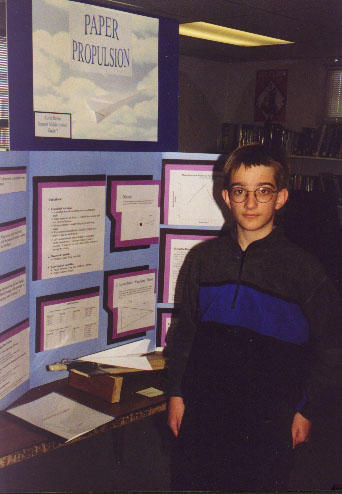
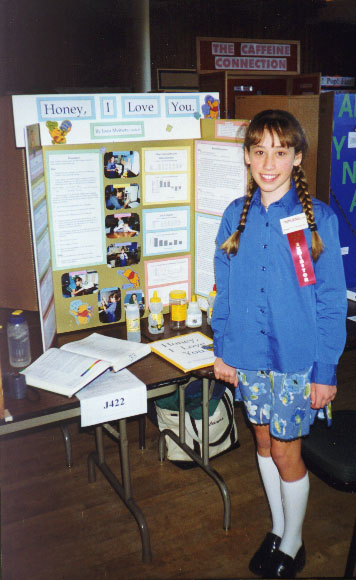
| The function of a backboard is to inform judges and visitors, but also to attract as many spectators as possible. To make it easy for spectators and judges to understand your research, you want your backboard to be clear and eye-catching. Make headings stand out. Use neat, colorful charts and graphs. You might want to include photographs of important parts/phases in your investigation. |
The function of a
backboard is to inform judges and visitors, but also to attract as many
spectators as possible. To make it easy for spectators and judges to understand
your research, you want your backboard to be clear and eye-catching. Make
headings stand out. Use neat, colorful charts and graphs. You might want
to include photographs of important parts/phases in your investigation.
You are free to choose your colors and format, but there are a few aspects
judges are looking for. Your backboard must include:
Your title is an extremely important attention-grabber. A good title
should simply and accurately present your research. Avoid making your
title too long. Write several titles on paper and think about them
for a few days before making a final decision. The title should make
the casual observer want to know more
A question or statement showing what you are trying to find out. Formulate
your question very specific, including the subjects to be tested and
the variables you will be measuring.
The hypothesis is a prediction of the outcome you expect from your
investigation. Just as in your question, formulate the hypothesis
very explicitly. Include the subjects to be tested, the experimental
variable you will change and the variable you will measure.
List your equipment, chemicals, foods, and other materials used during
your experiment. Include the amount you used of each, using proper
units (SI units if possible).
The procedure is a list of steps followed during the experimentation/investigation.
Make sure to use proper language grammar and spelling. Refer to any
experiment in your science textbook for an example of appropriate
wording.
These are
the data collected in the investigation. As a scientist, you must
keep record of everything you are doing in a notebook. Follow these
suggestions for keeping a notebook:
Note: On your backboard you should display only the most important
data or use averages. Nobody will read long tables with hundreds
of numbers. Judges and spectators want to see the overall picture.
Use visuals, such as photographs, diagrams, tables, charts, and
graphs. Make sure to label the axes on your graphs clearly and
give each item a descriptive title. Anyone should be able to understand
the visuals without further explanation.
Include an explanation of why the investigation turned out as it did.
Neatly presented, clear results make it easy to draw conclusions and
earn higher scores on your project. Show how your observations or
data relate to the hypothesis. Note that a hypothesis is never wrong.
If your results are not what you expected, you should say that your
results do not support your hypothesis and suggest why that happened.
Never say that your hypothesis was wrong!
- Exhibits must be sturdy and fully self-supporting, no part of an exhibit may be attached to walls or tables.
- Organisms may be displayed in proper containers or cages only. Inform your teacher ahead of time if you plan to bring organisms to the Summit Fair. (Note: no organisms are allowed at the Boulder Valley Regional Science Fair)
- No flammable substances may be displayed---no gases, solid rocket fuel, fumes, flammable liquids
- No chemicals may be displayed---no acids, salt solutions, insecticides, repellents
- Bare electric wiring and knife style switches may be used on circuits using 12 Volts or less only.
- Electrical connections using voltage over 12 Volt must be soldered or fixed with approved connectors. All wiring must be properly insulated. All switches and metal parts must be located out of reach of spectators and be designed with adequate overload protection
- Only 110 Volt, 60 Hz, single phase AC will be provided for exhibits. All writing on the display must be properly insulated. Do not use nails, tacks, or non-insulated staples to fasten wiring.
- Lasers may be displayed during judging only, but must be given in care of your teacher before and after the presentation. Class I and II lasers may be operated only with proper warning signs and protective housing. Class III and IV lasers may be displayed but not operated.
- Valuable instruments, objects, collections, etc. must be securely fastened or covered to guard against possible theft or damage.
- Potentially dangerous objects, such as sharp objects, may be displayed during judging but must be given in care of your teacher before and after the presentation. Ask your teacher ahead of time if you are in doubt of any objects in your display.
Introduction
| Guidelines
|
2001 Schedule
| Grading
& Rubrics
| Resources
Summit
Middle School Science Fair
Designed
and updated by Mery
Molenaar
October
2000
URL: http://www.geocities.com/mery_molenaar/sci_fair