

This document was
compiled for you to print out. We have removed all 'Test Your Knowledge'
exercises and most active links.
This document contains:
The
Scientific Method
Problem
Statement & Hypothesis
Project Categories
Judging Criteria
Exhibit and Display
The
Scientific method
The scientific
method is a series of steps a scientist takes to investigate a problem.
By doing a Science Fair project, you will become a scientist yourself,
so during your project you should follow the following steps:
- Stating the Problem --- decide on a topic and formulate a question
- Gathering Information --- do library research to educate yourself
- Forming a Hypothesis --- what outcomes do you expect and why?
- Testing the Hypothesis --- perform an experiment
- Stating a Conclusion --- compare the results with the hypothesis
- Reporting the Results --- present a list of materials, procedure, data, and conclusion at the Fair
Problem
Statement and Hypothesis
After choosing your topic, you will start doing research and writing a
research paper. While you are writing your research paper, you should
also spend some time thinking about an experiment.
Problem Statement
The experiment you will do must solve a very specific problem. When
deciding on a problem, be sure that it is one that you can answer with
the time, skills, resources, and equipment available. A big mistake students
make is to define their topic too broadly.
As an example, some problem statements that are worded too broadly:
- Does television have a bad effect on test scores?
- What is the effect of irrigating plants with salt water?
Well-worded problems state the intent of the experiment, list the subjects to be tested, and describe results to be measured. Look at the following examples of well worded problem statements:
- What is the difference in test scores between 7th graders watching less than 5 hours of TV per night and watching 5 or more hours of TV per night?
- What is the difference in growth rate between three different types of plants irrigated with tap water and the same plants irrigated with seawater?
Although the problem
statement and the hypothesis do not take more than a few sentences, they
are very important. They form the basis of the entire experiment,
and are the basis on which your results are judged.
Therefore, before you start your experiment, determine:
- problem (what is the problem/question you want to investigate?)
- subject (who are what are you investigating?)
- independent variable (what are you changing on purpose?)
- dependent variable (what are you measuring?)
- control variable(s) (important variables that are not changed)
- hypothesis
Hypothesis
Once you have decided on a problem and done enough research, you must
develop your hypothesis. The information you gathered while you were writing
on your research paper should come in handy now.
The hypothesis represents your prediction of what the results of your experiment will be. Your hypothesis should include:
- the subject of your experiment
- the independent variable (the variable you change throughout the experiment)
- the dependent variable (the variable that changes due to the independent variable)
- the result you expect.
For example:
- The test scores of 7th graders who watch more than 5 hours of TV per evening will be at least 20% lower than those watching less than 5 hours of TV, because students watching more TV spend less time reading.
- Sea water will retard growth in houseplants such as spider plant, ivy, and Boston fern, due to the high salt content, which is toxic to plants.
Project
categories
The following
categories are in accordance with the Boulder Valley Regional Science
Fair categories:
- Botany
- Earth and Environmental Science
- Engineering
- Health and Behavioral Science
- Mathematics and Computer Science
- Physical Science
- Zoology
- Team
Botany: All subjects dealing with plants (including mosses, ferns, and seed plants), plant ecology, agriculture, conservation, forestry, evolution, genetics, and plant growth. This category also includes the study of microorganisms, such as bacteria and fungi.
Earth and Environmental Science: Projects illustrating principles of geology, geography, and related fields, such as mineralogy, oceanography, meteorology. Also included in this category are studies of ecology, pollution (air, water, and land), environmental concerns, global change, and extinction.
Engineering: All projects that apply scientific principles to the development of devices, structures, and practical uses---civic, mechanical, aeronautical, chemical, electrical, photographic, sound, automotive, etc.
Health and Behavioral Science: Studies related to health and diseases including dentistry, nutrition, sanitation, pediatrics, allergies, speech and hearing, etc. or studies of human or animal behavior---psychology, linguistics, anthropology, archeology, learning, perception, reading problems, and educational testing.
Mathematics and
Computer Science: Projects illustrating theories, principles, or applications
of mathematics, including geometry, algebra, statistics, and probability
or demonstrating new developments in computer hardware or software, such
as internet networking and communications, graphics, and simulations/virtual
reality.
Notes:
1. If computers are used as a tool in research work, the project should
be placed in the category that describes the research.
2. Some projects related to computer hardware may be more appropriately
placed in the category Engineering.
Physical Science: All projects demonstrating principles of physics, such as light, sound, fluid dynamics, electricity, and magnetism or chemistry, including biochemistry (chemistry of life processes), acids and bases, and inorganic chemistry. This category also includes projects related to astronomy.
Zoology: All subjects dealing with animals (birds, fish, amphibians, reptiles, humans, etc.)---animal growth and behavior, genetics, paleontology, animal husbandry, animal ecology, studies of protozoa and other invertebrates, etc.
Team: All studies conducted by two or three students in any discipline. Team projects compete against each other and are not included in any specific category. Each team member must be fully involved with the project and be familiar with all aspects of the project. The final work should reflect the coordinated effort of all team members. In addition to the criteria used for individual projects, team projects are also evaluated on team work (see judging forms).
Judging
Criteria
At the Science Fair, several judges will examine your display and talk
to you for about 20 minutes each. What are the judges looking for?
Judges enjoy talking
to students who can talk freely and confidently about their work. They
are not interested in memorized speeches---they simply want to talk with
you about your research to see if you have a good grasp of your project
from start to finish.
Judges often ask questions such as 'What could you have done differently?'
or 'What would you do next?'
The judges will want to find out
- how much you know about your project
- how it involves laboratory, field, or theoretical work---not just library research
- how well you used the scientific method (problem statement, hypothesis, data, analysis, conclusion)
- whether you used your materials and equipment correctly and accurately
- how well you organized your backboard without any grammar and spelling errors
We have included
a copy of the judging form that will be used at the Summit Science Fair.
Note that there are different forms for individual
and team projects. Refer
to these forms while you design your backboard and when you practice your
oral presentation.
You should print the appropriate form out and have your friends, parents,
or siblings judge you, using the criteria on the judging form.
Judging Criteria (points):
| Individual Project | Team Project | |
| Creative Ability | 30 | 25 |
| Scientific Thought and Engineering Goals | 30 | 25 |
| Thoroughness | 15 | 12 |
| Skill | 15 | 12 |
| Clarity | 10 | 10 |
| Teamwork | --- | 16 |
| Total | 100 | 100 |
Exhibit
& Display
The purpose of the exhibit is to display your project and attract as many
interested spectators as possible. Although you have much freedom in choosing
the layout of your backboard, there are some specific rules to be followed
regarding size and safety requirements.
The following requirements are in accordance with the Boulder Valley Regional Science Fair Guidelines.
Mirror, Mirror on the Wall...Who is the Biggest of Us All?:
| Many students use a standard size backboard. However, when you look at the following size requirements (these are maximum sizes!), you could make your display quite a bit larger. Making your board a little large--don't overdo it--makes it stand out more, and that is exactly what you want, right? |
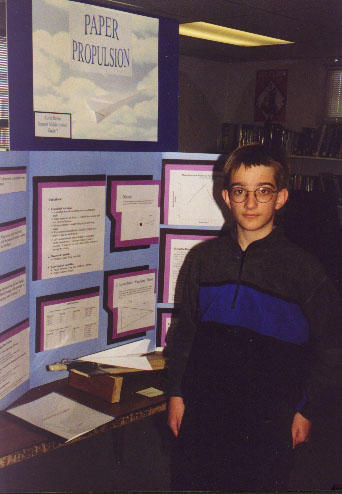
These are the maximum size requirements:
- Width: 122 cm (4 feet) side to side
- Depth: 76 cm (2.5 feet) front to back
- Height: 167 cm
(5.5 feet) for a table exhibit
or 274 cm (9 feet from floor) for a floor exhibit
What's on Your Backboard:
|
|
The function of a backboard is to inform judges and visitors, but also to attract as many spectators as possible. To make it easy for spectators and judges to understand your research, you want your backboard to be clear and eye-catching. Make headings stand out. Use neat, colorful charts and graphs. You might want to include photographs of important parts/phases in your investigation. |
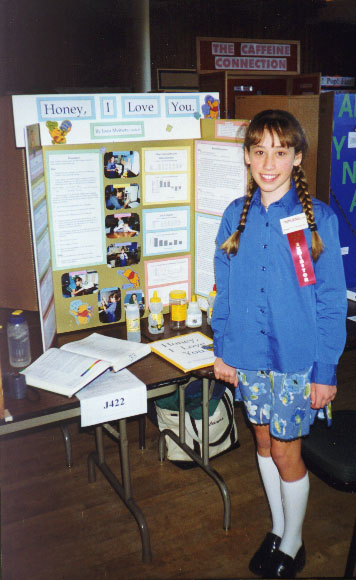
The function of
a backboard is to inform judges and visitors, but also to attract as many
spectators as possible. To make it easy for spectators and judges to understand
your research, you want your backboard to be clear and eye-catching. Make
headings stand out. Use neat, colorful charts and graphs. You might want
to include photographs of important parts/phases in your investigation.
You are free to choose your colors and format, but there are a few aspects
judges are looking for. Your backboard must include:
- TITLE
Your title is an extremely important attention-grabber. A good title should simply and accurately present your research. Avoid making your title too long. Write several titles on paper and think about them for a few days before making a final decision. The title should make the casual observer want to know more
- PURPOSE or QUESTION
A question or statement showing what you are trying to find out. Formulate your question very specific, including the subjects to be tested and the variables you will be measuring.
- HYPOTHESIS
The hypothesis is a prediction of the outcome you expect from your investigation. Just as in your question, formulate the hypothesis very explicitly. Include the subjects to be tested, the experimental variable you will change and the variable you will measure.
- MATERIALS
List your equipment, chemicals, foods, and other materials used during your experiment. Include the amount you used of each, using proper units (SI units if possible).
- PROCEDURE
The procedure is a list of steps followed during the experimentation/investigation. Make sure to use proper language grammar and spelling. Refer to any experiment in your science textbook for an example of appropriate wording.
- OBSERVATIONS or
DATA
These are the data collected in the investigation. As a scientist, you must keep record of everything you are doing in a notebook. Follow these suggestions for keeping a notebook:- Use a sturdy and permanently bound notebook.
- Date all notes.
- Complete notes are an absolute necessity. Don't rely on your memory.
- Write up all work, including failures. It is important to write in pen and to not erase anything or remove pages from your notebook. Something that seems an error now, may turn out to be correct later.
- Include the
notebook with your exhibit, so you can refer to it during the judging.
Judges will be impressed by a complete and well-organized data book.
Note: On your backboard you should display only the most important data or use averages. Nobody will read long tables with hundreds of numbers. Judges and spectators want to see the overall picture.
Use visuals, such as photographs, diagrams, tables, charts, and graphs. Make sure to label the axes on your graphs clearly and give each item a descriptive title. Anyone should be able to understand the visuals without further explanation.
- RESULTS or DISCUSSION
Include an explanation of why the investigation turned out as it did. Neatly presented, clear results make it easy to draw conclusions and earn higher scores on your project. Show how your observations or data relate to the hypothesis. Note that a hypothesis is never wrong. If your results are not what you expected, you should say that your results do not support your hypothesis and suggest why that happened. Never say that your hypothesis was wrong!
- CONCLUSION
The conclusion is a summary of the most significant results of the project. Be specific, do not generalize. You could suggest what your next step would be or how you would improve the project.
- Exhibits must be sturdy and fully self-supporting, no part of an exhibit may be attached to walls or tables.
- Organisms may be displayed in proper containers or cages only. Inform your teacher ahead of time if you plan to bring organisms to the Summit Fair. (Note: no organisms are allowed at the Boulder Valley Regional Science Fair)
- No flammable substances may be displayed---no gases, solid rocket fuel, fumes, flammable liquids
- No chemicals may be displayed---no acids, salt solutions, insecticides, repellents
- Bare electric wiring and knife style switches may be used on circuits using 12 Volts or less only.
- Electrical connections using voltage over 12 Volt must be soldered or fixed with approved connectors. All wiring must be properly insulated. All switches and metal parts must be located out of reach of spectators and be designed with adequate overload protection
- Only 110 Volt, 60 Hz, single phase AC will be provided for exhibits. All writing on the display must be properly insulated. Do not use nails, tacks, or non-insulated staples to fasten wiring.
- Lasers may be displayed during judging only, but must be given in care of your teacher before and after the presentation. Class I and II lasers may be operated only with proper warning signs and protective housing. Class III and IV lasers may be displayed but not operated.
- Valuable instruments, objects, collections, etc. must be securely fastened or covered to guard against possible theft or damage.
- Potentially dangerous objects, such as sharp objects, may be displayed during judging but must be given in care of your teacher before and after the presentation. Ask your teacher ahead of time if you are in doubt of any objects in your display.
Introduction
| Guidelines
|
2001 Schedule
| Grading
& Rubrics
| Resources
Summit
Middle School Science Fair
Designed
and updated by Mery
Molenaar
October
2000
URL: http://www.geocities.com/mery_molenaar/sci_fair