| Home Hotels Restaurants Things to See Tours Photos Other Yucatan Destinations |
| Merida and Yucatan Tours |
| Merida and the Yucatan are very rich in Mexican, Mayan and Spanish history, which supplies this area with many wonderful tours provided by several tour companies located in Merida. |
 |
 |
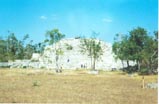 |
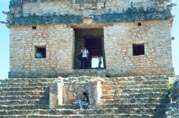
| Chichen Itza The sacred city of the Itza, called Chichen-Itza (chee-chehn eet-sah) in Maya, is located 75 miles east of Merida. This archaeological site is rated among the most important of the Maya culture and covers an area of approximately six square miles where hundreds of buildings once stood. Now most are mounds, but about thirty may still be seen by tourists. Possibly the best known construction on the site is Kukulcan's Pyramid. El Castillo (Kukulkan-Quetzalcoatl), a square-based, stepped pyramid that is approximately 75 feet tall. This pyramid was built for astronomical purposes and during the vernal equinox (March 20) and the autumnal equinox (September 21) at about 3 P.M.. the sunlight bathes the western balustrade of the pyramid's main stairway. This causes seven isosceles triangles to form imitating the body of a serpent 37 yards long that creeps downwards until it joins the huge serpent's head carved in stone at the bottom of the stairway. Mexican researcher Luis El Arochi calls it "the symbolic descent of Kukulcan" (the feathered serpent), and believes it could have been connected with agricultural rituals. Uxmal The name "Uxmal" means: "That which was built three times" or "Place of abundant harvest" and is located 78 km from the city of Merida. This archaeological zone is surrounded by ancient hill ranges, creating a magnificent frame for these series of settlements. The architecture in this region is distinct from other sites in the Yucatan and is know as the Puuc style. Uxmal is the site of one of these constructions, The Governor�s House, considered by experts as a wonder of the ancient world for it� precision and architectoral beauty. The Soothsayer�s Pyramid with it�s imposing 35 meter height is also a wonderful masterpiece and it still holds a large number of enigmas still to be discovered. Mayapan The walled city of Mayapan (Banner of the Mayas) is located on part of the tourist route known as the Covent Route. There are approximately 4000 structures at this site. This city is considered the last great Maya capital, dating back to the beginning of the common Era and reaching it�s golden age around 1200-1450 A.D. It is belived that this city once had a population of around 15,000 inhabitants, and is frequently mentioned in maya literature and other hispanic sources. It� ancient grandeur is still evident in it� great builings. The main builing is the "Castle of the Kukulcan", which was influenced by Chichen Itza. As more research and investigations are preformed in this area it is increasingly clear that this city was even more important than had previously thought. Dzibilchaltun Located just a few miles north of Merida, Dzibilchaltun means "The place with writing on the stones". It is one of the major centers of the Mayan culture in the Yucatan. At one time this city had a population of 40,000 inhabitants. It was discovered a few years after Chichen Itza and Uxmal, but it dates back to around 500BC. This site covers an area of 16 square KM in which there are about 8,400 structures. The Temple of the Seven Dolls is a wonderful masterpiece to behold. Also in the Central Square, which is the largest in the Mayan era is 130 meters long and also holds a wonderful pyramid and an open chapel build after the Spanish concered the Mayas. Just to the north of the Central Square is the Xlacah Cenote, which has a depth of at least 80 meters. Make sure to bring you swimsuit because it is a great place to cool off after you visit the ruins here. |
| Puuc Route The Puuc(which stands for hilly in Mayan) Route is a collection of several small ruins which include Kabah, Sayil, Xlapak and Labna, as well as the large ruins at Uxmal and others at Loltun(see below). The ruins here date between 250 B.C. to 1000 A.D. Kabah, near Uxmal, to which was connected by a stone causeway or "sac-be", competes with its larger city in the majesty and beauty of its palace facades. It's a monumental example of the Puuc style architecture in which each stone element is part of a total, linking men with its universe. Sayil dates from 800-1000 A.C. and its outstanding because of the existence of a construction called El Palacio (The Palace) with three stepped positions. Labna is outstanding because of an elegant arch shaped construction which marked the limit where the priests, soldiers and nobles lived. Its facade is decorated with small columns, depictions of palm houses and stylized serpents. In Xlapac there are 14 mounds with 3 pyramids in restoration process. Its one of the less restored sites in the zone, allowing the visitors to see how this sites are found. Also you may find many carved stones laying around the ground. Loltun These caverns, whose name comes from the maya "Lol": Flower, and "Tun": Stone, are one of the biggest known from the huge cave system that covers the great territory in the southern Yucatan. The caverns have been arranged for a safe tour that measures approx. .62 miles long. In one of it's cavities, known as "Huechil", archaelogical excavations were carried out and in one of it`s lowest levels extinct animal remains were found. There is also basrelief carvings that date back to 600 B.C. as well as other mural paintings of hands, faces, animals and flower motifs, which give the name to the cavern. Celestun The Celestun Estuary is located on the west coast of the Yucatan and in 1979 was declared as a ecological shelter. The banks of the coastal lagoon harbor fauna and flora of expectional beauty. There is a large variety of fishes, pelicans, herons, albatross and the Caribbean Flamingos (which Celestun is famous for) that live in the estuary. This region also boast 234 mammal species, among which include the ocelot, the jaguar and the spider monkey, all of which are considered endangered species as well as three different species of sea turtles and two of the crocodile. Merida City Tour A great way to learn and see Merida is the bus tour that leaves from Parque Santa Lucia(calle 55 and 60). The tour leaves at 10am, 1pm and 4pm and passes Paseo Montejo, Ave. Colon, Parque Las Americas as well as other of the many points of intrest along the trip. The tour last for about an hour and a half. |