
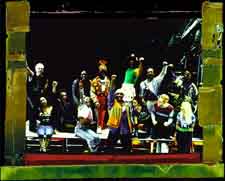
From December, when Jon finished the script, it was a quick sprint to the show you've seen, or perhaps you have yet to see. There were a lot of what Jon called "programming changes": shifting songs from one position to another, seeing where they fit best. In January Jim finally allowed himself to simply watch the show. He sat in a rehearsal with a group of NYTW board members, and the emotional response to RENT was extraordinary. "It continued to get even tighter and better through rehearsals," Daphne Rubin-Vega, the original Mimi, remembers. The New York Times got wind that a rock musical based on La Boheme was going to premiere on the 100th anniversary of the original La Boheme. No one had known this; it was a simple fluke. Since Jon's death, there have been a few revisions. Lynn, Jim and Michael would meet and attempt, by looking over the many drafts of RENT, to divide what changes Jonathan would have approved. They would put their heads together and out of their three component visions try to come up with a close duplication of Jonathan's. When the show premiered, they knew they had something special on their hands - people in the audience were weeping at the last act. Jon's death added an explosive, powerful element to the cast's understanding of the play. "The company had already come together so well, but that eve of Jon dying just brought us together that much more strongly," Daphne remembers. "It let us remember that the bottom line is really about what you do with this experience, because tomorrow isn't promised you. There was no more powerful way of receiving that message than from someone who was completely healthy and died. Someone whose life was just beginning. It just became that much more urgent to do right by him." The day of Jon's death, no one at the Workshop was quite sure what to do. The first performance was scheduled for that evening. Jim Nicola was for canceling; but he knew they needed to do something for Jonathan's memory. The first act, in particular, involved a lot of tricky dancing and jumping on tables. It hadn't been completely rehearsed, and he was afraid there would be injuries. Eddie Rosenstein urged him to run the whole show full out. By the evening, Jonathan's friends were streaming into the theatre, his parents were there, New York Theatre workshop was filled to capacity with people Jon had loved. Jim decided on a sing-through - no acting, just songs. Throughout the first act, the cast was able to hold their seats. But very slowly, they began to rise. They acted, they danced. "It was incredible and terrible," Anthony remembers. "It was like we had to do it. We were all sobbing and crying." The lighting people made their way to the lighting booth; the sound manager began to pick up his cues. "They couldn't contain themselves," Eddie remembers. "The audience was reaching out to the cast. They were crying and cheering." By the second act, he was laughing. Silently. He was laughing on the inside. You know what happened to the play next. The show has become one of the biggest things ever on Broadway. It's become the sort of thing a playwright hopes for in the middle of the night, and in the morning is embarrassed at how wild he's let his fantasies run. RENT - Jon's first produced show - is like an athlete that has won the Rookie of the year award, a gold medal, the World Series, and the Most Valuable Player, all in the same season. It collected the New York Drama Critics Circle Award, the Drama Desk Award, The Obie Award, the Tony Award, and the Pulitzer Prize. RENT was on the cover of Newsweek. Time called it a "breakthrough." The New York Times, "an exhilarating landmark." At the 1996 Democratic National Convention, the cast of RENT sang "Seasons of Love." Movie and television stars have returned again and again, and afterwards, at the Nederlander Theater, they've gone backstage to sign a long brick wall, a kind of Broadway Wailing Wall - Spike Lee, and Billy Joel and Jodi Foster - forwarding their best wishes and congratulations to Jonathan and the cast. People in the show say they recognize the same audience members coming back to the Nederlander ten, fifteen times. If a young playwright told you this was a fantasy of theirs, you'd smile at their ambitions, and they'd walk away embarrassed. But here it is true.
