
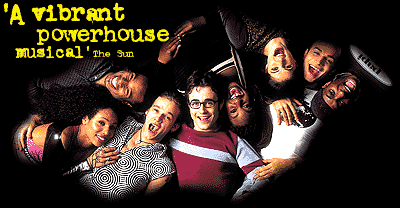
Jon had written lots of music in the years between leaving college and mounting RENT. He'd written two shows that didn't end up getting produced. An ambitious young producer named Jeffrey Seller had nearly taken on the second, so when RENT came around, so did Jeffrey Seller. He felt the time was right to produce a musical; he had stayed in touch with Jon, because he was convinced that one day, "Jon was going to write a brilliant musical."
When Jeffrey first saw the show, he felt the play was baggy, a collage with no narrative shape. "There were great songs," Jeffery remembers, "but there were endless songs. It was as if Jon had thrown everything at the wall to see what would stick." Some producer friends he had brought with him left at intermission, assuring Jeffrey the work was unsalvageable. Jeffrey was still interested, though - as long as Jon found a story as good as the music.
Jon sent a letter to Stephen Sondheim, his mentor, asking for advice and assistance. The older composer responded by helping to arrange a $45,000 grant from the Richard Rodgers Foundation, to support a workshop production of RENT. What they needed now was a director. Jim Nicola, artistic director of the New York Theatre Workshop - a space Jon had decided was perfect for his musical - immediately suggested Michael Greif, a young New York director who had recently become artistic director of the La Jolla Playhouse in San Diego. He sent Greif Jon's tape and script. Greif listened to the tape on a Walkman flying from California to New York. The script seemed shaggy. "What impressed me, he remembers, was its youth and enthusiasm, and that it was a musical about contemporary life. Jon was writing about some people I felt I knew, that I sort of loved, or had loved in my life." What Jim wanted in a director was a counterweight to Jon's kefi philosophy, which had allowed him to treat dark subjects like AIDS, homelessness, and drug addiction with optimism. Michael was hard-nosed and cool-headed. He met with Jim and Jonathan in January of 1994, and the three set to work on bringing the script to the level of the music. "It was very fragile material at the time," Jim recalls." And it was so easy for it to become sentimental or hokey, or any number of things. I felt Michael had the right sort of dryness and sharpness to balance Jonathan's writing."
Jim saw his instincts had been right as soon as the three got down to shaping the script in Jon's loft. They met for a week in the middle of the spring, preparing for the workshop scheduled for November. They went over the script scene by scene, moment by moment. Immediately, the dynamic between Jonathan and Michael slipped into a productive yin and yang. Michael was afraid there was something self-congratulatory about the young bohemian heroes of the show; Jon toned down the lyrics of "La Vie Boheme." Michael fretted about the homeless characters - that they not simply serve as East Village window dressing, as moral scarecrows where Mark and Roger could drape their good social conscience; Jonathan wrote the new song, "On the Street," where a homeless woman gives Mark a stern telling off. Most importantly, Michael had reservations about the message of the show, the "No Day But Today" cheerfulness of the life support meetings. Michael had friends with HIV, just as Jon did, and they were not cheerful about it. Jon added the new scene of Gordon questioning the life support credo, saying he regretted his low T-cell count. And Jon himself kept Michael from becoming too hard-nosed and cool-headed.
"What Jon gave Michael was some of his hope and heart and generosity of spirit. And what I think Michael gave Jon was some edge and realism and complexity, and making sure things didn't all resolve nicely and prettily. It was a good marriage," remembers Anthony Rapp, who originated the role of Mark. Jim, Michael, and Jonathan met again that summer at Dartmouth College, where the NYTW ran a kind of working camp for its affiliated artists. Michael and Jon talked plot. One large problem, they agreed, was the relationship between Maureen and Mark; in these drafts, a major plot point was Mark winning Maureen back. Michael didn't like it. "My position was, if they're gonna be lesbians, let them be lesbians. Don't make them about going-back-to-their-man." In October, back in the city, Michael worked out the "performance vocabulary" of RENT. For budgetary reasons - and also because it suited the nature of the characters - the NYTW decided to have minimal props. Michael suggested the three "Frankenstein" tables, which could be made to serve multiple functions in the show. He pushed for a multi-racial cast. Because it was rock, Michael played around with microphones, with actors singing directly to the seats: "We were very anxious to take advantage of the fact that it would be as much a concert as it was a play."

